49 works in this view — arrow keys or swipe to move between them.
Dance in Art
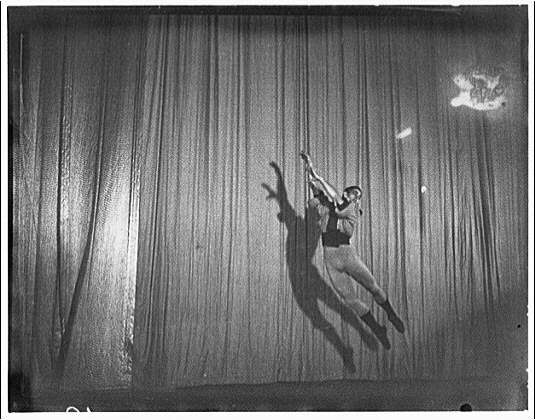
Ballet dancer. Ballet dancer at National Theater III
Unknown artist
- Collection:
- Prints & Photographs
- Source:
- Library of Congress
- Rights:
- Rights vary by item — check the source record before reusing this image. Source record ↗
- Recorded as:
- Library of Congress — no known restrictions (verify per item)
This photograph is evidence of professional ballet practice and performance standards in 1920, a crucial moment in ballet's modernization. It also demonstrates the role of photography in codifying and promoting classical ballet technique to a wider public. For historians and dancers, it is a precise visual record of how the ballet line and the jump were understood and executed during the early twentieth century.
What you are looking at
A single ballet dancer is captured mid-leap against a backdrop of vertical curtains rendered in dramatic chiaroscuro. The figure is suspended at the apex of a jump, body fully extended in a dynamic diagonal line across the frame. The dancer wears a classical tutu and pointe shoes, arms raised in an open, expressive position. The photograph is taken from a low angle, emphasizing the height and weightlessness of the jump. The lighting is theatrical and precise, creating sharp definition between the illuminated dancer and the heavily shadowed fabric folds behind. A faint emblem or mark appears in the upper right corner. The composition isolates the dancer completely, allowing focus on the purity of the movement and the classical aesthetic.
The dancing
The dancer's body is fully airborne, extended in a near-horizontal line from head to toe. Both arms are raised and open, creating a broad frame across the upper body. The legs are in a clean ligne, with the supporting leg pointed and the working leg extended, suggesting either an arabesque or attitude position. The torso is upright and composed, the head held proudly. The overall carriage is one of controlled power rather than strain—the dancer appears weightless despite the effort required. The positioning and line quality suggest technical mastery and classical training.
The dance depicted
This is classical ballet, almost certainly Romantic-era or early twentieth-century ballet. The tutu, pointe work, and arabesque-like position are hallmarks of the academic ballet tradition established in the nineteenth century. The photograph captures a single virtuoso moment—the peak of a grand allegro or possibly the climactic pose of an adagio. The dramatic theatrical lighting and stage setting indicate this is a professional theater performance, not a studio study. The work exemplifies the Romantic ballet ideal of ethereal weightlessness and technical perfection that dominated the period when this photograph was made.
How it was made
This is a black-and-white photograph, likely a gelatin silver print or similar photomechanical process typical of early twentieth-century theater documentation. The precise focus, strong contrast, and theatrical lighting are characteristic of professional stage photography. The vertical format and deliberate composition suggest this was a posed documentation or promotional image rather than an action shot, though the ballet itself is genuine. Photography at this period was still relatively slow, making such airborne images notable achievements; the photographer has captured a genuinely suspended moment, not a constructed tableau.
About this work
This is a professional photograph of a classical ballet dancer in mid-leap, dating to 1920 and associated with performance at the National Theater. The image exemplifies the aesthetic and technical ideals of early twentieth-century academic ballet—the emphasis on line, weightlessness, and the transformation of human effort into apparent effortlessness. The photograph documents both a moment of performance and a standard for classical technique that defined the era. It is a valuable record of how ballet was practiced and photographed in the early twentieth century, when dance photography was still a specialized and technically demanding art.
How to look at it
Observe the extremity of the jump and the absolute stillness of the frame—the dancer is caught at the height of flight, where momentum is entirely arrested. Notice how the photographer has positioned the camera to maximize the sense of elevation against the backdrop. The vertical curtains serve as a measuring scale for the height achieved. The lighting isolates the figure completely, directing all attention to the body's geometry and carriage. This is a deliberate choice about what moment to capture: not the takeoff or landing, but the sustained apex where the classical ballet ideal of weightlessness becomes visually manifest.
The period
In 1920, ballet was in a state of productive tension between the rigid academicism of the late nineteenth century and modernist experiments. The photographs of this era served multiple purposes: they were promotional materials for theaters and dancers, technical records for students and teachers, and artistic images intended for independent circulation and collection. Theater photography was becoming more sophisticated, and the investment in high-quality lighting and composition reflects ballet's status as a major art form. This photograph sits within a broader early twentieth-century movement to document dance through photography, which would accelerate dramatically after the 1920s.
Where it lives
This print is held in the Prints & Photographs Collection of the Library of Congress. It is catalogued as professional theater documentation from the National Theater, dated 1920. The precise theater, production, and dancer are not recorded in the extant catalogue record.
Dance in this work
Questions about this work
Is this a real photograph or an artistic rendering?
This is a genuine photograph, a black-and-white print made using photomechanical processes standard in 1920. The dancer is a real performer captured mid-leap during an actual performance or documentation session. Photography this precise required controlled lighting, fast film, and skilled timing to achieve such a suspended image.
What ballet is being performed?
The catalogue record does not identify the specific ballet, dancer, or choreography. The pose and costume are consistent with classical ballet as practiced in the early twentieth century, but without additional documentation, the specific work cannot be determined from the photograph alone.
Why was this photograph made?
Theater photographs from this period served multiple functions: they were promotional images for the theater and dancers, technical records for teaching and study, and artistic documents intended for sale or publication. This image's high quality and careful composition suggest it was made for professional distribution.
More dance artwork





