49 works in this view — arrow keys or swipe to move between them.
Dance in Art
Ballet dancer. Ballet dancer at National Theater V
Unknown artist
- Collection:
- Prints & Photographs
- Source:
- Library of Congress
- Rights:
- Rights vary by item — check the source record before reusing this image. Source record ↗
- Recorded as:
- Library of Congress — no known restrictions (verify per item)
This photograph shows us how ballet was being photographed and understood in 1920—as an art of idealized geometry and infinite extension rather than dramatic narrative. It is evidence of the dominance of Russian technique (Vaganova/Imperial method) in reshaping European ballet aesthetics during the early twentieth century, when the dancer's body became a primary subject rather than a vehicle for story.
What you are looking at
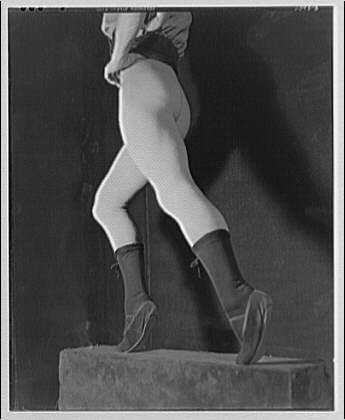
A monochromatic photograph shows a dancer in classical ballet pose, shot against a dark background. The figure stands on the balls of the feet in a high relevé position on a low rectangular platform, wearing what appears to be a short tunic or dance costume with straps or suspenders visible at the shoulders. The dancer's legs are elongated and nearly vertical, with the body held in a formally upright carriage. The photograph isolates the dancer against shadow, emphasizing the geometry of the extended limbs and the sculptural quality of the pose. The image is cropped to show primarily the lower torso and legs, with the head and upper body partially visible at the top of the frame.
The dancing
A single dancer is captured in a fully extended relevé, standing on both feet with legs straight and body held in perfect vertical alignment. The positioning suggests either a held pose or a fleeting moment in motion—the kind of geometric precision that early twentieth-century ballet photography valued. The dancer wears what appears to be a classical tunic with support straps, consistent with ballet dress of the period. The feet and ankles are engaged and stretched, the torso erect, indicating either classically trained technique or the photographer's direction toward an idealized pose.
The dance depicted
This is ballet, almost certainly classical or Romantic ballet technique based on the pointe work, the formal tunic, and the upright carriage. The pose—sustained relevé with elongated limbs—was central to early twentieth-century ballet aesthetics, particularly in the Ballets Russes era when Russian technique (Vaganova or Imperial method) was reshaping European ballet. The catalogue indicates a National Theater, likely Eastern European given the record attribution and the 1920 date. The photograph documents a moment of formal display rather than narrative action, consistent with how ballet was being photographed and promoted in the 1920s—as an art of line, extension, and technical purity.
How it was made
This is a black-and-white photograph, created using the gelatin silver or similar process standard in 1920. The high contrast, the clean isolation of the figure against dark shadow, and the careful studio lighting all indicate a professional studio photograph rather than a candid theatrical shot. The framing and pose suggest the photographer directed the dancer deliberately, composing for formal beauty of line rather than capturing spontaneous motion. Photography allowed ballet to be documented with precision impossible in painting or sculpture, making the dancer's body legible as an object of aesthetic study.
About this work
This photograph documents a moment in classical ballet around 1920, likely from a National Theater in Central or Eastern Europe. It captures the codified aesthetic of early twentieth-century academic ballet—the cult of extension, verticality, and technical display that characterized the Vaganova and Imperial Russian methods as they influenced European theaters. The image is a record of how ballet was being conceived and promoted during the interwar period: not as narrative spectacle, but as pure form and the perfection of the trained body. The photograph is both a performance document and a sculptural study, treating the dancer as a formally composed object.
How to look at it
Attend to the sustained relevé position and the absolute verticality of the spine and neck. This is not a moment of explosive power or dramatic gesture, but rather a held demonstration of control and extension—what ballet calls 'pulling up.' The photographer has chosen a moment of stasis, not transition. Notice how the photograph frames the body to emphasize line: the legs are nearly parallel to the picture plane, making them appear even more extended. This was a deliberate choice; by 1920, photography was being used to render visible the formal and technical ideals that ballet training aimed at—the impossibly vertical body, the endless line of the leg.
The period
In 1920, classical ballet was undergoing profound transformation. The Ballets Russes (founded 1909) had revolutionized European taste, championing Russian Imperial technique and recruiting dancers and choreographers from the Russian Imperial Ballet. By 1920, many European theaters had adopted Russian methods or were learning them. This photograph appears to document a dancer at a National Theater (likely in Czechoslovakia, Poland, or another Central European nation rebuilding after World War I), where classical ballet was becoming institutionalized in state theaters. The aesthetic—pure extension, upright carriage, the pointe work as endpoint of verticality—reflects Vaganova principles. Photography in this period was becoming a primary means of promoting ballet, allowing theaters to circulate images of their leading dancers and to aestheticize the dancer's body as an object of formal study.
Where it lives
This photograph is held in the Library of Congress Prints & Photographs collection, catalogued as a record from a National Theater, likely in Central or Eastern Europe. It is a studio photograph, indicating it was made for documentation or promotional purposes rather than captured during a performance.
Dance in this work
Questions about this work
How do I know this is classical ballet and not another kind of dance?
The pointe work (the dancer is standing on the balls of the feet, not flat), the formal tunic costume with support straps, the upright carriage, and the sustained verticality of the body are all hallmarks of classical ballet technique as taught in the early twentieth century. The pose—a sustained relevé—belongs specifically to the vocabulary of ballet, not modern dance or other theatrical forms.
Why is the dancer's head cut off?
The photographer deliberately composed the frame to emphasize the legs and extension of the body, treating the dancer as a formal object rather than a portrait. By cropping high, the photographer focuses attention on the line and geometry that ballet valued: the elongated leg, the engaged foot, the vertical thrust. This compositional choice was deliberate and reflected how ballet was being aestheticized and documented in the 1920s.
Is this a performance photograph or a posed studio shot?
This is a posed studio photograph. The controlled lighting, the isolated dark background, and the formal composition all indicate that the photographer directed the dancer into this position. The photograph was likely made for promotional purposes—to document the dancer's technique and to circulate an idealized image of classical ballet form.
More dance artwork





