49 works in this view — arrow keys or swipe to move between them.
Dance in Art
Ballet scene
Unknown artist
- Collection:
- Prints & Photographs
- Source:
- Library of Congress
- Rights:
- Rights vary by item — check the source record before reusing this image. Source record ↗
- Recorded as:
- Library of Congress — no known restrictions (verify per item)
Romantic ballet was fundamentally about illusion—the dancer's body transformed into something ethereal, weightless, and not quite human. This print preserves the visual language of that transformation at a moment when photography could not yet capture movement, and when hand-coloured prints were the principal way dance images reached the public. For historians and dancers alike, such prints are primary evidence for what Romantic ballet looked like and how it was understood by its own era.
What you are looking at
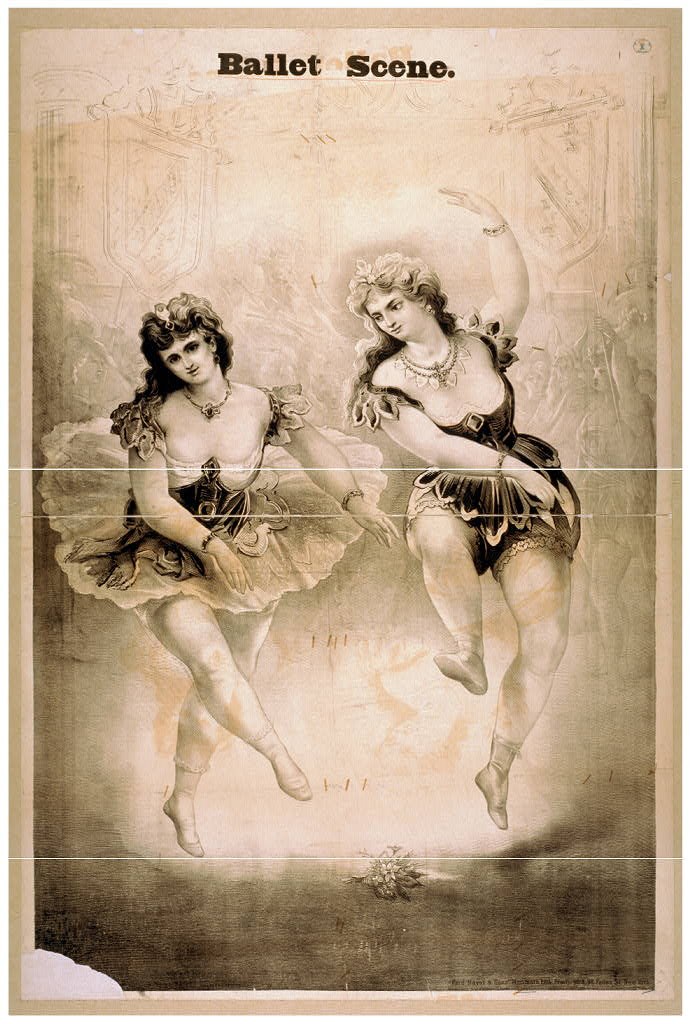
Two female dancers in pointe shoes leap upward in a cloudscape setting, their bodies suspended against a pale background that fades from cream to grey. Both wear classical ballet tutus—one in pale yellow or white with darker trim, the other in a darker shade—and both sport the upswept hairstyles typical of mid-nineteenth-century ballet. The figure on the left extends her left arm in a graceful port de bras while her right leg appears bent; the figure on the right mirrors this with opposing limbs, creating a compositional balance. Below them, a small bundle of flowers or garland sits on what appears to be clouds. The theatrical setting, the ethereal quality of the scene, and the upward momentum of the leap all suggest a moment from a Romantic ballet—possibly one involving supernatural or celestial elements.
The dancing
Both dancers are captured mid-jump in a vertical leap, with their bodies achieving remarkable height and extension. Their torsos are upright, arms extended in the fluid, expressive port de bras characteristic of Romantic ballet. The line from hip through pointed foot appears extended, though the precise turnout and technique are stylised rather than pedagogically exact—consistent with printmaking conventions of the era. The dancers face slightly outward and downward, their expressions peaceful, as if hovering or flying rather than performing a grounded step.
The dance depicted
This is Romantic ballet, circa 1870, likely depicting a scene from a narrative work involving aerial or supernatural elements—possibly a pas de deux from a ballet such as La Sylphide or Giselle, or from one of the many fairy-tale ballets popular in that period. The upward leap and ethereal setting strongly suggest a sylph or spirit character rather than a mortal dancer. The two figures appear to be a pair or corps dancers performing a similar movement simultaneously, which was a common compositional choice in mid-nineteenth-century ballet spectacle.
How it was made
This is a hand-coloured engraving or lithograph, evidenced by the fine line work, the tonal gradations achieved through ink washes, and the applied colour (visible particularly in the tutus and hair). The medium allowed for multiple copies to circulate among theatre patrons, critics, and the curious public, making this likely a promotional or commemorative image published during or shortly after a popular production. The soft toning and romantic treatment are typical of theatrical publicity prints of the Gilded Age.
About this work
This is a mid-nineteenth-century dance print documenting a celebrated moment from Romantic ballet—the ethereal leap of two sylphs or spirit dancers. The image captures the aesthetic and narrative concerns of the era: the fascination with supernatural female figures, the emphasis on weightless elevation and upward-pointing line, and the technical achievement of the jump itself. As a print, it documents not the live performance but rather its theatrical afterlife in popular culture and the collective memory of the ballet-going public. Such images are crucial evidence for understanding how nineteenth-century ballet was imagined and circulated beyond the theatre itself.
How to look at it
Attend to the moment of suspension: the artist has chosen the peak of the jump, where the dancer appears to hang weightless in air. The compositional symmetry between the two figures—mirrored poses, matched elevation—emphasises the mathematical perfection and control that Romantic ballet demanded beneath its illusion of effortless grace. The cloudscape and the small bundle of flowers below anchor this moment in the narrative world of the ballet rather than in a studio or stage. The soft, diffused background suggests stage lighting and the theatrical haze created by gas lamps.
The artist
The artist is unrecorded in the catalogue, which is common for theatrical prints of this period. Such works were often produced by commercial publishing houses and signed by printmaker rather than designer; authorship was sometimes collective or anonymous. The style and execution suggest a competent workshop hand trained in the conventions of mid-nineteenth-century theatrical publicity.
The period
The 1870s were the final flowering of Romantic ballet in Europe, though the style had been dominant since the 1830s. By this date, ballet was increasingly a vehicle for virtuosic spectacle and national prestige rather than narrative coherence. The supernatural sylph, the fairy, the spirit—stock characters of Romantic ballet—remained central to the repertory even as the choreography evolved toward greater technical display. Lithography and engraving were the standard technologies for circulating dance imagery; photography of dance was still in its infancy and could not easily capture the jump. Theatre prints had become a major commercial product, sold to audiences as souvenirs and as a form of celebrity merchandise.
Where it lives
This work is held in the Prints & Photographs collection of the Library of Congress. It is a commercial theatrical print, a mass-produced image meant to circulate widely among theatre patrons and the general public. Such prints form a substantial archive of nineteenth-century performance practice.
Dance in this work
Questions about this work
How do we know this is Romantic ballet and not another style?
The pointe work, the ethereal setting, the upward leap, the tutus, and the hairstyles are all signatures of Romantic ballet. The supernatural or aerial context—suggested by the cloudscape—is a defining theme of the genre. By the 1870s, this style of imagery was already becoming nostalgic, as ballet was shifting toward Classicism, but Romantic works remained in the repertory.
Was this image made from a real performance?
Not directly. It is a stylised theatrical print, likely made from a sketch or memory of a performance, or from the artist's study of ballet conventions. The composition is too symmetrical and the moment too perfect to be a record of an actual performance. It represents the ideal of the ballet, not its lived reality.
Why are both dancers doing the same move?
In nineteenth-century ballet, symmetrical corps work was standard. Dancers often performed in matched pairs or lines, executing identical movements. This created visual harmony and showcased the uniformity and discipline of the troupe. The pas de deux, performed by soloists, often involved matched or mirrored phrases as well.
How was this printed and coloured?
This is likely a hand-coloured engraving or lithograph. The image was first printed in black ink, then coloured by hand—a laborious but economical process that allowed publishers to produce many copies at modest cost. Hand-colouring meant slight variations between prints, making each one partly unique.
More dance artwork





