49 works in this view — arrow keys or swipe to move between them.
Dance in Art
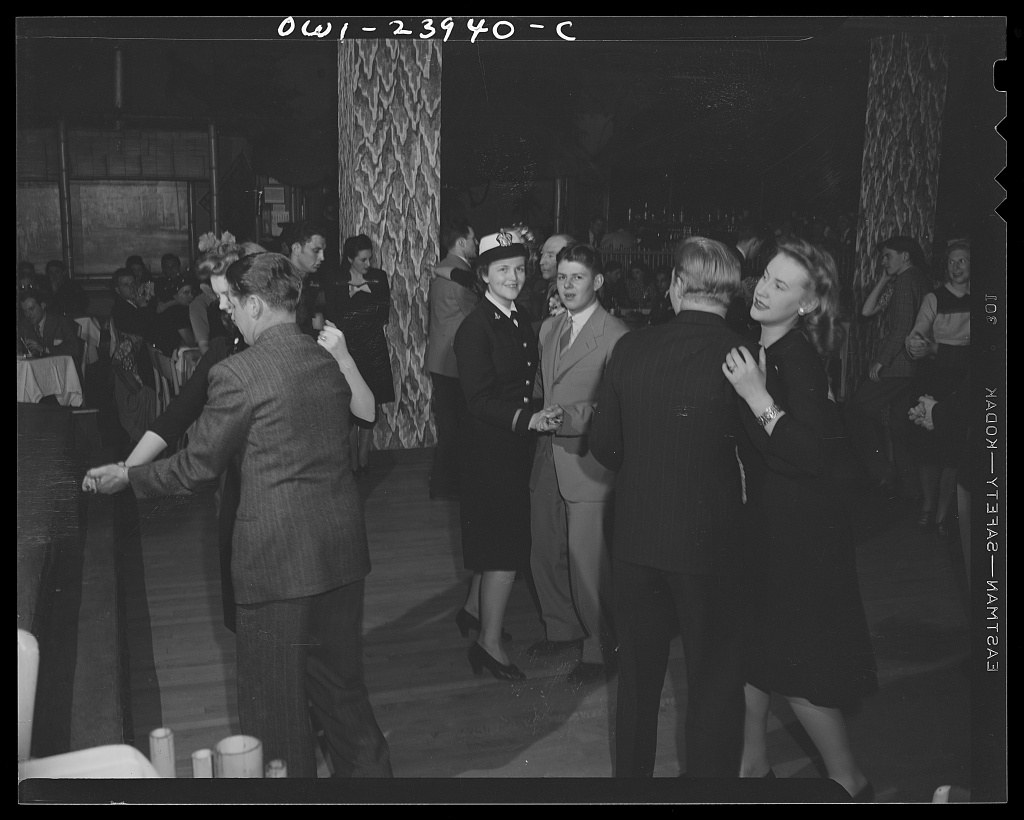
[Untitled photo, possibly related to: New York, New York. Dancers at the Hurricane Ballroom. They are dancing to the music of Duke Ellington and his orchestra]
Unknown artist
- Collection:
- Prints & Photographs
- Source:
- Library of Congress
- Rights:
- Rights vary by item — check the source record before reusing this image. Source record ↗
- Recorded as:
- Library of Congress — no known restrictions (verify per item)
The photograph documents vernacular ballroom dancing as it was actually danced—not in competition or on stage, but in social practice—during a formative moment in American dance and music. It preserves evidence of the integration of specific musical ensembles (Ellington's orchestra) with specific dance styles and specific communities, showing how dance and music were inseparable in urban African American culture. For dance historians and practitioners, it is a visual record of how ballroom dancers of this era held their bodies, managed crowded space, and sustained the frame and momentum of swing and smooth styles in real time.
What you are looking at
A ballroom packed with couples dancing to what is identified as Duke Ellington's orchestra at the Hurricane nightclub in New York. The photograph captures a moment of social vitality: the dance floor is crowded with African American dancers in close proximity, many in couples hold, moving across a wooden floor. The space is dimly lit, with large decorative columns visible in the background—tall, textured pillars that frame the scene. The figures are dressed formally in the styles of the 1940s: women in dark dresses and hats, men in suits and dress shirts. The composition is dense and energetic; bodies overlap and interweave across the frame, suggesting the press and momentum of live ballroom dancing. In the foreground and middle ground, individual couples are discernible; further back, the crowd dissolves into a mingling of silhouettes. The photograph was taken from floor level or slightly above, which places the viewer among the dancers rather than observing from a distance.
The dancing
The dancers are in closed ballroom hold—men's right hand on women's back, left hand extended to the side holding the woman's right hand—a frame that was standard for social ballroom dancing of the era. The bodies show the engagement of the frame, with couples rotated at varying angles to accommodate the crowded floor. Weight is distributed in a relaxed, forward-moving posture consistent with swing and smooth ballroom styles. Footwork is not clearly visible from this angle, but the overall carriage suggests the momentum and lift of dancers actively moving through space. Individuals stand at varying heights, suggesting both natural variation and the dynamic shift of weight that is part of ballroom movement.
The dance depicted
The dance is most likely Swing, Lindy Hop, or one of the smooth ballroom styles (Foxtrot or Waltz) being performed in a social ballroom setting—the Hurricane was a prominent venue for African American jazz and dance in the 1940s. The closed hold, the formal dress, and the reported presence of Duke Ellington's orchestra all point to vernacular ballroom dancing of the Swing Era, when such styles were social and improvisational rather than competitive. The crowded conditions and the informality of the moment suggest this is not staged performance but live social dancing, capturing a brief moment of how such dances were actually practiced by ordinary dancers in nightclubs. The image documents the continuity of ballroom dancing in African American communities during a period when such venues and practices were racially segregated.
How it was made
This is a black-and-white photograph, likely shot with available light in a darkened ballroom, which explains the grainy quality and the contrast between lit figures and deep shadow. The technique of available-light photography—handheld camera, fast film, natural contrast—was developing in the 1940s and allowed photographers to document interior scenes without the apparatus of studio lighting. The photograph bears the archival markings of the Library of Congress and the reference number visible in the header, indicating it was part of a documentary photography project. This type of image was produced for documentary or journalistic purposes and was not a fine-art photograph but a record: it was made to capture and preserve evidence of a social scene.
About this work
This is a documentary photograph of African American ballroom dancers at the Hurricane nightclub in New York in 1943, dancing to Duke Ellington's orchestra. It captures a moment of social vernacular dance during the Swing Era, when ballroom dancing in closed hold was a central form of social and courtship ritual in urban African American life. The photograph is a record of a specific venue, a specific musical moment, and a specific set of dance practices—not a staged or posed image, but an attempt to preserve the texture of a live event.
The work is significant as both a dance document and a historical artifact. It shows the technical competence, the formal dress code, and the social context of ballroom dancing in the 1940s, during a period of racial segregation when such venues were important centers of African American social life. The presence of Duke Ellington's orchestra, one of the most significant ensembles in jazz history, grounds the image in a specific moment of musical and cultural significance.
How to look at it
Attend first to the frame—the closed hold in ballroom position—and notice how each couple maintains it despite the crowding and overlap of bodies. Observe how the photograph captures the moment mid-movement, with bodies at different angles and heights, showing the continuous flow of rotation and traveling that is ballroom dance. Notice the formal dress and the attentiveness to appearance, which speaks to the social importance of the occasion. Look at the background columns, which suggest a designed interior space; this was not a casual or improvised venue but an established nightclub. The photograph's graininess and available-light quality are not defects but evidence of the documentary intention—to capture the scene as it actually was, not to compose it for aesthetic effect.
The artist
The photographer is not recorded. The image is part of the Library of Congress Prints and Photographs collection, which suggests it was part of a documentary or journalistic project—possibly a WPA-era documentation effort or a news agency assignment. The available-light photography technique and the subject matter suggest a photographer working in the documentary tradition of the 1940s, interested in capturing African American social life and urban culture.
The period
The 1940s were the height of the Swing Era, when big-band jazz and social ballroom dancing were at the center of American popular culture. Duke Ellington's orchestra was one of the most acclaimed and prolific ensembles of the period, and venues like the Hurricane were significant cultural spaces. However, these spaces existed under conditions of racial segregation; African American dancers and musicians had their own circuits, venues, and audiences. The photograph documents this parallel culture—not marginal or derivative, but vibrant and fully developed. By 1943, swing and ballroom dancing had been central to American social life for nearly a decade, and the technical sophistication visible in the image reflects a mature, widely practiced set of styles and skills.
Where it lives
The image is held in the Prints and Photographs division of the Library of Congress. It is catalogued with a reference number (OWI-239940-C) and the collection mark "NYWCTS-KODACHROME" and other source indicators, suggesting it was part of a government or institutional documentary project. The archival markings indicate it was preserved as a historical record.
Dance in this work
Questions about this work
Who was dancing at the Hurricane in 1943?
The photograph does not identify individual dancers by name. It documents the social ballroom dancing of African American New Yorkers who patronized the Hurricane, a venue that featured Duke Ellington's orchestra and other prominent jazz ensembles. These were likely a mix of regular patrons, couples, and musicians' associates—the ordinary social dancers of the Harlem and upper Manhattan scene.
What dance style is this?
The closed ballroom hold and the formal dress code suggest Swing, Lindy Hop, Foxtrot, or Waltz—the social ballroom styles of the Swing Era. The specific style cannot be determined from the still image alone, but the frame and carriage are consistent with any of these. What is clear is that this is social, not staged or competitive ballroom dancing.
Why does the image look grainy and dark?
This is a black-and-white photograph taken with available light in a darkened nightclub interior, likely using fast film and a handheld camera. The graininess and contrast are products of the available-light documentary photography technique, which was the only way to capture interior scenes without the apparatus of studio lighting. This technique also allowed the photographer to work unobtrusively and capture the scene as it was actually happening.
What does this tell us about ballroom dancing in the 1940s?
It shows that ballroom dancing was a widespread, technically competent, formally dressed social practice in urban African American life. Dancers maintained proper frame and hold, managed the crowded dance floor with skill, and participated in a culture where dancing was central to social life, courtship, and leisure. The presence of Duke Ellington's orchestra underscores the integration of elite musical performance with vernacular social dance practice.
More dance artwork





