49 works in this view — arrow keys or swipe to move between them.
Dance in Art
[Julian and Julienne]
Unknown artist
- Collection:
- Prints & Photographs
- Source:
- Library of Congress
- Rights:
- Rights vary by item — check the source record before reusing this image. Source record ↗
- Recorded as:
- Library of Congress — no known restrictions (verify per item)
This image is evidence of how ballroom dancing was transformed from a social accomplishment into a visual and theatrical commodity in the 1920s. The exaggerated drama and art-deco formalization of the couple's pose show how exhibition dancers and illustrators worked together to reshape what counted as beautiful and desirable in ballroom movement. For historians of dance and design, it records the moment when social dance entered the language of modernist graphic art.
What you are looking at
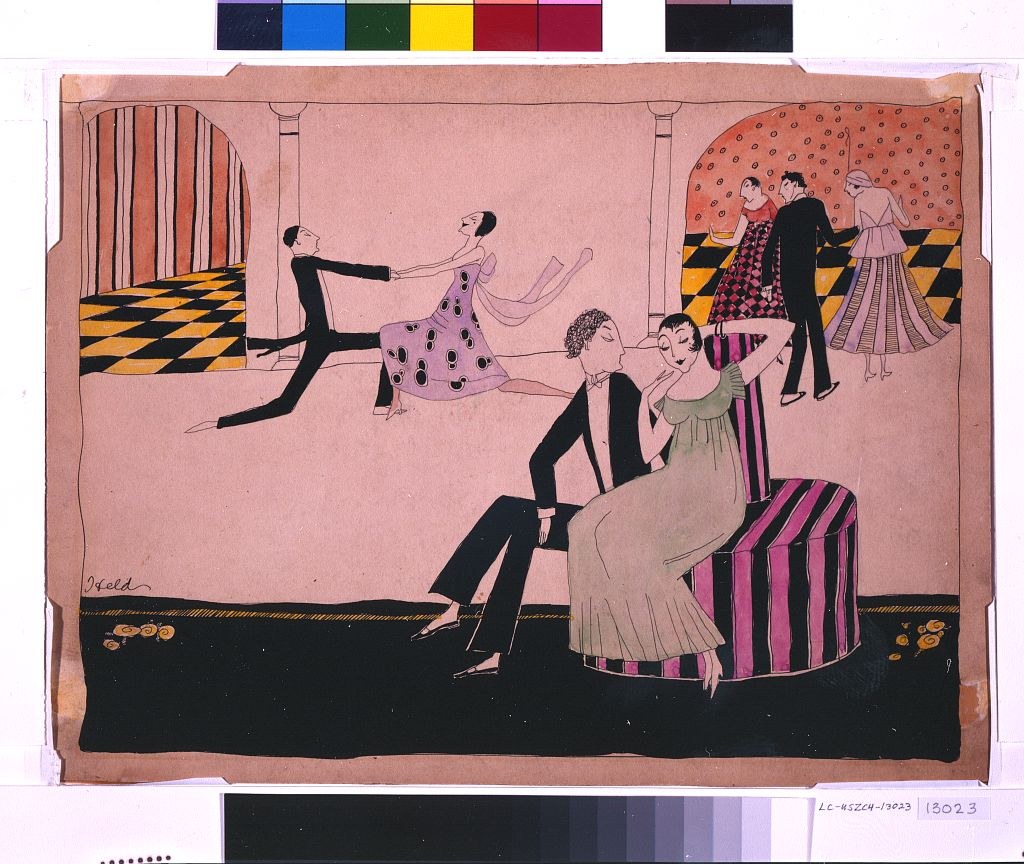
A fashionable ballroom scene rendered in Art Deco style, dominated by a pink wall and black-and-yellow checkered floor. In the foreground, a couple in closed ballroom hold dominates the composition: the man wears black tails and leans back in a dramatic lunge, while his partner in a pale gown with green sash and purple polka-dot overlay extends her leg and trails her arms with fluid grace. Behind them, a second couple sits on a striped settee (magenta and black), the woman in cream and green watching the dancers. In the middle distance, a third couple begins to dance, while at the back, near a doorway with red and yellow striped curtains, two more figures in evening dress stand conversing. The scene captures a moment of social choreography: some bodies in motion, others paused in conversation, all arranged in the shallow space typical of 1920s commercial illustration.
The dancing
The lead couple displays the hallmark closed ballroom hold of the period—man's right hand at woman's back, their left hands joined—but executed with exaggerated extension and drama. The man's weight is driven back and down into a deep lunge or promenade position; the woman responds with a corresponding line that extends through her raised leg and trailing arm. The other couples are less dramatically posed but maintain the same upright carriage and formal frame. The figures are spare and linear, with elongated limbs typical of 1920s fashion illustration, emphasizing the verticality and elegance of ballroom deportment.
The dance depicted
This is almost certainly a social ballroom dance of the 1920s, most likely a Waltz or Foxtrot given the closed hold, the man's characteristic lunge position, and the formal evening dress. The exaggerated dramatic lean and extension suggest the theatrical interpretation of ballroom style that emerged in the 1920s, when exhibition dancers began to emphasize visual spectacle alongside technical precision. The setting—a private ballroom or hotel dancehall—and the title 'Julian and Julienne' (a paired male-female name) reinforce that this is a formal social dance, possibly shown as a fashionable spectacle for a wealthy audience.
How it was made
The work is a hand-colored print or illustration, likely lithography or pochoir (stencil coloring), executed in the flat, bold color palette and linear style characteristic of 1920s commercial art and fashion illustration. The registration of the colors—pink ground, black and yellow geometric floor, discrete blocks of magenta and purple—is crisp and deliberate, suggesting either lithographic printing or careful hand coloring. This was a common medium for advertising, theater programs, and fashion magazines of the period, ensuring wide circulation among the urban middle and upper classes who frequented ballrooms.
About this work
This is a 1920s Art Deco illustration of a fashionable ballroom scene, centered on a dramatically posed couple executing a formal closed-hold dance—almost certainly a Waltz or Foxtrot. The image captures the theatrical presentation of social ballroom dancing as it was consumed and performed by the urban elite in the interwar period, when exhibition dancers and fashion illustration helped elevate ballroom technique into a visual art form. The work belongs in a dance gallery because it documents not only a specific dance technique and social ritual, but also the modernist visual language through which the 1920s made ballroom dancing into spectacle.
How to look at it
Attend first to the lead couple's body line: the man's dramatic backward lunge and the woman's extended leg and trailing arm create a diagonal axis that energizes the entire composition. This is not naturalistic movement but rather the theatrical exaggeration that exhibition dancers developed to make ballroom technique visible from a distance. Notice how the artist has flattened the space and simplified the figures to graphic essentials—the closed hold, the extended line, the elegant dress—rendering ballroom dancing as a design problem rather than a literal social scene. The other couples and observers serve as a social frame that validates the lead couple's drama as a desirable performance.
The artist
The signature at the lower left appears to read 'Held' or similar, but the artist is not recorded in the Library of Congress catalogue. The work is characteristic of 1920s commercial and fashion illustration in the Art Deco idiom—a style that flourished in advertising, theater programs, and magazine illustration. Artists working in this mode typically had training in both fine art and commercial design, and often specialized in fashion, theater, and leisure subjects aimed at affluent urban audiences.
The period
The 1920s saw an unprecedented fusion of social ballroom dancing with theatrical exhibition and commercial entertainment. The rise of the Charleston and Jazz Age dances created a visual appetite for ballroom imagery; simultaneously, Art Deco emerged as the dominant aesthetic for modern leisure and fashion. Ballroom dance instruction and exhibition became a commercial industry, with professional dancers performing in hotels, cabarets, and theaters, and their styles disseminated through fashion magazines, theater programs, and illustrations like this one. This image sits at the intersection of social dance practice, theatrical presentation, and modernist graphic design.
Where it lives
The work is held in the Prints & Photographs Online Catalog (PPOC) of the Library of Congress. It is catalogued as a print illustration dated to 1910, though the style and content strongly suggest the 1920s. The collection includes commercial illustrations, fashion plates, theater imagery, and entertainment graphics from this period.
Dance in this work
Questions about this work
What dance are they doing?
The closed hold, the formal evening dress, and the man's characteristic lunge position all point to a Waltz or Foxtrot—the standard ballroom dances of the 1920s. The exaggerated dramatic extension suggests this is not a social dance but an exhibition or theatrical interpretation meant to be visually striking.
Who were Julian and Julienne?
The catalogue record does not identify them. The names may refer to famous ballroom dancers of the period, or may simply be generic paired names chosen for the poster or program this illustration appeared in. Without additional documentation, their identity cannot be established.
Why is the date listed as 1910?
This may be a cataloguing error. The Art Deco style, the fashion, the graphic technique, and the social context all point much more strongly to the 1920s. The Library of Congress record should be reviewed.
What is this image from?
It appears to be a commercial illustration, likely from a theater program, ballroom advertisement, or fashion magazine of the 1920s. The hand-coloring and printing technique were standard for this kind of commercial entertainment imagery.
More dance artwork





