49 works in this view — arrow keys or swipe to move between them.
Dance in Art
Dancing waiter
Unknown artist
- Collection:
- Prints & Photographs
- Source:
- Library of Congress
- Rights:
- Rights vary by item — check the source record before reusing this image. Source record ↗
- Recorded as:
- Library of Congress — no known restrictions (verify per item)
The dancing waiter represents a now-vanished tradition of physical entertainment that bridged service, circus, and theatre. The image documents how performers of the 1920s understood and deployed their bodies for comedic effect, and how modernist visual practice recorded movement through minimal, expressive line. For dance historians, this drawing reveals the spectrum of movement culture beyond formal dance genres—the informal, comedic, acrobatic performances that populated commercial entertainment venues and shaped how audiences experienced the trained body.
What you are looking at
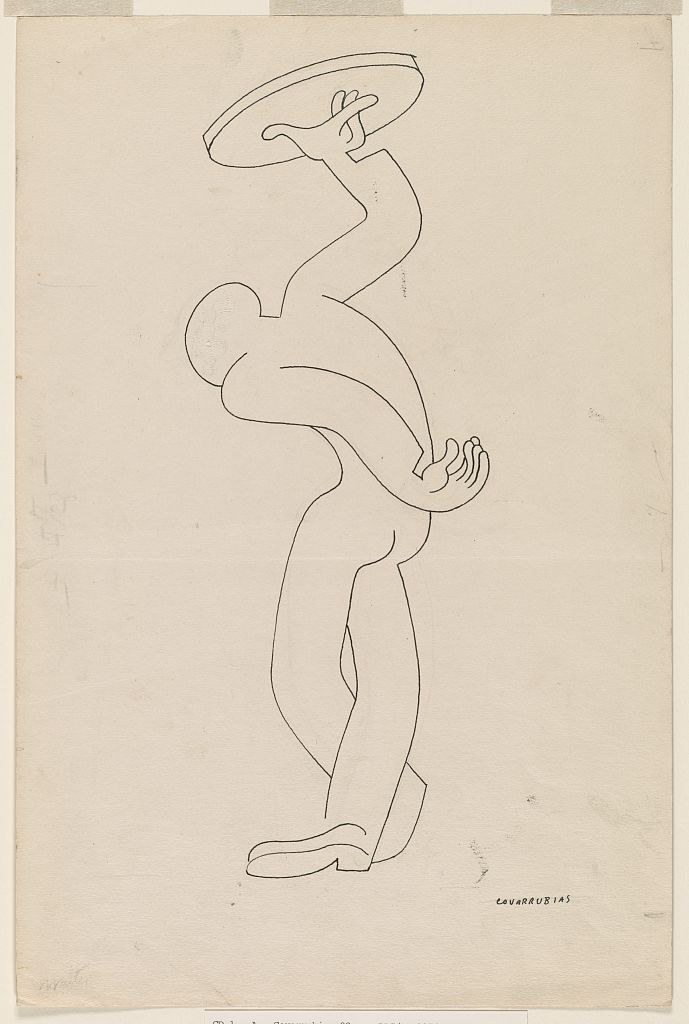
A single figure is drawn in continuous outline against a plain ground. The body is rendered in an exaggerated, contorted posture: the torso twists sharply, the legs bow outward in an extreme forward bend, and the arms reach overhead in a stretched, strained gesture. The head tips back and the face is sketched with minimal features. Most strikingly, the figure balances or supports a large circular form—a tray or platter—atop the head and one hand, held at an impossible angle that requires the entire spine and limbs to arch and twist to counterbalance it. The pose suggests both acrobatic strain and comedic absurdity. The line is confident and economical, capturing the figure's exertion through the tension of the drawn line itself.
The dancing
A single male figure (indicated by the simplified facial features and the context of the title) executes an extreme backbend or contortion while simultaneously balancing a large circular tray. The weight appears to be distributed between the feet, which are planted wide, and one raised hand supporting the tray overhead. The spine is hyperextended and the arms are fully extended to manage the load. The pose reads as one of deliberate physical struggle rather than graceful control—the body is forced into an unnatural configuration to achieve the balance.
The dance depicted
This drawing depicts a 'dancing waiter'—a figure performing an acrobatic or comedic display of serving rather than any formal dance style. The image captures a moment of theatrical entertainment common in 1920s cabaret, vaudeville, or music-hall performances, where waitstaff or performers would demonstrate exaggerated physical feats as part of their act. The emphasis here is on contortion and acrobatic balance rather than footwork or choreographed movement, though the dynamic, strained posture suggests a trained body capable of extraordinary flexibility and strength. This falls into the tradition of physical comedy and circus-influenced performance that was popular in entertainment venues of the period.
How it was made
This is a pen or ink drawing on paper, executed in a single continuous line or minimal linework characteristic of modernist sketch practice. The economy of the line—the absence of shading, hatching, or modelling—suggests influence from early twentieth-century drawing practices, possibly Expressionist or Modernist in origin. The technique captures movement and strain through the quality of the drawn line itself: the tension in the figure's body is conveyed by the deliberation and pressure of the mark. Such drawings were often used for rapid documentation, study, or as finished works for reproduction in periodicals and portfolios.
About this work
This 1927 drawing documents a moment of physical comedy and acrobatic performance that was part of the entertainment ecology of the 1920s. The 'dancing waiter' was a established figure in cabaret and music-hall culture—a performer who combined service with showmanship through feats of balance and contortion. The image captures not a formal dance but a theatrical physicality: the body trained and disciplined to execute impossible postures for the amusement of diners or audiences. It belongs in a dance archive not because it depicts ballet, ballroom, or social dance, but because it records a performance tradition that depended entirely on the trained body in motion and the comic possibilities of bodily extremity. The drawing's spare, energetic line captures the strain and absurdity of the moment with economy and wit.
How to look at it
Attend to the contortion of the spine and the distribution of weight: this is not a graceful pose but a strained one, captured at the moment of maximum strain. The artist has chosen to freeze the figure at the point of extremity—the moment when the balance is most precarious and the physical effort most visible. Notice how the line itself conveys tension: it is not relaxed or flowing, but taut and deliberate. The circular tray at the top is the punctuation mark that transforms an ordinary backbend into a comic feat of service.
The artist
The artist is not recorded. The drawing's style and technique—the economical, continuous-line approach—suggests familiarity with early twentieth-century modernist drawing practices, possibly European. The inscription 'CAVAJOUS LAS' or similar at lower right may be a signature or mark, but cannot be confirmed from available information.
The period
In the 1920s, cabaret, music-hall, and revue entertainment reached a peak of popularity in major European and American cities. These venues employed performers who blended roles: waiters who performed, dancers who served, acrobats who entertained diners. The period was one of experimentation in both dance and visual art—modernist movements in painting and drawing were emerging simultaneously with innovations in popular entertainment. Drawing became a tool for documenting performance, capturing movement in its ephemeral moment. The sparse, energetic line of this sketch reflects the visual culture of the period, in which capturing the essence of a moving body through minimal means became a modernist ambition.
Where it lives
The drawing is held in the Library of Congress Prints & Photographs collection. It is catalogued as a 1927 work titled 'Dancing waiter,' with artist, medium, and technique not formally recorded. The work appears to be a single-sheet drawing, likely created for reproduction or as part of a portfolio of theatrical or entertainment sketches.
Dance in this work
Questions about this work
Is this actually a dance?
Not in the formal sense of ballet, ballroom, or any recognized dance style. It documents a performance tradition—the 'dancing waiter'—that combined acrobatics, comedy, and service work. It belongs in a dance archive because it records how trained bodies were deployed for entertainment, and because performers like this were part of the performance ecology that dancers inhabited.
What does the title 'Dancing waiter' mean?
In 1920s cabaret and music-hall culture, a 'dancing waiter' was a performer who combined table service with acrobatic display. While serving food or drinks, they would execute feats of balance, contortion, or dance to entertain diners. The title identifies the performer's role and the nature of the performance captured here.
Why is the figure in such an extreme pose?
The exaggerated contortion and backbend serve two purposes: they demonstrate the performer's trained physicality and flexibility, and they create a comic effect through the absurdity of attempting to balance a large tray while in such a strained position. The pose is deliberately impossible-looking, which is precisely the point.
Who created this drawing?
The artist is not recorded in the Library of Congress catalogue. The drawing bears a signature or mark at the lower right that may read 'Cavajous' or similar, but this has not been verified or researched.
More dance artwork





