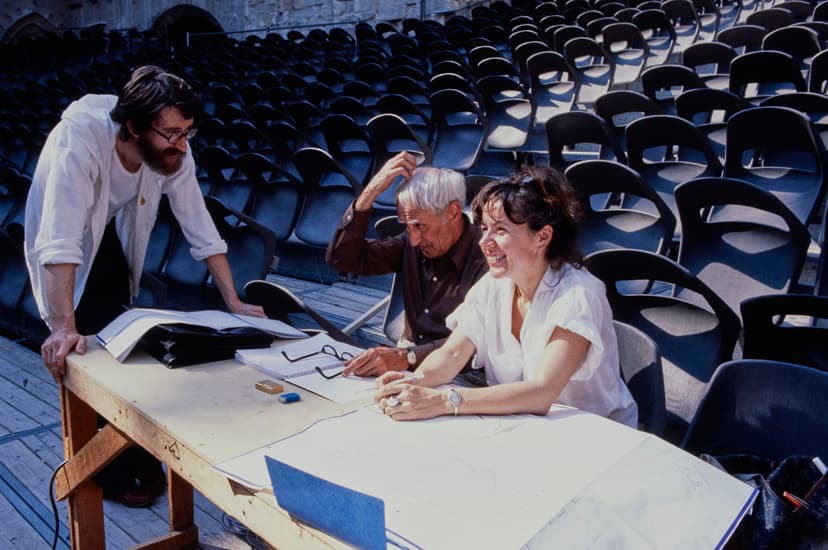
Alwin Nikolais
Legend of Dance
Why They Matter
Nikolais matters because he made the stage environment itself choreographic. His dancers did not merely perform in front of scenery or to accompaniment: their movement entered a system of elastic lines, fabric volumes, projections, color fields, and composed electronic sound. That approach widened…
Biography
Alwin Nikolais was born on November 25, 1910, in Southington, Connecticut, and entered performance through an unusual path: music and theatre rather than childhood dance training. He studied piano and organ, accompanied silent films, worked with puppetry, and developed practical skills in stagecraft. After seeing the German modern-dance artist Mary Wigman, he began dance study and later trained at the Bennington School of the Dance with major American modern-dance figures. These experiences gave him an unusually broad foundation in sound, visual design, and movement.
Nikolais created his first choreography in the late 1930s—*Eight Column Line* is identified as his first commissioned ballet in 1939—but military service in the U.S. Army Signal Corps interrupted his developing career during the Second World War. After his return, he worked with Hanya Holm, whose analytical approach to space and form strongly influenced his teaching. In 1948, he began a long association with the Henry Street Settlement Playhouse on Manhattan's Lower East Side, which became the base for his company, school, and laboratory for stage experimentation.
At Henry Street, Nikolais developed productions in which no single element automatically dominated. *Masks, Props and Mobiles* and related work, including *Tensile Involvement*—premiered in 1953 and built around dancers' manipulation of elastic cords—treated dancers, fabrics, costumes, projected color, and electronic sound as interacting components. He resisted the psychologically driven hero-and-narrative model then common in American modern dance. The resulting theatrical environment could be playful and spectacular, but its deeper proposition was structural: motion, light, sound, and bodies shared the same compositional field. *Imago Suite*, created in 1963, became an enduring repertory work that joined abstract movement to this authored theatrical environment.
Murray Louis became Nikolais's leading dancer, associate director, artistic collaborator, and life partner. Their work was closely linked, but their choreographies represent distinct authorship. The Nikolais Dance Theatre's 1968 Paris season helped establish the company's international reputation, and France became especially important to his career. He directed the Centre national de danse contemporaine in Angers from 1978 to 1981 and created *Schéma* for the Paris Opera Ballet in 1980.
Nikolais also composed the sound scores and designed the scenic, costume, and lighting systems for much of his repertory. His electronic works, collected as *Electronic Dance Music*, used tape, electronics, Moog synthesizer, and Synclavier to create theatrical scores rather than conventional accompaniments. He created the choreography, sound scores, and scenic designs for more than one hundred productions. Recognition late in his career included the National Medal of Arts and Kennedy Center Honors, both in 1987. Nikolais continued making work while facing cancer and died in New York City on May 8, 1993. Preservation, licensing, and teaching of the repertory continue through the Nikolais/Louis Foundation.
Career Highlights
Created Eight Column Line, identified in institutional biographies as his first commissioned ballet. University of Washington Department of Dance University of Washington Department of Dance
Began his long association with Henry Street Settlement Playhouse, which became the base for his company and production experiments. Jacob’s Pillow Dance Interactive Jacob’s Pillow Dance Interactive
Premiered Tensile Involvement, a signature work built around dancers’ manipulation of elastic cords. University of Washington Department of Dance University of Washington Department of Dance
Created Imago Suite, an enduring repertory work joining abstract movement to an authored theatrical environment. University of Washington Department of Dance University of Washington Department of Dance
The Nikolais Dance Theatre’s Paris season helped establish the company’s international reputation. The Washington Post The Washington Post
Directed the Centre national de danse contemporaine in Angers, France. The Washington Post The Washington Post
Created Schéma for the Paris Opera Ballet and Mechanical Organ, whose score is represented in his electronic-music catalogue. The Washington Post; DRAM The Washington Post
Received the National Medal of Arts. National Endowment for the Arts National Endowment for the Arts
Was named a Kennedy Center Honoree. Kennedy Center Kennedy Center
Died in New York City; the Foundation and repertory archive continued the Nikolais/Louis legacy. The Washington Post; Nikolais/Louis Foundation The Washington Post
Gallery
Legacy & Impact
Nikolais matters because he made the stage environment itself choreographic. His dancers did not merely perform in front of scenery or to accompaniment: their movement entered a system of elastic lines, fabric volumes, projections, color fields, and composed electronic sound. That approach widened the field's understanding of authorship and helped establish a durable path from modern dance to multimedia performance. His pedagogy, repertory, scores, and designs transmitted that thinking through generations of dancers and makers.


Explore More Legends
Discover the dancers, teachers, choreographers, and cultural icons who shaped how the world moves.
Keep the thread going
Dance history, technique, and the occasional rabbit hole — in your inbox. Thoughtful, infrequent, unsubscribe anytime.
Free. No spam. One click to leave.