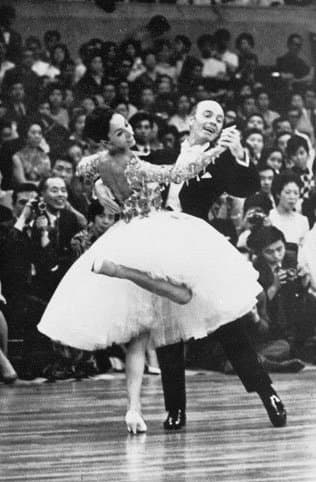
Competitive Champion · Partnership Icon
Bill & Bobbie Irvine
Standard's Golden Couple
Why They Matter
Their unprecedented decade of dominance established the gold standard for competitive ballroom partnership and technical excellence.
Known For
Biography
William "Bill" Irvine and Bobbie Cearn Irvine were a British professional ballroom and Latin partnership who amassed thirteen world titles between 1960 and 1968, making them one of the most successful competitive dance couples of their era. Bill was born on 30 January 1926 in Low Craigends, Kilsyth, Scotland, and came from a mining family; early accounts describe Royal Navy service and an apprenticeship before dance became his profession. Bobbie Barwell was born on 27 July 1932 in Oudtshoorn, South Africa, where her father worked for Shell. Bill travelled to South Africa as a young teacher, met Bobbie there, and they married in 1957. After winning championships in South Africa, they moved to London, where they rose to prominence in a field shaped by the retirement of previous champions and their developing rivalry with couples such as Peter Eggleton and Brenda Winslade. Their 1962 British Professional Ballroom Championship victory marked a turning point in their competitive ascent.
What distinguished the Irvines was their dual-discipline success. Between 1960 and 1968, they won titles across professional Ballroom (then called "Modern"), Latin American, and combined Nine-Dance categories—a breadth that set them apart in an increasingly specialized field. *The Times* specifically credits them with three world Latin titles alongside their Ballroom achievements. Their principal coaches included Eric Hancox, Len Scrivener and Sonny Binnick in Ballroom, and Nina Hunt in Latin. The partnership balanced contrasting physical presences: Bill's dancing was marked by strongly projected upper-body carriage and clear forward intention, while Bobbie was known for a distinctive lightness and precision. Contemporary accounts describe her technique as "feather-light" and emphasize her attention to posture, subtlety and the individual character of each dance.
Both partners were appointed Members of the Order of the British Empire in the 1967 Birthday Honours for services to Ballroom Dancing, a recognition that underscored their standing in the dance world. After retiring from competition, they remained active as teachers, lecturers and adjudicators, working from the Starlight studio in Streatham, South London. Bill succeeded Alex Moore as chair of the ISTD Ballroom Branch, leading it until 1992 and later serving as vice-president and president of the Society. Bobbie continued teaching during her final illness and performed in a Blackpool demonstration featuring an unpartnered, synchronized foxtrot with women pupils. Their influence thus extended far beyond competition medals into the transmission and governance of International Style Ballroom.
Bobbie died on 30 May 2004, aged seventy-one. Bill died on 13 February 2008. The WDC continues to honor them through the Bill and Bobbie Irvine President's Award for professional contribution to Ballroom, while Guinness recognizes the partnership in its record entry for the most successful professional ballroom dancing partnership. These institutional memorials reflect a legacy that encompasses not only their titles but their authority as teachers, judges and standard-setters whose influence persisted in competitive and professional culture long after their competitive years ended.
Career Highlights
William “Bill” Irvine was born on 30 January and came from Low Craigends, Kilsyth, Scotland. Source Source
Bobbie Barwell was born on 27 July in Oudtshoorn, South Africa. Source Source
Bill and Bobbie married after meeting in South Africa, where they had developed their partnership. Source Source
Their world-title sequence began; a surviving British Pathé report documents Bill and Bobbie Irvine among the winners at a world dancing championship. Source Source
They won the British Professional Ballroom Championship and are also listed for world Ballroom and combined-dance success that year. Source Source
They won the Professional World Ballroom Championship; British Pathé footage documents the championship field and their dancing. Source Source
Their Ballroom championship run continued, including a British title in the commonly reproduced career record. Source Source
Both were appointed MBE in the Birthday Honours for services to Ballroom Dancing. Source Source
They completed a nine-year world-title span; Guinness records thirteen world titles in total between 1960 and 1968. Source Source
Their autobiographical account, The Dancing Years of Bill & Bobbie Irvine, was published. Source Source
Bill chaired the ISTD Ballroom Branch after Alex Moore and later served as ISTD vice-president and president. Source Source
Bobbie died in 2004 and Bill in 2008; their names remain attached to a WDC President’s Award for professional contribution to Ballroom. Source Source
Legacy & Impact
The Irvines matter because they joined competitive breadth, pedagogical depth and institutional longevity. Winning at the highest level in both Ballroom and Latin made them an exception in an era of increasing specialization; their combined-dance titles reinforced that versatility. Their thirteen-title total is significant, but their deeper legacy lies in the transmission from performance to teaching: rivals sharpened their competitive identity, coaches refined it, and the Irvines then transmitted a conception of posture, musicality, partnership and professional conduct to later dancers. Bill's ISTD leadership and the WDC award bearing both names turned that embodied influence into an institutional one that shapes ballroom culture today.


Explore More Legends
Discover the dancers, teachers, choreographers, and cultural icons who shaped how the world moves.
Keep the thread going
Dance history, technique, and the occasional rabbit hole — in your inbox. Thoughtful, infrequent, unsubscribe anytime.
Free. No spam. One click to leave.