Franziska “Fanny” Elßler
Legend of Dance
Why They Matter
Elssler matters because she broadened the Romantic ballerina ideal. Her fame demonstrated that ballet virtuosity could be grounded, percussive, dramatically direct and tied to theatrical character rather than only weightless and supernatural. Her American tour also revealed a new scale of internatio
Watch
Ballet Evolved — Fanny Elssler 1810–1884
Royal Ballet and Opera
Official company overview with Royal Ballet dancer Romany Pajdak demonstrating the historical contrast associated with Elssler
DNB — La Cachucha (1836) by Fanny Elssler, excerpt A
Dance Notation Bureau
Shows how a modern staging can be generated from a notation score
Ballet Evolved — Marie Taglioni 1804–1884
Royal Ballet and Opera
Provides a carefully framed comparison for the Taglioni–Elssler contrast
Biography
Fanny Elssler was an Austrian ballerina born June 23, 1810, in Gumpendorf, Vienna, who became one of the nineteenth century's first international dance celebrities and a defining alternative to the dominant Romantic ballet aesthetic. She grew up in a family connected to Vienna's musical establishments—her father worked in the Esterházy court where Joseph Haydn served—and trained alongside her elder sister Therese. The two sisters performed together from childhood, appearing at Vienna's Kärntnertortheater before Fanny was seven, a partnership that shaped both their early careers.
After further training in Vienna, Fanny and Therese traveled to Naples in 1827, where Fanny's success led to engagements in Berlin in 1830 and later in Vienna and London. In 1834, she entered the Paris Opéra, where management actively promoted a contrast between Elssler and the reigning Marie Taglioni. Where Taglioni embodied a buoyant, otherworldly style, Elssler brought weight, speed, dramatic address and exact footwork to the stage. The comparison was real, though later simplified into period critical rhetoric that need not limit how we understand her artistry.
Elssler's defining triumph came in 1836 in Jean Coralli's *Le Diable boiteux*, with music by Casimir Gide. In the Cachucha, she deployed castanets, rhythmic footwork, torso inclination, épaulement and vivid dramatic focus to create a theatrical Spanish persona that electrified audiences and helped establish national and character dances as essential to ballet. This was a Parisian stage construction—Elssler herself was Austrian—but the performance's energy and precision made it a model for generations of dancers.
From 1840 to 1842, Elssler undertook an unprecedented transatlantic tour, performing in New York, Washington, Baltimore, Philadelphia, Boston, New Orleans and other American cities, as well as in Cuba. The tour generated extraordinary attention and merchandising; President Martin Van Buren invited her to the White House in 1841, an honor documented by Henry Inman's portrait now held by the White House Historical Association. The American circuit established Elssler as a case study in nineteenth-century female celebrity and demonstrated ballet's capacity to travel and captivate audiences far beyond European opera houses.
After returning to Europe in 1842, Elssler continued to perform in major cities and danced in Russia before retiring in 1851. She spent her later years first near Hamburg and then in Vienna, where she died on November 27, 1884. Her legacy survives through prints, reviews, musical scores, notation, memoirs and later reconstructions—no film footage exists from her lifetime—but these sources together offer rich evidence of a dancer who made rhythm, weight, characterization and dramatic address central to ballet virtuosity.
Career Highlights
Born June 23 in Gumpendorf, Vienna. Britannica
Appeared at Vienna’s Kärntnertortheater as a child. Europeana
Traveled with Therese Elssler to Naples for further dance study and performance. Europeana
Began a successful Berlin engagement after her Naples appearances. Europeana
Debuted at the Paris Opéra, where management amplified comparison with Marie Taglioni. Europeana
Created the Cachucha in Coralli and Gide’s Le Diable boiteux, her defining stage success. NYPL
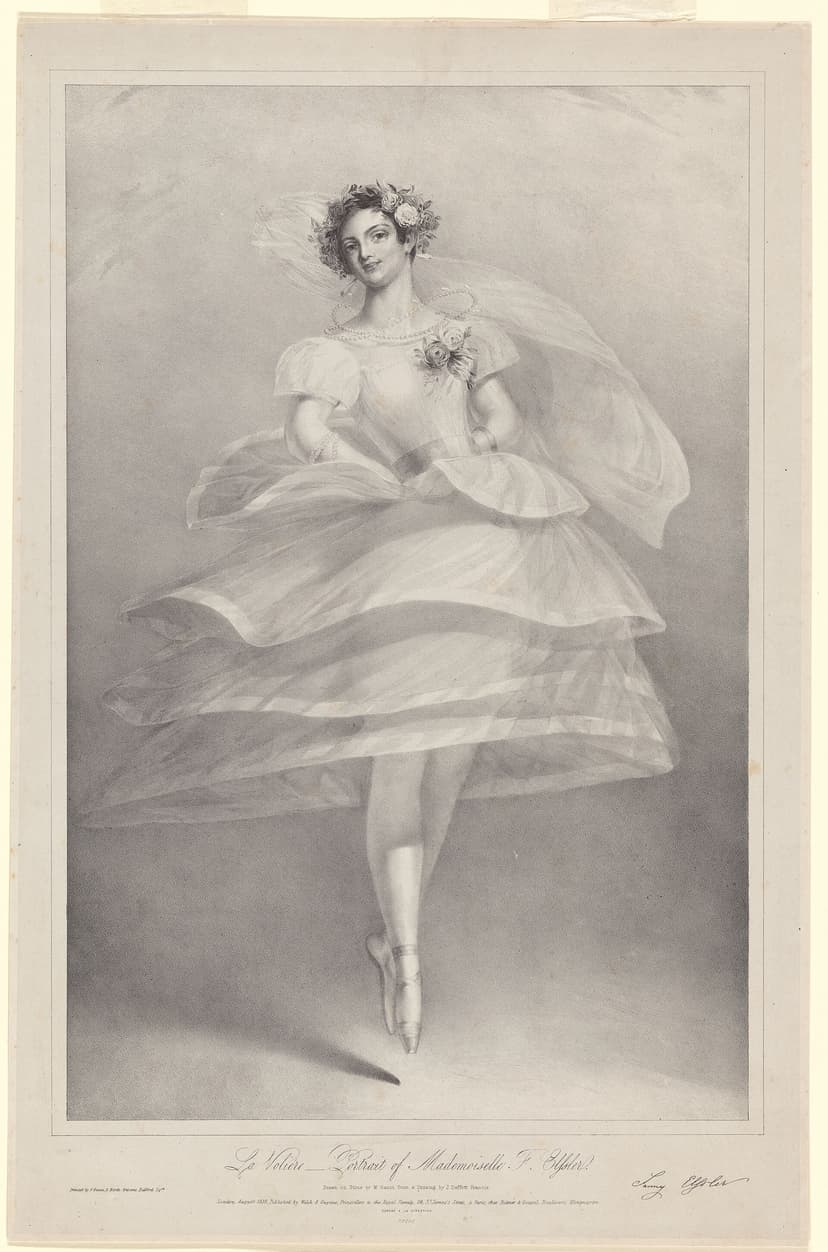
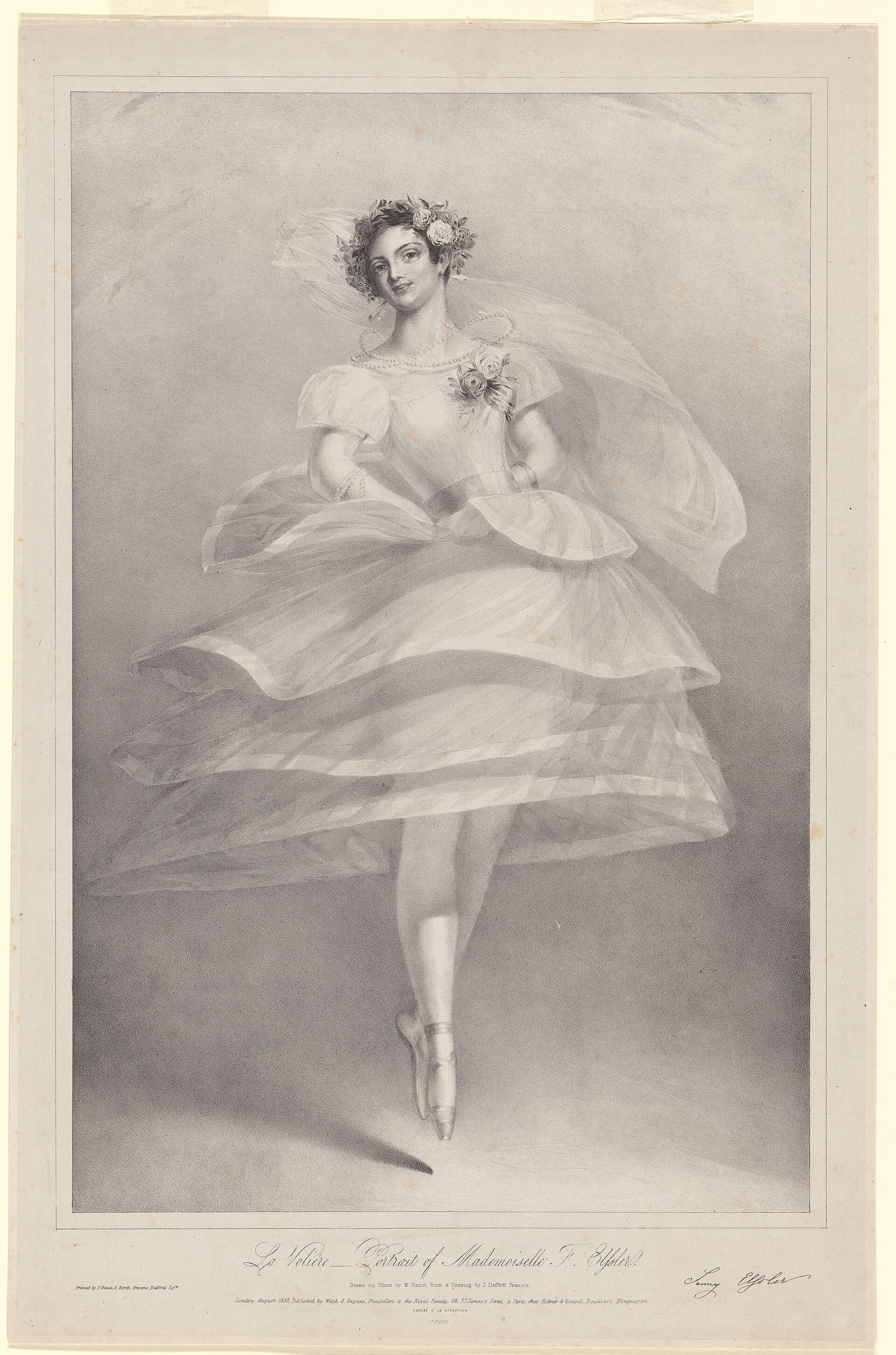
Appeared in La Volière; a named-artist lithograph documents her airborne theatrical pose. Wikimedia Commons
Opened her American tour in New York, beginning a two-year North American and Cuban circuit. Europeana
Visited the Van Buren White House during the American tour. White House Historical Association
Returned to Europe after the American tour. Europeana
Retired from performance after further European and Russian engagements. Europeana
Died November 27 in Vienna. Britannica
Gallery
Legacy & Impact
Elssler reshaped what a Romantic-era ballerina could be. She proved that virtuosity did not require ethereality; that grounded, percussive, rhythmically exact dancing could command international stages; and that theatrical character and dramatic directness were sources of power, not limitations. Her American tour revealed a new scale of female celebrity and showed how ballet could become mass culture across the Atlantic. For dancers today, the Cachucha remains both her clearest legacy and a lens through which to examine how ballet has historically transformed living cultural forms into stylized types.


Explore More Legends
Discover the dancers, teachers, choreographers, and cultural icons who shaped how the world moves.
Keep the thread going
Dance history, technique, and the occasional rabbit hole — in your inbox. Thoughtful, infrequent, unsubscribe anytime.
Free. No spam. One click to leave.