John Wells
Legend of Dance
Why They Matter
Wells matters less as a recoverable star performer than as evidence of how circus movement was organized and transmitted. Wells’s Circus gave performers a recognizable affiliation, and the later Wells family record shows equestrian and acrobatic work continuing through children and allied…
Biography
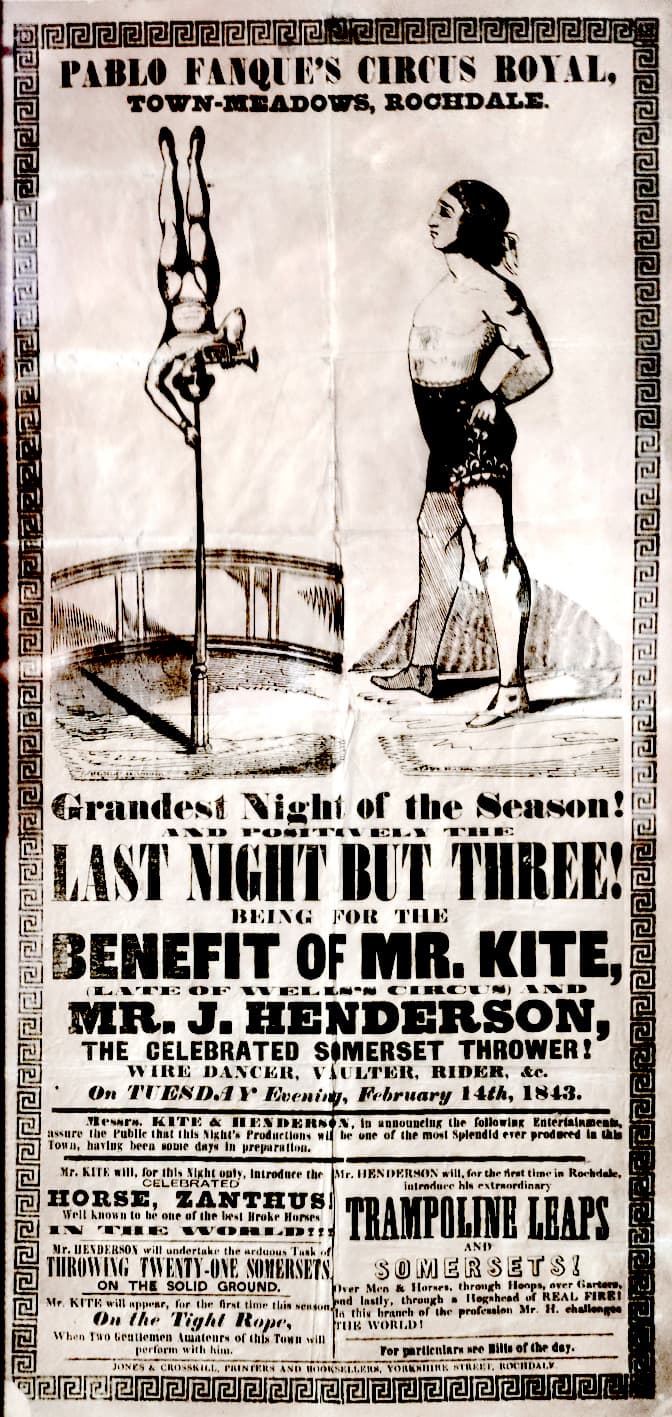
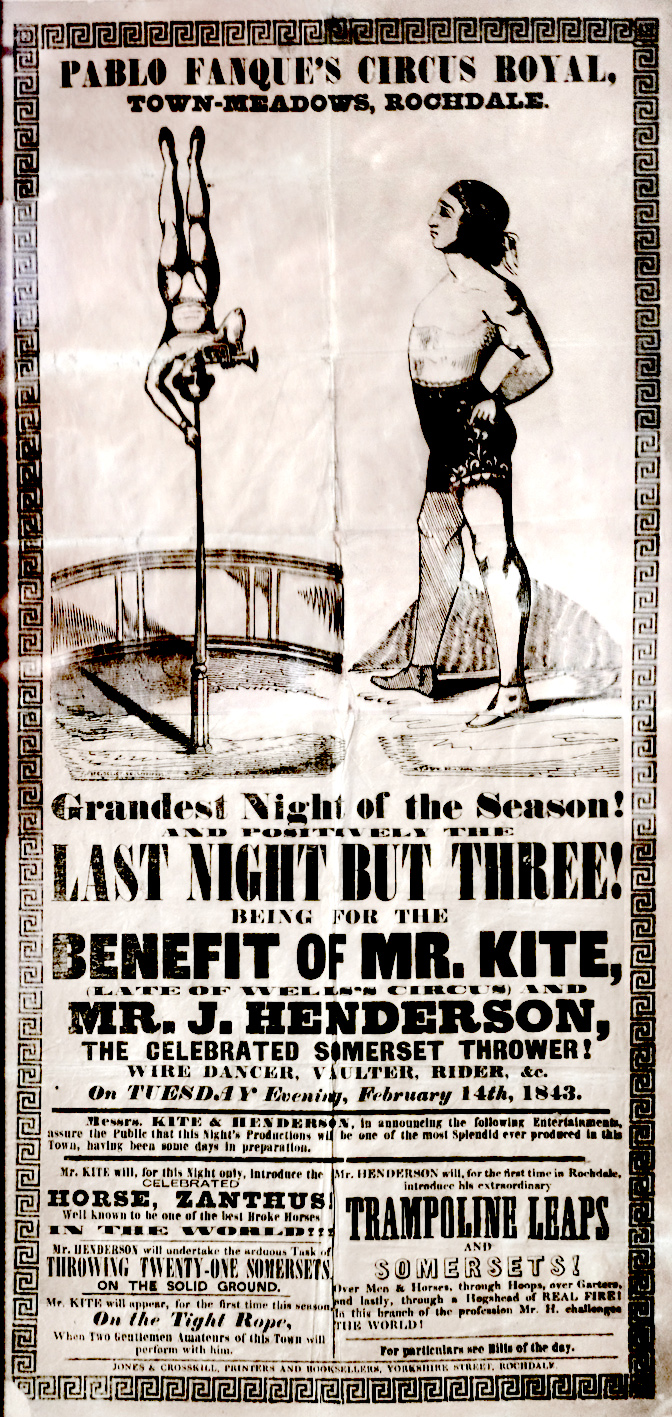
John Wells was a British circus proprietor active in the early Victorian era, representing a generation of family-based circus companies whose individual histories remain fragmentary. By 1843, Wells's Circus had achieved enough professional standing to function as a meaningful credential: a surviving bill from Pablo Fanque's Circus Royal in Rochdale advertised William Kite as "late of Wells's Circus," indicating that prior engagement with Wells's company carried marketable recognition when performers moved to other proprietors.
The movement ecology surrounding Wells's company emerged through the artists who worked for him and those who carried his name into other ventures. The 1843 Fanque bill documents the period's mixed performance vocabulary—trained riding, tightrope walking, vaulting, trampoline leaps, and somersaults—though these particular feats are directly credited to Kite and J. Henderson rather than to Wells himself. Later nineteenth-century notices preserved by John Stewart reference performers identified as "Mr. Wells," "Miss Wells," "Infant Wells," and "the Wells Family" circulating through companies including W. F. Wallett's, Newsome's, Hengler's, and Madame Macarte's.
Emily Jane Wells, born in Ashby-de-la-Zouch in 1840 and identified by Stewart as John's daughter, provides the clearest family connection. In 1859 she appeared with Hengler's in Liverpool performing an equestrian spectacle as Joan of Arc. In 1861 she married clown and vaulter James Barnes and performed alongside him in an act called *La Tranca*. By 1862, "the Wells Family" was listed in Madame Macarte's Alhambra Circus company in Brighton, demonstrating that the Wells name retained marketability as a family troupe designation throughout the mid-century period.
These scattered notices establish Wells as a node in an intergenerational circus network rather than a solitary star. The strength of his historical footprint lies not in documented personal performance but in his role as a proprietor whose company name and family connections structured employment, training, and movement transmission across multiple touring circuits. John Wells died on 18 September 1880, reportedly described by Stewart as an old circus owner. The thinness of his personal archive—no secure birth date, birthplace, or death location in the consulted sources—reflects a broader pattern: nineteenth-century proprietors shaped the labor, vocabulary, and embodied practice of circus performance without necessarily generating the institutional records that document later theatrical figures.
Career Highlights
Wells’s Circus had become a recognizable prior engagement: a surviving Rochdale bill advertised William Kite as “late of Wells’s Circus.” Source Source
The Pablo Fanque bill preserved the performance ecology surrounding Wells’s former artist—riding, tightrope, vaulting, trampoline leaps, and somersaulting—while clearly crediting those acts to Kite and J. Henderson. Source Source
A review reprinted by Stewart praised a “Mr. Wells” and “Miss Wells” as riders with W. F. Wallett’s company; the source does not prove that the man was John, so the notice is contextual rather than a secure personal credit. Source Source
The same chronology records Miss Wells performing equestrian feats in Bradford, evidence that the Wells name was attached to riding performance by mid-century. Source Source
“Infant Wells” appeared as an attraction with Newsome’s in Cheltenham; the child’s precise relationship to John is not established in the cited notice. Source Source
Emily Jane Wells, identified by Stewart as John’s daughter, appeared with Hengler’s in Liverpool as Joan of Arc. Source Source
Emily Jane Wells married clown and vaulter James Barnes and was documented performing with him in La Tranca. Source Source
“The Wells Family” was listed in Madame Macarte’s Alhambra Circus company in Brighton, showing the continued marketability of a family troupe under the Wells name. Source Source
John Wells, described by Stewart as an old circus owner, died on 18 September. Source Source
Gallery
Legacy & Impact
John Wells embodies the proprietor-family system through which equestrian, acrobatic, and circus-adjacent movement was organized and transmitted in early Victorian Britain. Rather than a recoverable performer, he matters as evidence of how technique circulated: a performer could leave one company, carry the former proprietor's name as a credential, and repackage skills for new audiences. The 1843 Fanque bill and the Wells family's documented work across mid-century circuits show how movement knowledge—balance, timing, aerial orientation, risk management—survived and spread through family networks and touring companies before institutional dance archives.


Explore More Legends
Discover the dancers, teachers, choreographers, and cultural icons who shaped how the world moves.
Keep the thread going
Dance history, technique, and the occasional rabbit hole — in your inbox. Thoughtful, infrequent, unsubscribe anytime.
Free. No spam. One click to leave.