Performer · Stage Icon · Community Builder
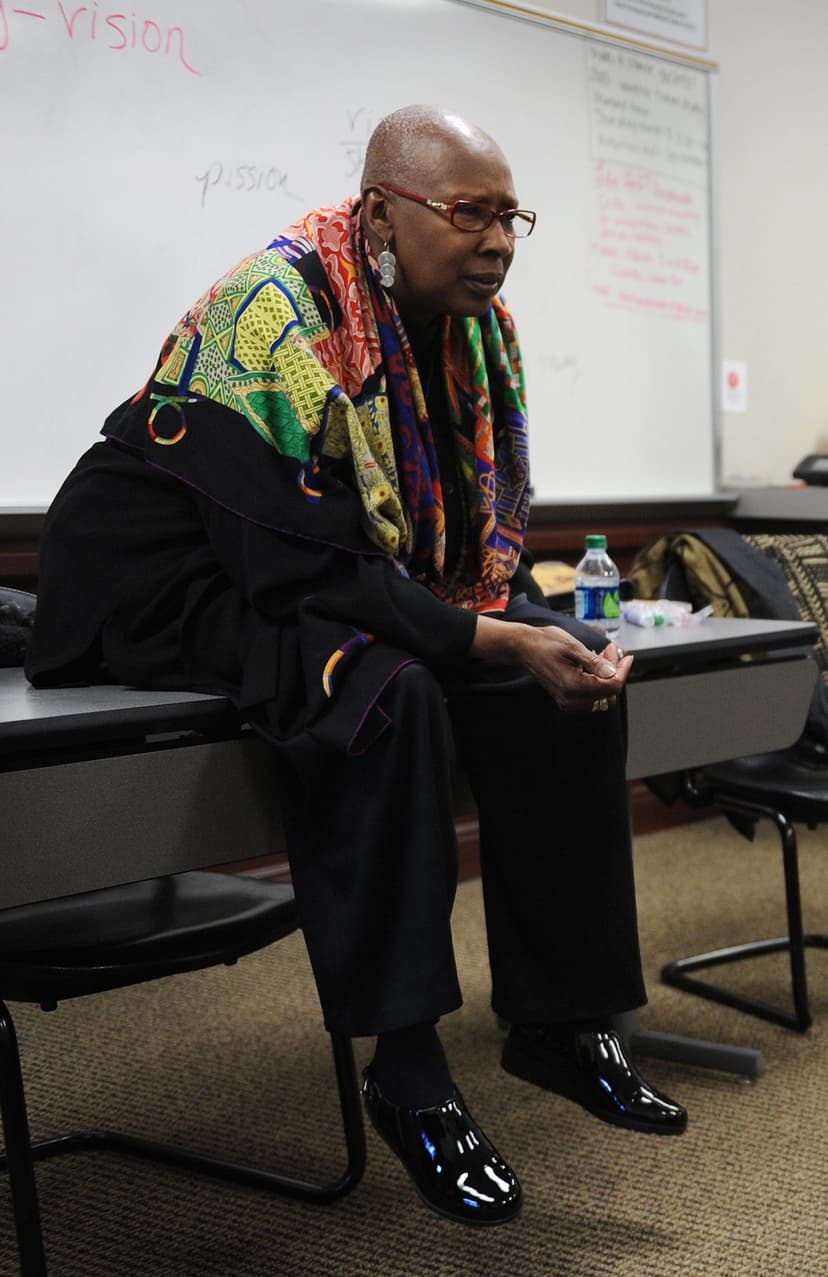
Judith Jamison
Revelation in Motion
Why They Matter
She carried forward Ailey's vision and proved that a single dancer's presence can transform an entire art form's visibility.
Watch
Ailey Up Close with Judith Jamison: Cry
AILEY
Jamison discusses dancing Ailey's Cry and provides first-party interpretive context.
Celebrating 50 Years of Alvin Ailey's Cry
AILEY
Connects Jamison's 1971 originating performance with the solo's continued life in the repertory.
Judith Jamison on Divining
AILEY
Jamison introduces her 1984 choreographic debut for the Ailey company in her own words.
Revelations from a lifetime of dance | Judith Jamison and the Alvin Ailey American Dance Theater
TED
Extended public account of Jamison's artistic philosophy alongside Ailey company performance.
Ailey dancers reflect on company's scrappy beginnings | Ailey | American Masters | PBS
American Masters PBS
Places Jamison's recollections within a documented institutional history of the Ailey company.
A Kennedy Center Tribute to Judith Jamison (1943-2024)
The Kennedy Center
Authoritative posthumous tribute from the institution that named her a 1999 Honoree.
Biography
Judith Jamison was born on 10 May 1943 in Philadelphia, Pennsylvania, and became one of modern dance's most commanding interpreters and institutional leaders. She began dancing as a child at the Judimar School of Dance under Marion Cuyjet, a formative teacher who offered serious ballet and modern-dance training to Black students when many institutions excluded them. Jamison's early education encompassed ballet, modern dance, Horton technique, Dalcroze eurhythmics and dance notation, alongside music studies that developed her exceptional rhythmic authority.
In 1964, Agnes de Mille brought Jamison to New York to perform in *The Four Marys* with American Ballet Theatre, placing her inside the city's professional dance network. Two years later, in 1965, Alvin Ailey invited her to join Alvin Ailey American Dance Theater, beginning a 15-year performing association that made her an international star. Ailey's stated principle that dancers should make choreography their own found an unusually forceful advocate in Jamison. Her physical amplitude, musical authority and dramatic directness made her a defining interpreter of his work, leaving strong impressions in *Revelations* and other repertory while her guest appearances with ballet companies challenged the narrow opportunities then available to Black women in concert dance.
In 1971, Ailey created the solo *Cry* on Jamison as a birthday gift for his mother and dedicated it to Black women. Jamison originated the role and through her interpretation—her choices of timing, attack, stillness, scale and emotional trajectory—transformed how the work would be understood and performed by generations to come. She left the Ailey company in 1980 and appeared on Broadway in *Sophisticated Ladies*, while her choreographic identity became increasingly visible. Her work *Divining*, created for Ailey in 1984, marked her debut as a choreographer for the company. She founded her own ensemble, the Jamison Project, in 1988, creating works including *Forgotten Time* (1989), *Hymn* (1993), *HERE…NOW.* (commissioned for the 2002 Cultural Olympiad), *Love Stories* (2004, with additional choreography by Robert Battle and Rennie Harris), and *Among Us (Private Spaces: Public Places)* (2009).
After Alvin Ailey died in 1989, Jamison became the company's second artistic director, a succession Ailey had asked her to undertake. During the next 21 years she preserved foundational repertory while bringing in additional choreographers and mentoring dancers. The company undertook two engagements in South Africa and a 50-city tour for its 50th anniversary. Under her stewardship the organization also secured a permanent Manhattan home, the Joan Weill Center for Dance. This institutional labor—fundraising, repertory planning, touring, artist development and public advocacy—proved as central to her legacy as her stage presence.
Jamison published the memoir *Dancing Spirit* in 1993, edited by Jacqueline Kennedy Onassis. She received a Kennedy Center Honor in 1999 and the National Medal of Arts in 2001. When she stepped down as artistic director in 2011, she remained artistic director emerita and continued advocating for the arts and the Ailey legacy. Jamison died in New York on 9 November 2024 after a brief illness. Her influence survives in film and repertory, in a company culture that treats the dancer as a thinking artist, in the choreographers and performers she nurtured, and in the durable institution she helped build.
Career Highlights
Born in Philadelphia on 10 May. Associated Press Associated Press
Performed in Agnes de Mille’s The Four Marys with American Ballet Theatre. Smithsonian Smithsonian
Joined Alvin Ailey American Dance Theater. AILEY AILEY
Originated Alvin Ailey’s solo Cry, created on her and dedicated to Black women. AILEY memorial AILEY memorial
Left the Ailey company and moved into Broadway and guest work, including Sophisticated Ladies. AILEY AILEY
Made her Ailey choreographic debut with Divining. AILEY memorial AILEY memorial
Established the Jamison Project. AILEY memorial AILEY memorial
Became Alvin Ailey American Dance Theater’s second artistic director and created Forgotten Time. AILEY AILEY
Published Dancing Spirit and created Hymn. AILEY AILEY
Received a Kennedy Center Honor. Kennedy Center Kennedy Center
Received the National Medal of Arts. National Endowment for the Arts National Endowment for the Arts
Concluded 21 years as artistic director and continued as artistic director emerita. AILEY AILEY
Legacy & Impact
Jamison changed American dance first through interpretation and then through leadership. Her originating performance in *Cry* made visible a Black woman's monumental scale, complexity and emotional authority without reducing performance to autobiography. As artistic director she demonstrated that stewardship is creative work: protecting an inheritance while commissioning new voices, developing dancers, widening access and building the infrastructure that lets an institution endure. Her career links Philadelphia's Black dance-training lineage, Ailey's humanist modernism, Broadway, choreography and arts administration—a breadth that makes her not merely a company icon but a model for how a dancer's knowledge can shape an entire cultural institution.


Explore More Legends
Discover the dancers, teachers, choreographers, and cultural icons who shaped how the world moves.
Keep the thread going
Dance history, technique, and the occasional rabbit hole — in your inbox. Thoughtful, infrequent, unsubscribe anytime.
Free. No spam. One click to leave.