Loïe Fuller
Legend of Dance
Why They Matter
Fuller matters because she made choreography inseparable from stage technology. She anticipated multimedia performance by treating light as time-based material and fabric as a mobile screen. Her work also altered the visual culture of an era: artists, designers and early filmmakers translated the Se
Watch
Jody Sperling / Time Lapse Dance
Jody Sperling / Time Lapse Dance
Shows a leading contemporary interpreter preserving and extending Fuller's stage logic
Clair de lune — Fuller-style solo
Jody Sperling / Time Lapse Dance
Clear contemporary demonstration of the physical coordination behind the visual effect
Loie Fuller Celebration Clip
Jody Sperling / Time Lapse Dance
Documents a sustained modern lineage of Fuller interpretation
A talk on Loïe Fuller and Auguste Rodin
Museum/institutional program
Places Fuller's dance within visual-art and Rodin contexts
Biography
Loïe Fuller was born Marie Louise Fuller on January 15, 1862, in Fullersburg, Illinois, and became one of the most influential figures in modern performance. Rather than pursuing conventional dance training, she accumulated practical stage experience through theater, melodrama, burlesque and touring work. A formative moment came in 1889 when she traveled to London to produce and star in *Caprice*; after the venture failed, her time at the Gaiety Theatre exposed her to the skirt-dance tradition that would become her vehicle for innovation.
In 1891, while performing in *Quack, M.D.*, Fuller discovered that moving fabric under changing light could create startling visual effects. She enlarged the skirt, suspended it from the neck and inserted wands to extend its reach, transforming the costume into both partner and projection surface. At New York's Casino Theatre, manager Rudolph Aronson named the act "The Serpentine." Its success was immediate, but so was imitation—her unsuccessful legal action against a replacement performer became an early landmark in the troubled history of choreographic copyright.
Fuller left New York for Paris in 1892 and became a sensation at the Folies-Bergère, where she would develop signature dances including the *Fire Dance*. There she expanded her lighting system with colored gels, coordinated instruments, below-stage illumination, magic-lantern projections and increasingly complex cueing. She did not simply dance in light; she composed fabric, color, music and motion as a single integrated event. Her stage image resonated with Symbolism and Art Nouveau, inspiring works by Toulouse-Lautrec, Jules Chéret, Raoul Larche and many other visual artists of the era.
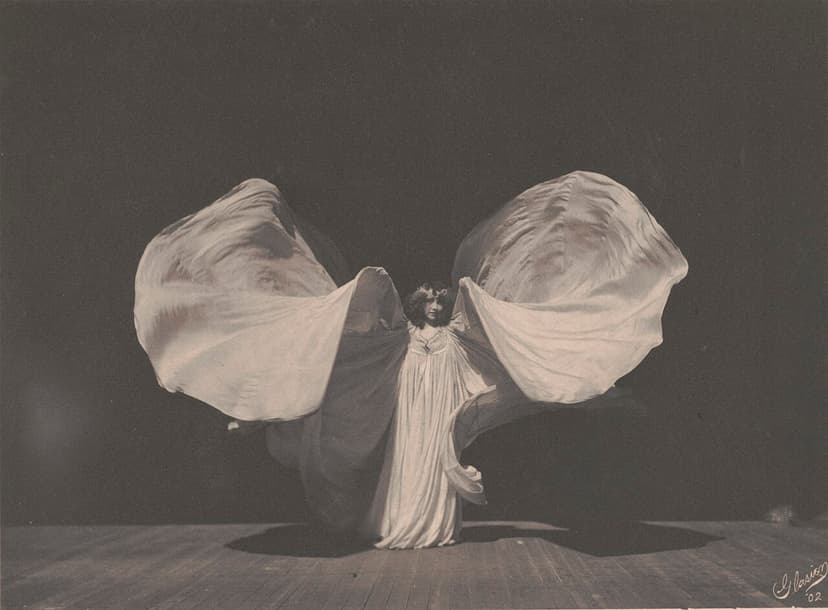
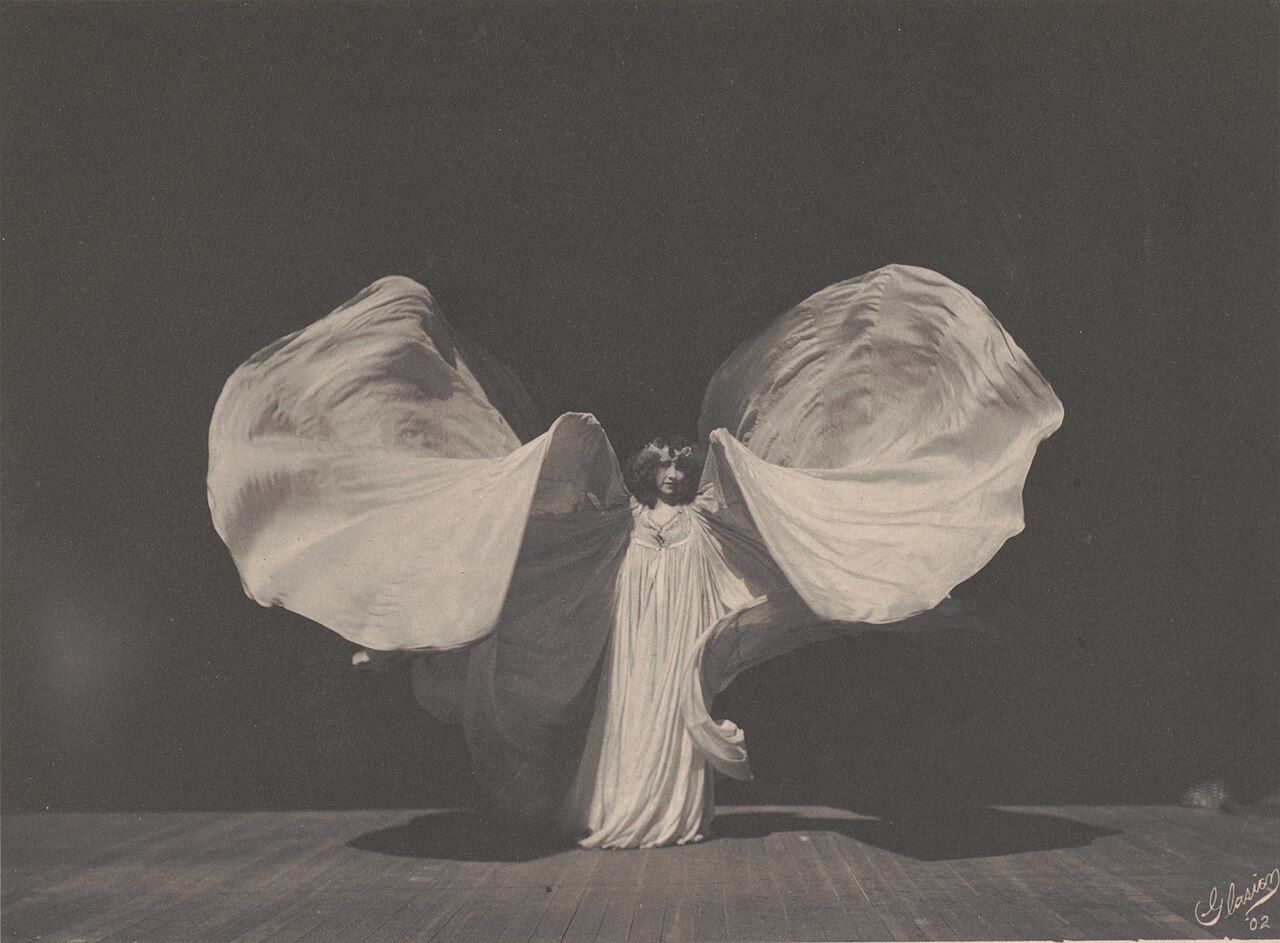
Fuller's work was grounded in engineering as much as artistry. She secured patents for stage devices and experimented with phosphorescence, mirrors and projections. Her body was often visually submerged inside the illuminated costume, producing forms that spectators read as butterflies, flowers, flames, waves or spirits. This apparent dematerialization of the performer made the work readily imitated; many surviving "serpentine dance" films feature other dancers rather than Fuller herself.
Beyond her own performances, Fuller promoted other artists and pursued ambitious projects. She supported Isadora Duncan's early European opportunities, directed a school and troupe of young dancers, and collaborated closely with her longtime partner Gabrielle Bloch, later known as Gab Sorère. In the 1920s, Fuller and Sorère experimented with filmmaking, including *Le Lys de la vie* (*The Lily of Life*, 1921). Fuller died in Paris on January 1, 1928; Sorère continued the troupe for several years, but the absence of a continuous school and the ubiquity of imitations helped obscure her direct authorship in the decades that followed.
Career Highlights
Born January 15 in Fullersburg, Illinois. American National Biography
Traveled to London for Caprice and encountered the Gaiety Theatre skirt-dance milieu. Time Lapse Dance
Developed the fabric-and-light movement experiment that became the Serpentine Dance. Time Lapse Dance
Performed the Serpentine in New York, then relocated to Paris and achieved major success at the Folies-Bergère. Time Lapse Dance
Lost Fuller v. Bemis, a consequential early dispute over protection for nondramatic dance. Time Lapse Dance
Became the subject of Henri de Toulouse-Lautrec's color lithograph Miss Loïe Fuller. The Met
Expanded theatrical systems using coordinated colored light, below-stage illumination, projection, mirrors and extended silk costumes. National Portrait Gallery
Operated her own theater at the Paris Exposition, a milestone in her international visibility. The Met
Sat for Frederick Whitman Glasier's now-public-domain portrait, preserved by the Library of Congress. Wikimedia Commons
Founded a school and toured with young performers known as the “Muses”. Time Lapse Dance
Extended her practice into cinema with Le Lys de la vie. Time Lapse Dance
Died January 1 in Paris. EBSCO
Gallery
Legacy & Impact
Fuller remains essential because she made choreography inseparable from stage technology, anticipating multimedia performance by decades. She treated light as time-based material and fabric as a mobile screen, questions that remain urgent in contemporary practice. Her visual innovations shaped Art Nouveau and early cinema, while the continuing revival of Fuller-inspired work shows that her central insight—how to compose body, costume, illumination and machinery into a single event—transcends historical period.


Explore More Legends
Discover the dancers, teachers, choreographers, and cultural icons who shaped how the world moves.
Keep the thread going
Dance history, technique, and the occasional rabbit hole — in your inbox. Thoughtful, infrequent, unsubscribe anytime.
Free. No spam. One click to leave.