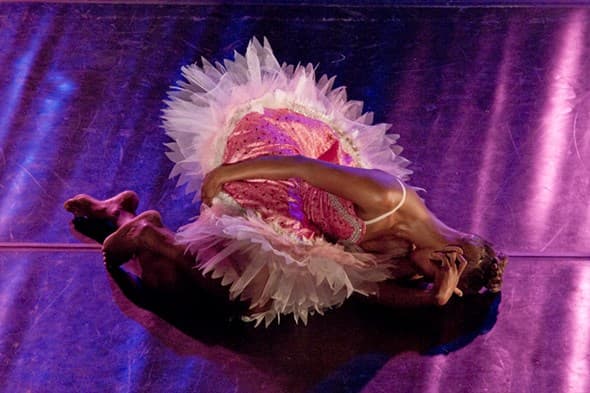
Mamela Nyamza
Legend of Dance
Why They Matter
Nyamza matters because she turns classical technique into a site of argument. Her work gives Black, queer and township experience formal authority while insisting that autobiography and political history are choreographic structures, not supplementary themes. She also shows how deconstruction can…
Styles Mamela Nyamza shaped
Each one links to the style’s own page — its origins, music, tempo and video.
Watch
Hatched Ensemble
Mercat de les Flors
Institutional presenter documentation of the ensemble work
Hatched Ensemble Festival TransAmériques
Festival TransAmériques
Useful artist/presenter framing of the work's politics
Hatched original archive
performance archive
Potential comparison point between the 2008 solo and ensemble remake
Biography
Mamela Nyamza is a South African choreographer, dancer, performance artist and educator whose work uses the ballet-trained Black queer body to dismantle classical authority and stage South African histories of gender, violence, race and belonging. Born in 1976 in Gugulethu, Cape Town, Nyamza began ballet training at Zama Dance School around age eight and later earned a National Diploma in Ballet at Pretoria Dance Technikon. In 1998 she received a scholarship to study at the Alvin Ailey American Dance Center in New York, after which she performed with various companies and in commercial productions.
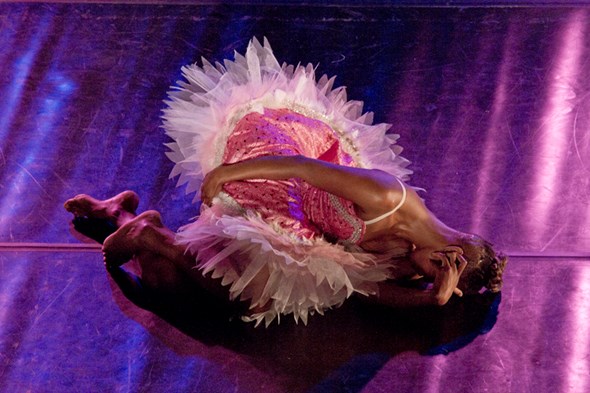
Nyamza's artistic practice does not reject her classical training but rather exposes its assumptions. Pointe shoes, tutus and canonical music become materials through which she asks who is permitted to embody ballet and whose stories remain outside it. The 2008 solo *Hatched* established this signature approach. In this work and subsequent pieces including *Isingqala*, *Amafongkong*, *The Meal*, *19-born-76-rebels*, *I Stand Corrected*, *Black Privilege* and *GroundeD*, Nyamza investigates gender, sexuality, racial hierarchy, domestic roles and South African political memory through movement that draws on contemporary, gumboot and other African practices alongside ballet.
In 2011 Nyamza received the Standard Bank Young Artist Award for Dance. She has worked internationally as performer, maker and curator, expanding her reach through the *Hatched Ensemble*, which reimagined her early solo for ten performers and carried its critique of ballet into a collective frame. International presentations in 2024, including a major Dance Umbrella showing, drew substantial critical attention.
In July 2026 La Biennale di Venezia awarded Nyamza the Silver Lion for Dance, recognizing how her bodily thought draws on collective memory and histories of gender, society and politics. The honor acknowledged an established body of work rather than a single production, marking her as a major voice in contemporary dance.
Career Highlights
Born in Gugulethu, Cape Town. La Biennale
Received a scholarship to study at the Alvin Ailey American Dance Center. Zeitz MOCAA
Received the FNB Dance Umbrella award for outstanding female contemporary performance for The Dying Swan, as reported in institutional biographies.
Created the solo Hatched, the work La Biennale identifies as her international breakthrough.
Named Standard Bank Young Artist for Dance.
Created The Meal, later documented at Infecting the City 2013.
Created 19-born-76-rebels, linking personal birth-year history to the Soweto uprising.
Featured Artist at the National Arts Festival, a notable recognition for dance.
Toured Hatched Ensemble, including a major Dance Umbrella presentation reviewed by The Guardian.
Received the Silver Lion for Dance at La Biennale di Venezia on 21 July.
Gallery
Legacy & Impact
Nyamza matters because she turns classical technique into a site of argument rather than display. Her work gives Black, queer and township experience formal choreographic authority while insisting that autobiography and political history are structural principles, not supplementary themes. She demonstrates how deconstruction can remain theatrically precise, sensuous and accessible—repeating familiar classical signs until their racial and gender assumptions become visible.


Explore More Legends
Discover the dancers, teachers, choreographers, and cultural icons who shaped how the world moves.
Keep the thread going
Dance history, technique, and the occasional rabbit hole — in your inbox. Thoughtful, infrequent, unsubscribe anytime.
Free. No spam. One click to leave.