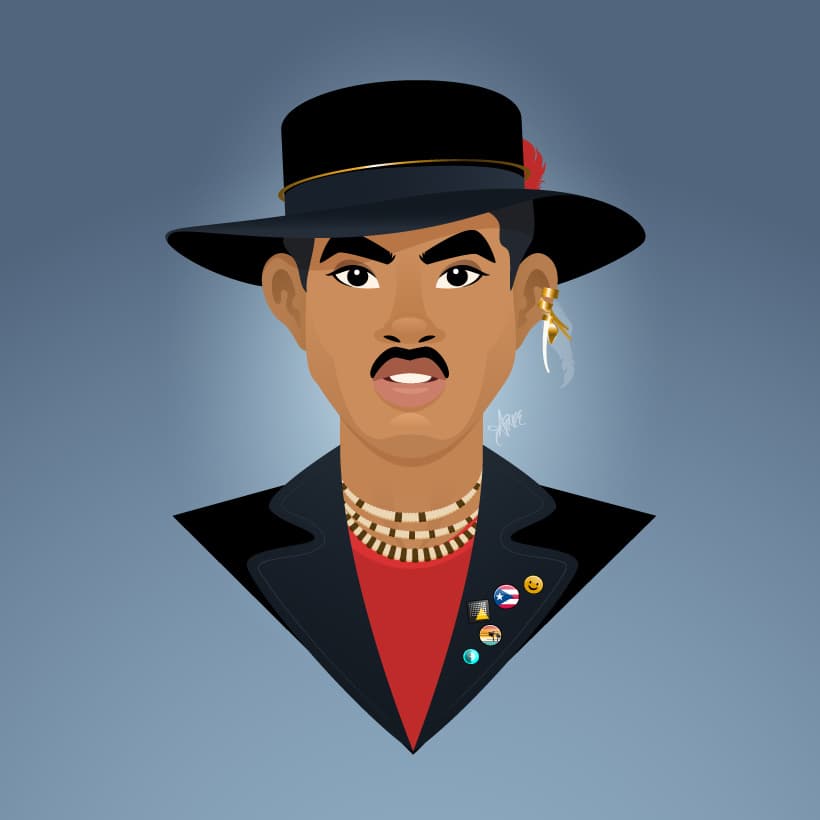
Shabba Doo
Legend of Dance
Why They Matter
Shabba-Doo matters because he made street-dance virtuosity legible across several systems at once: club competition, television variety, theatrical troupe work, pop choreography and narrative film. His stardom in Breakin’ showed that a street dancer could carry character, style and story on a commer
Biography
Adolfo Gutierrez Quiñones, known professionally as Shabba-Doo, grew up in Chicago's Cabrini-Green housing development in a Black and Puerto Rican family. As a child and teenager, he developed a reputation in neighborhood dance battles, absorbing music from James Brown to Tito Puente. When his mother moved the family to California in 1971, Quiñones pursued connections to *Soul Train*, which had just entered national syndication, as a pathway into professional performance.
In 1973, Quiñones joined Don Campbell and fellow *Soul Train* dancers in forming the Lockers. The troupe's theatrical locking combined rhythmic freezes, hand slaps, kicks, footwork, comic character and acrobatics. Television and concert appearances brought this club- and street-derived form to audiences far beyond its Los Angeles base. Quiñones experimented with stage names before settling on Shabba-Doo and became one of the group's most camera-ready storytellers. He left the Lockers in 1976 but continued moving across concert, screen and commercial performance.
His widest public breakthrough came in 1984 as Orlando "Ozone" in *Breakin'*, released on 4 May alongside Lucinda Dickey and Michael "Boogaloo Shrimp" Chambers. He returned as Ozone in *Breakin' 2 Electric Boogaloo*, released on 19 December the same year. The films used real street dancers in prominent roles and made Quiñones an internationally recognizable face of the era's street-dance boom.
Quiñones continued as a dancer and choreographer for major recording artists. He choreographed Madonna's 1987 *Who's That Girl* tour and later choreographed Three 6 Mafia's performance of "It's Hard out Here for a Pimp" at the 78th Academy Awards in 2006. His film and television work also included *Xanadu*, *Tango & Cash* and *Lambada*. In 1993, he directed *Rave, Dancing to a Different Beat*, extending his authorship behind the camera.
In later years, Shabba-Doo taught private lessons and master classes, developed the Funk-Shway dance-fitness program and directed the documentary *The Kings of Crenshaw* in 2017. He died in Los Angeles on 29 December 2020 at age 65. His career remains central to understanding how street-dance artists negotiated television, cinema, choreography, authorship and professional recognition.
Career Highlights
Born on 11 May in Chicago, Illinois. The Washington Post The Washington Post
Moved with his family to California and pursued opportunities connected to the newly nationally syndicated Soul Train. The Washington Post The Washington Post
Helped form the Lockers with Don Campbell and other Soul Train dancers. The Washington Post The Washington Post
Left the Lockers and continued into concert, television and film work. The Washington Post The Washington Post
Starred as Ozone in Breakin’, released 4 May. AFI Catalog AFI Catalog
Returned as Ozone in Breakin’ 2 Electric Boogaloo, released 19 December. AFI Catalog AFI Catalog
Choreographed Madonna’s Who’s That Girl tour. The Washington Post The Washington Post
Directed Rave, Dancing to a Different Beat. The Washington Post The Washington Post
Choreographed Three 6 Mafia’s performance at the 78th Academy Awards. The Washington Post Caution: some retrospectives incorrectly label the ceremony 2007. The Washington Post
Directed the street-dance documentary The Kings of Crenshaw. The Washington Post The Washington Post
Died on 29 December in Los Angeles at age 65. Chicago Sun-Times Chicago Sun-Times
Gallery

Shabba Doo on screen
Films and television featuring Shabba Doo, with the sequences we have indexed.
Poster artwork from TMDB.
 This site uses TMDB and the TMDB APIs but is not endorsed, certified, or otherwise approved by TMDB.
Legacy & Impact
Shabba-Doo matters because he made street-dance virtuosity legible across several systems at once: club competition, television variety, theatrical troupe work, pop choreography and narrative film. His stardom in *Breakin'* showed that a street dancer could carry character, style and story on a commercial movie screen, while his teaching and later directing asserted that dancers could control how the culture was framed. His legacy is strongest when situated among collaborators—including Don Campbell, the Lockers, Toni Basil, Michael Chambers and the many dancers credited in the *Breakin'* films—rather than reduced to a lone-genius origin story.

Explore More Legends
Discover the dancers, teachers, choreographers, and cultural icons who shaped how the world moves.
Keep the thread going
Dance history, technique, and the occasional rabbit hole — in your inbox. Thoughtful, infrequent, unsubscribe anytime.
Free. No spam. One click to leave.