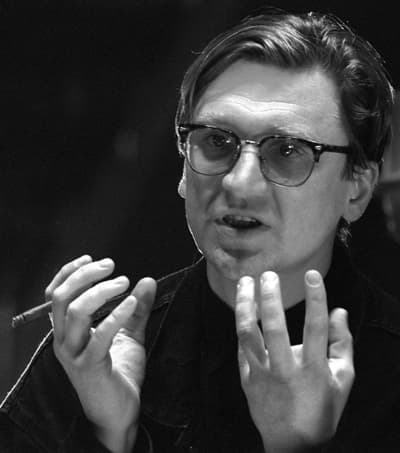
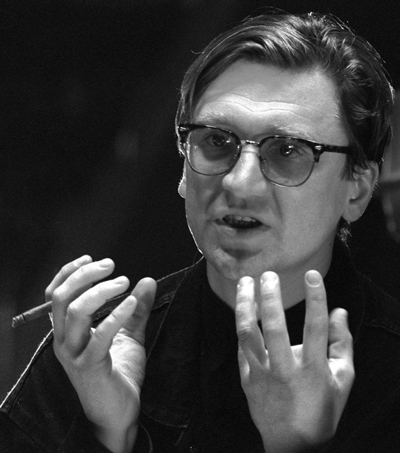
Valentin Gneushev
Legend of Dance
Why They Matter
Gneushev matters to dance history because he made choreographic thinking indispensable to circus dramaturgy without dissolving circus into dance. His best-known acts preserved the danger, apparatus, and demonstrable skill of traditional circus, yet organized bodies in space through musical phrasing,
Biography
Valentin Alexandrovich Gneushev was a Russian circus director, choreographer, and movement innovator who reshaped the visual language of contemporary circus by joining elite acrobatic technique to tightly composed theatrical elements. Born in Nizhny Tagil in 1951, Gneushev entered circus through performance rather than family tradition. As a teenager he performed in an amateur circus, and during the 1970s he worked in Giedrius Mackevičius's Theatre of Plastic Drama, where he developed foundational skills in mime and deliberately shaped stage movement. He graduated from Moscow's State School of Circus and Variety Arts in 1978 after studying clowning, then completed a degree in circus direction at GITIS in 1986.
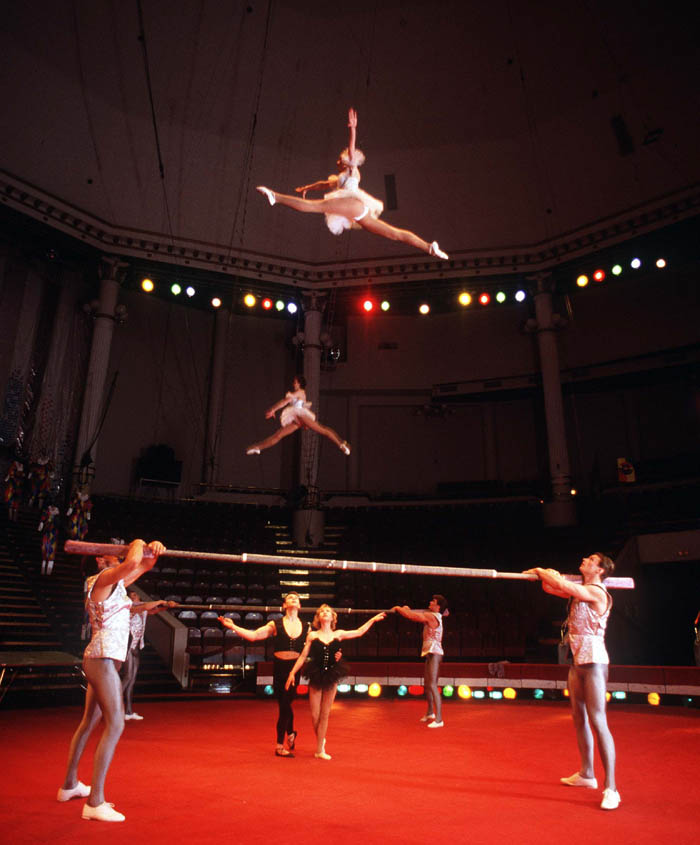
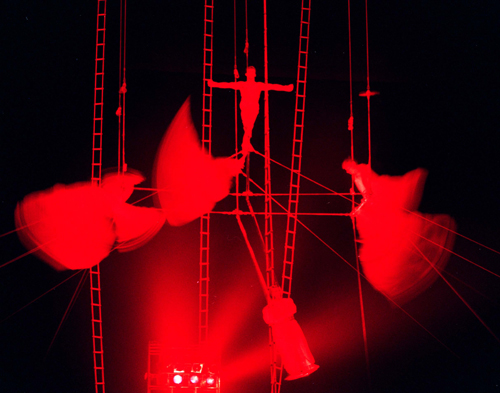
From the early 1980s onward, working in Sergey Kashtelyan's Moscow circus studio, Gneushev developed a distinctive method that treated each act as a complete miniature theatrical world. Apparatus and virtuosity remained essential, but gesture, silhouette, rhythm, music, costume, and character were organized with choreographic intention. His aerial ensemble *Cranes* and Vladimir Tsarkov's juggling characterization *The Red Harlequin*—which won the Gold Medal at the Festival Mondial du Cirque de Demain in Paris in 1986—brought international attention. Over the following years, acts and performers developed through his workshop circulated through Russian state circus companies, international festivals, Cirque du Soleil, and Las Vegas, including aerialist Vladimir Kekhayal.
In 1991, *Moscow Circus—Cirk Valentin* reached Broadway's Gershwin Theatre as an animal-free theatrical presentation. Gneushev served as artistic director of the production, which brought together acts developed under his artistic direction with choreography by Pavel Briun, staging and book by Bob Bejan, and music by Bobby Previte. During the 1990s, Gneushev moved his experimental workshop to the Moscow Circus on Tsvetnoy Boulevard, where he worked with Yuri Nikulin and became chief director in 1996. He staged productions including *Fair of Miracles* and expanded his practice into spoken theatre, where he contributed plastic and movement direction, and into pedagogy, training future circus directors and coaching artists whose work demanded both technical mastery and sharply legible stage imagery.
Gneushev died in Moscow on 11 March 2026, aged seventy-four. The Russian State Circus Company memorialized him as an influential artist credited with more than forty original circus acts, emphasizing the expressive plasticity and philosophical dimension of his productions.
Career Highlights
Performed in Giedrius Mackevičius's Theatre of Plastic Drama, developing experience in mime and movement-led theatre. Circopedia Circopedia
Graduated from the State School of Circus and Variety Arts in Moscow after studying clowning. Circopedia Circopedia
Joined Sergey Kashtelyan's Moscow circus studio as a director and began developing acts through an increasingly distinctive theatrical method. Circopedia Circopedia
Contributed movement direction and choreography to the aerial ensemble Cranes and developed The Red Harlequin for juggler Vladimir Tsarkov. Circopedia Circopedia
Tsarkov's Red Harlequin received the Gold Medal at the Festival Mondial du Cirque de Demain in Paris; Gneushev also completed his circus-directing degree at GITIS. Circopedia Circopedia
Created an aerial act for Vladimir Kekhayal, who subsequently performed with Cirque du Soleil's Nouvelle Expérience. Circopedia Circopedia
Served as artistic director of Moscow Circus—Cirk Valentin at Broadway's Gershwin Theatre. Internet Broadway Database Internet Broadway Database
Moved his experimental workshop to the Moscow Circus on Tsvetnoy Boulevard. Circopedia Circopedia
Became chief director of the Moscow Circus on Tsvetnoy Boulevard and staged Fair of Miracles. Circopedia Circopedia
Received the title Honored Art Worker of the Russian Federation. Russian-language biographical record Russian-language biographical record
Died in Moscow on 11 March; the Russian State Circus Company memorialized him as an influential innovator and creator of more than forty acts. Russian State Circus Company Russian State Circus Company
Gallery
Legacy & Impact
Gneushev matters to contemporary dance and circus because he made choreographic thinking indispensable to circus dramaturgy without dissolving circus into dance. His acts preserved the danger, apparatus, and demonstrable skill of traditional circus while organizing bodies in space through musical phrasing, sculptural groupings, gesture, costume, and character. That synthesis—treating individual acts as short theatre pieces with complete visual authorship—provided a model for the director-led, visually sophisticated circus that became internationally prominent at the end of the twentieth century and continues to influence how circus artists and directors approach composition today.


Explore More Legends
Discover the dancers, teachers, choreographers, and cultural icons who shaped how the world moves.
Keep the thread going
Dance history, technique, and the occasional rabbit hole — in your inbox. Thoughtful, infrequent, unsubscribe anytime.
Free. No spam. One click to leave.