Teacher · Syllabus / System Builder · Competitive Champion · Cultural Preserver
Walter Laird
The Latin Bible Author
Why They Matter
His codification of Latin technique created the technical foundation that all competitive Latin dancers worldwide study, standardizing the art form for generations.
Known For
Styles Walter Laird shaped
Each one links to the style’s own page — its origins, music, tempo and video.
Biography
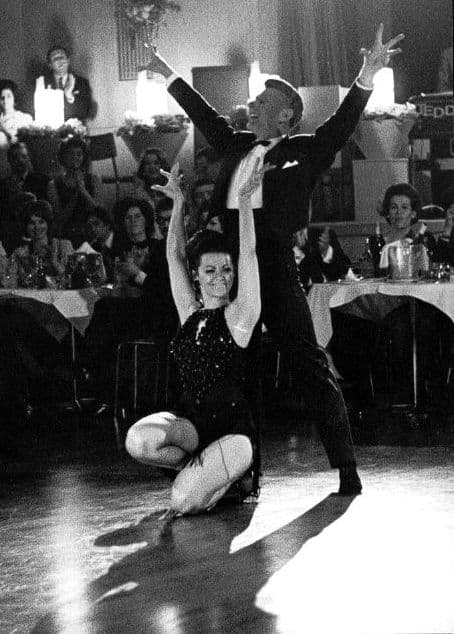
Walter William Laird was a British dancer, teacher, coach and technical author who shaped International Latin dancing through competition, systematic analysis and institutional leadership. Born on 26 July 1920 in Leyton, Essex, Laird began dancing with his sister Joan while still at school, winning a local jitterbug championship in 1936. He studied electronic engineering at technical college—an education that would distinguish his mature approach to dance technique, combining competitive intuition with analytical precision about weight, timing and body action.
During the Second World War, Laird worked at the Royal Aircraft Establishment and later remained with the Ministry of Aviation until 1980. There he met Andé Lyons, who became his early professional partner in the Ballroom and Standard tradition. By the early 1960s, Laird formed the partnership that defined his competitive legacy with Lorraine Reynolds, later known as Lorraine Rohdin. Together they won the World Professional Latin championship three consecutive times—1962, 1963 and 1964—establishing themselves as dancers of significant technical authority.
Laird's competitive career and technical authorship developed in parallel. His *Technique of Latin Dancing* first appeared in 1961, before his first world title. Rather than preserving a fixed snapshot, he revised the work repeatedly as the field changed. The influential 1972 edition expanded the analysis and adopted a tabular presentation that could separate foot position, timing, alignment and the specific action used. This structural approach encouraged dancers to understand that two figures sharing steps could look different because their body mechanics and musical intention differed.
As a teacher and coach, Laird worked across generations with champions including Peter Maxwell, Lynn Harman, Donnie Burns, Gaynor Fairweather, Espen Salberg, Allan Tornsberg, Jukka Haapalainen and Sirpa Suutari. Lorraine Reynolds and later Julie Laird were active collaborators in the development and demonstration of the technique, shaping the system alongside him. Laird also served the profession organizationally: he was secretary and later president of the Ballroom Dancers' Federation during a period of significant growth, eventually elevated to honorary vice-president. He was a Fellow and examiner of the International Dance Teachers' Association. His perspective on dance was rooted in artistry rather than sport; *The Guardian* recorded his opposition to Olympic inclusion on the grounds that dance belonged to the arts.
Laird died on 30 May 2002, aged eighty-one. Julie Laird completed the commemorative edition that followed. The technical lineage has continued far beyond its author: the International Dance Teachers' Association released an eighth edition in 2022 and identifies the Laird Technique as required reading for candidates and trainers working toward professional examinations. The World Dance Council's published examination syllabus likewise recognizes the Walter Laird Technique. This continuing institutional use is the strongest evidence for his legacy—his name remains attached not only to historical ideas but to a living, revised pedagogical system.
Career Highlights
Walter William Laird was born on 26 July and raised or educated in Leyton, Essex. Source Source
He won a jitterbug championship in Leyton while still a schoolboy. Source Source
During the Second World War he worked at the Royal Aircraft Establishment, where he met his early professional partner Andé Lyons. Source Source
The first edition of The Technique of Latin Dancing was published. Source Source
Laird and Lorraine Reynolds won their first World Professional Latin championship, held in Australia. Source Source
The pair retained the World Professional Latin title; archival footage places them at the center of that year’s championship. Source Source
They won a third consecutive World Professional Latin championship and retired from competition later that year. Source Source
A major new edition of Laird’s technique work introduced a more systematic tabular analysis of Latin movement. Source Source
He retired from his parallel government career at the Ministry of Aviation while continuing his dance work. Source Source
A supplement extended the technique to additional figures associated with the British Dance Council appendix. Source Source
Laird died on 30 May 2002; Julie Laird completed the posthumous commemorative edition. Source Source
IDTA issued an eighth edition, confirming that the Laird system remained active in contemporary professional training. Source Source
Legacy & Impact
Walter Laird matters because he linked elite performance, scientific inquiry and reproducible teaching language. Three consecutive world titles established that his ideas were tested in competition, but the book gave those ideas reach across countries and generations. By charting movement in analyzable components and revising the charts as the dancing evolved, he helped make International Latin teachable through a systematic framework. The continued use of the Laird Technique by IDTA and WDC is more meaningful than historical titles: it shows his technical framework became infrastructure for examinations, coaching and syllabus development.


Explore More Legends
Discover the dancers, teachers, choreographers, and cultural icons who shaped how the world moves.
Keep the thread going
Dance history, technique, and the occasional rabbit hole — in your inbox. Thoughtful, infrequent, unsubscribe anytime.
Free. No spam. One click to leave.