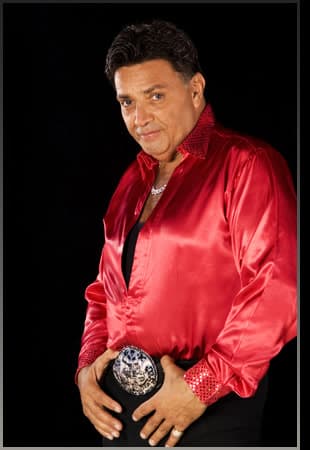
Teacher · Innovator · Syllabus / System Builder · Social Dance Icon
Eddie Torres
The Mambo King
Why They Matter
He systematized mambo/salsa technique in a way that could be taught and transmitted, shaping how millions dance salsa worldwide.
Known For
Styles Eddie Torres shaped
Each one links to the style’s own page — its origins, music, tempo and video.
Watch
GRAMMY.com: Mambo King Eddie Torres & Eddie Torres Jr.
Recording Academy / GRAMMYs with International Salsa Museum
First-person discussion of roots, Tito Puente, preservation and intergenerational transmission.
Eddie Torres Interview: Vision 1982 — Part 1
Eddie Torres Mambo On2 official channel
Preserves Torres's own framing of his early teaching and company ambitions.
Eddie Torres Interview — Part 1
Eddie Torres Mambo On2 official channel
Offers direct testimony useful for checking biographical and teaching claims.
Eddie Torres Interview — Part 2
Eddie Torres Mambo On2 official channel
Continues Torres's direct account and should be reviewed alongside Part 1.
Llévatela — Eddie Torres & His Mambo Kings Orchestra
Useful for manual listening because a rights-holder/distributor audio is available; do not assign rhythm before review.
To Be With You — Eddie Torres & His Mambo Kings Orchestra
Useful for manual listening because a rights-holder/distributor audio is available; do not infer bolero from the title.
Biography
Eddie Torres, born July 3, 1950, in New York City and raised in Spanish Harlem by Puerto Rican parents, became one of salsa's most influential teachers and the architect of a systematized New York mambo method known as Mambo On2. At age twelve, after returning from two years in Puerto Rico, Torres resolved to learn to dance following a formative encounter with Eddie Palmieri's "Azúcar Pa' Ti"—a moment that rooted his later teaching system in lived experience rather than inherited mastery. Beginning around age fifteen, he studied dancers at the Hunts Point Palace in the Bronx, learning through observation and repeated practice alongside mentors including Freddy Rios, the Cha Cha Aces, Tommy Johnson, and Augie and Margo, connecting his development to the older Palladium-era generation.
In teaching other dancers, Torres recognized that his own phrasing broke direction on the second beat, a discovery that became the foundation of his method. From roughly 1975 to 1986, the Corso nightclub served as his principal artistic home, where he danced to bands led by Tito Puente and Machito. Puente encouraged Torres to transform his social-dance knowledge into choreographed performance, and Torres responded by creating pieces including "El Cayuco" and "Palladium Days" while training and performing with Maria Torres, who became his principal partner, colleague, and co-teacher. Their 1980 appearance with Tito Puente at the New York Coliseum's Latin Expo, performing as the Tito Puente Dancers, helped establish a concert-stage vocabulary from mambo practices rooted in ballrooms and nightclubs.
Torres and Maria worked with Puente for more than two decades, dancing, choreographing, and teaching. In 1992, they performed Mambo On2 at Ford's Theatre for President George H. W. Bush to Puente's "Ran Kan Kan." His work extended into music as well: in 1994, Torres formed Eddie Torres & His Mambo Kings Orchestra and released the album *Dance City*, produced by Oscar Hernández, crediting himself as vocalist and composer. The project reflected his integrated vision of dancing and music—instruction, choreography, live-band performance, and recording all belonged to the same mambo practice.
Over subsequent decades, Torres became recognized internationally as a teacher and company director. The International Salsa Museum credits him with popularizing Mambo On2 and preserving a connection to New York's mambo heritage. His legacy is explicitly intergenerational: his son Eduardo "Eddie" Torres Jr. continues the family's work, and Torres Sr.'s official site maintained active class information as of July 2026. Yet this lineage cannot obscure Maria's role—the documented career is a partnership as well as an individual achievement. A 1991 New York Public Library oral-history interview captured Torres discussing his background and the development of mambo from the Palladium era onward, creating an important archival record of his perspective on the form's history.
Career Highlights
After returning to New York from Puerto Rico, Torres resolved to learn to dance following a formative encounter with Eddie Palmieri’s “Azúcar Pa’ Ti.” Official biography
At about fifteen, he began studying dancers at the Hunts Point Palace and learning through observation and practice. Official biography
The Torres family legacy chronology dates his formalized mambo syllabus to this year. Caution: the stronger “first official syllabus” claim is not independently verified. Mambo Royalty
The Corso became his principal nightclub base during an approximately eleven-year period of dancing to bands including Tito Puente and Machito. Official biography
Eddie and Maria Torres debuted with Tito Puente at the New York Coliseum Latin Expo as the Tito Puente Dancers. Official biography
“Palladium Days” received a standing ovation at Madison Square Garden, according to the official Torres biography. Official biography
The New York Public Library recorded Torres for its Dance Oral History Project, preserving his account of his background and mambo’s development. NYPL catalog
He performed Mambo On2 at Ford’s Theatre for President George H. W. Bush to Tito Puente’s “Ran Kan Kan.” Mambo Royalty
Eddie Torres & His Mambo Kings Orchestra released the twelve-track album Dance City. Apple Music
The Recording Academy and International Salsa Museum presented a documented father-and-son discussion of Torres’s roots, work with Puente and approach to preserving and evolving salsa. Recording Academy
His official site continued to publish New York in-person class information, confirming an active teaching presence as of July 28. Official site
Legacy & Impact
Eddie Torres matters because he made a historically rooted New York mambo practice teachable at global scale. His classes, company, staged repertory, recorded instruction, and sustained collaboration with Tito Puente gave dancers worldwide a shared vocabulary for timing, partner work, and performance. The achievement is codification and transmission rather than invention. It emerges from a network that includes Maria Torres, Puente, older Palladium dancers, company members, musicians, and later teachers. Contemporary dancers continue to study the Eddie Torres On2 method and its principles of musicality, weight organization, and partner pathways.


Explore More Legends
Discover the dancers, teachers, choreographers, and cultural icons who shaped how the world moves.
Keep the thread going
Dance history, technique, and the occasional rabbit hole — in your inbox. Thoughtful, infrequent, unsubscribe anytime.
Free. No spam. One click to leave.