International Samba
Also known as: International Samba, Ballroom Samba
- Origin
- Brazil
- Era
- 1890–1920
- Rhythm
- 2/4 time
- Tempo
- 100-104 BPM
- Character
- Rhythmic, sensual, bouncy, celebratory
History & Cultural Context
Samba encompasses a family of Brazilian musical genres and dance forms rooted in African rhythmic traditions brought by enslaved peoples, particularly from Angola and the Congo. In its social form (samba no pe), it features rapid hip movements and quick footwork to syncopated 2/4 rhythms. The ballroom version (samba de gafieira) developed in Rio's dance halls, incorporating partner work influenced by European dances. Samba's most visible expression is the Carnival parade, where samba schools perform elaborate choreography with thousands of dancers. International Standard Samba, codified for competition, emphasizes bounce action, hip rotation, and characteristic rhythmic patterns like the samba walk and volta.
Cultural Significance
Samba represents the African-Brazilian cultural synthesis and remains the heartbeat of Brazilian Carnival celebrations. The dance was born in the samba schools of Rio's poor neighborhoods and rose to become a symbol of Brazilian national identity. Samba's acceptance into international ballroom competition during the 1950s-1960s marked a significant shift toward Latin American dance recognition. Today, samba competitions during Carnival and ballroom samba competitions represent two distinct but equally vibrant traditions.
Characteristic Movement & Technique
International Samba is characterized by the distinctive samba bounce action that creates a rhythmic, bouncy quality throughout the dance. The movement emphasizes the 'samba bounce,' created through vertical motion in the body as dancers shift weight and flex their knees with the musical rhythm. The dance features rapid, traveling movement with dancers covering significant ground as they move around the floor. The footwork is executed in a 'bounce' rhythm with specific step patterns that create the characteristic samba rhythm. The movement includes characteristic figures like the 'volta' (rotation), the 'samba walks,' and various traveling patterns. The upper body remains relatively upright while the legs and hips execute the distinctive samba bounce action. The overall movement quality is joyful, energetic, and celebratory, reflecting samba's origins in Brazilian Carnival traditions.
Partnering Dynamics
International Samba is danced in both closed and open positions with frequent transitions between positions. The partnership is characterized by energetic connection and coordinated movement despite positional changes. The leader guides the follower through directional changes, rhythm patterns, and positional transitions using frame pressure and clear lead signals. Partners work in close coordination to maintain the distinctive samba bounce rhythm while managing positional changes and choreographic patterns. The follower responds quickly to lead signals while maintaining independent expression of the samba bounce action. Partners maintain connection through frame contact when in closed position and through hand holds and eye contact in open positions. The partnership is characterized by synchronized timing, clear leading and following, and the ability to maintain energetic movement throughout the dance.
Competitive Context
International Samba is one of the five International Latin dances competed at all levels of ballroom competition under WDSF and WDC governance. Competition occurs at amateur preliminaries through professional world championships. Dancers progress through bronze, silver, and gold levels with increasingly complex choreography. International Samba is known for joyful, energetic competition performances that showcase the distinctive bounce action and rapid movement. Professional Samba competition features dynamic performances with complex choreography and creative interpretation of the samba rhythm. Judges evaluate technique, choreography, timing, partnership, and presentation. The dance remains popular in professional exhibition contexts where performers create celebratory, theatrical presentations.
Regional Variations
While International Samba maintains standardized technique, regional variations exist in choreographic interpretation and stylistic emphasis. Brazilian dancers, reflecting samba's cultural origins, sometimes emphasize more pronounced hip motion and Brazilian stylistic elements. European dancers have developed approaches emphasizing the bounce action and traveling patterns with different choreographic emphasis. Different schools vary in how they construct choreography and manage the challenging bounce rhythm at competitive tempo. Professional exhibition Samba often incorporates contemporary Brazilian music and theatrical elements while maintaining core Samba technique. Some contemporary performers explore cultural interpretation and artistic expression that expand traditional boundaries while maintaining recognizable Samba rhythm.
Common Misconceptions
A common misconception is that Samba is primarily a hip-focused dance; in reality, the hip motion results from proper bounce action and footwork rather than intentional hip movement. Another misconception is that Samba is easier than other Latin dances because of its celebratory nature; in fact, the distinctive bounce rhythm at competitive tempo requires significant technical skill and conditioning. Some people incorrectly believe that Samba's rapid movement requires excessive speed; control and musicality matter more than absolute velocity. A frequent misconception is that Samba is primarily a women's dance; the dance requires equal skill and strength from both partners. Finally, people often incorrectly believe that Samba is historically a social dance without competitive significance; International Samba is a major competitive ballroom dance with sophisticated technique and choreography.
Signature Figures
- Basic Bounce Step
- Travelling Samba Step
- Samba Whisks
- Turning Samba
- Bounce Fallaway
Notable Codifiers
- Imperial Society of Teachers of Dancing
- Brazilian carnival masters
- Walter Laird
- Donnie Burns
- ISTD (Imperial Society of Teachers of Dancing)
- WDSF (World DanceSport Federation)
- WDC (World Dance Council)
International Samba Playlists
Curated collections on the LODance YouTube channel — performances to watch, lessons to learn from, and the right music to practice with. Tap a collection to play.
▶ Performances · Open on YouTube →
International Samba Music & Tempo
Drawn from 1,742 International Samba tracks in the LODance music library.
Example tracks at practice tempo
- Breaking Down The Door — Santana103 BPM
- Djobi, Djoba — Gipsy Kings108 BPM
- New York Afternoon — Diapason Orchestra104 BPM
- La Isla Bonita - Remix — Madonna100 BPM
- C'était hier — Agustin Galiana99 BPM
- Coño (feat. Jhorrmountain x Adje) — Puri100 BPM
Seen on Dancing with the Stars
Recent celebrity Samba routines from Dancing with the Stars — tap a name to watch.
▶ Whitney Leavitt — Samba · Season 34 · scored 24/30
Who governs International Samba
Federations, councils and examining bodies with a recorded role in this style. No single organisation can tell you this — each one knows only itself.
Legends of International Samba
Dancers, choreographers and teachers whose work shaped this style.
International Samba on screen
Films and television where International Samba appears, with the sequences worth watching for.
 Dance With Me (1998)1 sequence indexedProfessional Latin final: samba · chor. Daryl Matthews; Liz Curtis
 Strictly Ballroom (1992)1 sequence indexedSouthern Districts samba and non-Federation break · chor. John O'Connell
Poster artwork from TMDB.
 This site uses TMDB and the TMDB APIs but is not endorsed, certified, or otherwise approved by TMDB.
What to Wear
Attire guidance for International Samba and other International Latin dances. Each card below is sized to the moment — class, practice, social, or competition — because the wardrobe shifts as the stakes do.
Reading the cards
In Class
Form-fitting practice wear that allows full range of motion. Women: crop tops, leggings, or short practice skirts. Men: fitted shirts and stretchy trousers.
Social Dancing
Dressy and expressive. Women: short dresses, fitted skirts, heels. Men: open-collar shirts, slim trousers. Latin nights are typically high-energy and fashion-forward.
Competition
Women: highly embellished Latin dresses, typically short, with fringe, crystals, and cutouts. Men: fitted Latin shirts and high-waisted trousers, increasingly embellished at higher levels. Skin-toned underlayment is common.
Shoes
Women: strappy Latin sandals with 3–3.5" heels, suede soles. Men: Latin shoes with 1.5" Cuban heels. Ankle straps recommended for women in fast dances.
In Practice
Form-fitting from the first lesson. Leaders in a tight practice tee or Latin shirt and stretchy trousers — judges and partners need to see weight changes through the standing leg, hip rotation, and ribcage movement. Followers in crop top and leggings or short practice skirt; many add a coin hip scarf for early Cuban motion training. Practice shoes match competition shoes by category — buy Latin, not all-purpose.
By Role
Leaders
Class: Fitted practice shirt or tight T-shirt tucked into stretchy trousers. Loose tops hide the technique a teacher needs to see.
Competition: Fitted Latin shirt (open-collar or V-neck), often in stretch fabric. Long sleeves, sometimes loose at the wrist for line in arm extensions. Black is the workhorse but Latin welcomes color. High-waisted trousers held by suspenders or elastic waistband — never a belt. Slim through the thigh, slightly flared at the ankle for clean leg line during walks and lunges.
Followers
Class: Crop top, fitted tank, or sports bra with leggings or a short practice skirt. Hair pulled back. Ankle-strap practice heels.
Competition: Short, fitted, lavishly embellished dress — rhinestones, fringe, sequins, cutouts, asymmetrical drape. Hemline above the knee, often well above. Fringe is a technical asset: it moves a half-beat after the hip, visually doubling every Cuban motion. Skin-toned underlayment standard at higher levels. Hair tight and slicked, often a low bun or ponytail.
Common Pitfalls
- ✗Wearing American Rhythm shoes (2.5–3" heel) to International Latin events — the half-inch shifts your center of gravity wrong.
- ✗Loose, draped men's shirts — they hide every piece of technique a judge is grading.
- ✗Belt instead of suspenders or elastic waistband — breaks the line and lets the shirt untuck.
- ✗Rubber-soled shoes — grab the floor at Latin tempo and heel height; injury risk is high.
Price Range
- Budget: Practice wear $40–100; entry-level Latin shoes $90–150.
- Mid: Off-the-rack Latin dresses $400–1,200; men's Latin shirts and trousers $200–500; mid-tier shoes $180–280.
- Premium: Custom Latin gowns $3,000–10,000+; bespoke men's competition kit $600–1,200; premium shoes $280–420.
Key Terms
- Cuban heel
- 1.5" angled heel on men's Latin shoes, designed for the ball-flat pressing action of Latin technique.
- Fringe (as technical asset)
- Decorative strands that lag a half-beat behind the hip, amplifying Cuban motion at distance for the judge.
- Skin-toned underlayment
- Nude mesh inserts that turn cutouts into structured panels, anchoring the dress during fast spins and large arm movements.
- Strappy ankle-strap heel
- Open-toe Latin sandal with 3–3.5" heel and ankle strap — the strap is what keeps the foot inside the shoe during pivots at that heel height.
Quick Tips
- •Suede-soled shoes allow controlled sliding and pivoting — essential for most partner dances.
- •Avoid rubber soles on dance floors; they grip too much and can cause knee injuries.
- •Bring a separate pair of clean shoes for the dance floor to keep it in good condition.
Recommended Gear for International Samba
Essential equipment and apparel selected for dancers learning International Samba.

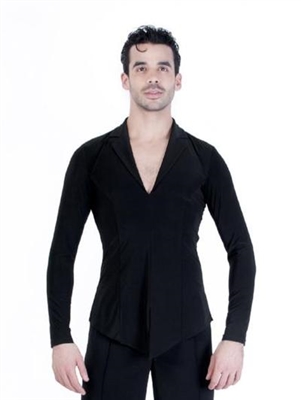
Style Brayden Black Latin Shirt - Mens Dancewear
Blue Moon Ballroom Dance Supply
$100–$200


Women's Ballroom, Latin, American Rhythm, Tango, Salsa Dress Top
Lets Dance Store
$100–$200
As an Amazon Associate, LODance earns from qualifying purchases. Affiliate disclosure
Sources & Further Reading
Where This Dance Is Documented
ISTD syllabus; WDSF technique manuals
An editor's note on where the technique for this dance is actually written down — sometimes a named book, sometimes the fact that no such book exists. A judgement, not a count of what we hold.
Syllabi (instructional standards, not citable sources)
Competitive technique and choreographic standards are maintained by:
- • ISTD (Imperial Society of Teachers of Dancing) and WDSF (World DanceSport Federation) official syllabi and technique manuals
- • DVIDA (Dance Vision International Dance Association) materials for American dance variants
- • USA Dance and other national governing body resources
- • WDC (World Dance Council) competition rules and adjudication standards
Cultural & Historical Context
International Samba emerged from Brazil during the 1890s—1920s. Understanding the cultural roots, musical traditions, and social circumstances of this era enriches appreciation for the dance's characteristics and significance.
Formative Influences
Codifiers & Standardizers:
Imperial Society of Teachers of Dancing, Brazilian carnival masters, Walter Laird, Donnie Burns, ISTD (Imperial Society of Teachers of Dancing), WDSF (World DanceSport Federation), WDC (World Dance Council)
Signature Movement Vocabulary:
Basic Bounce Step, Travelling Samba Step, Samba Whisks, Turning Samba, Bounce Fallaway
Primary Source Documents
The Library of Dance contains public-domain primary sources for dance history. Copyrighted modern syllabi are indexed with purchase links to their respective copyright owners. Search by dance name or codifier to discover primary source documents.
Last reviewed: October 2026 — This dance profile synthesizes historical research, cultural documentation, and contemporary practice knowledge to provide authoritative context.
Related Dances
More in International Latin
International Cha-Cha-Cha
The Cha-Cha-Cha originated in 1950s Cuba as a slower variant of the Mambo, featuring a distinctive triple-step rhythm. Its playful character and Cuban motion made it instantly popular in dance halls and ballrooms worldwide.
International Rumba
Rumba evolved from Cuban son and Spanish guitar traditions, featuring the characteristic Cuban motion, slow sensual rhythm, and emphasis on hip action. It became the romantic centerpiece of ballroom Latin competition.
International Paso Doble
Paso Doble, literally 'double step,' takes its bullfight theme and pasodoble music from Spain, but the partnered ballroom dance itself was developed in France (the figure names — sur place, huit, coup de pique — are French). It was adapted for International Latin competition and is built on a distinct two-step march rhythm with a dramatic, theatrical character.
International Jive
Jive evolved from African-American swing traditions and jitterbug, featuring energetic kicks, flicks, and a bouncy character. When adapted for ballroom competition, it became the fastest and most playful of the Latin dances.
What did dancers wear?
International Samba belongs to the Modern Competition (1950s–present) era. See how attire shaped the choreography — and the other way around.
Explore Modern Competition attire →Our Library of Dance corpus skews to historical public-domain sources (pre-1925). Modern competitive technique citations require additional rights-cleared sources — see roadmap.
Continue Exploring
Lineage of Dance
500 years of dance evolution
Champions of Dance
Winners of marquee national & world titles
Language of Dance
161 dance terms & translations
Listening of Dance
Tempo, timing & musicality tools
Gallery of Dance
5,700+ artworks from museum collections
Attire of Dance
Evolution of dance dress across eras
Keep the thread going
Dance history, technique, and the occasional rabbit hole — in your inbox. Thoughtful, infrequent, unsubscribe anytime.
Free. No spam. One click to leave.