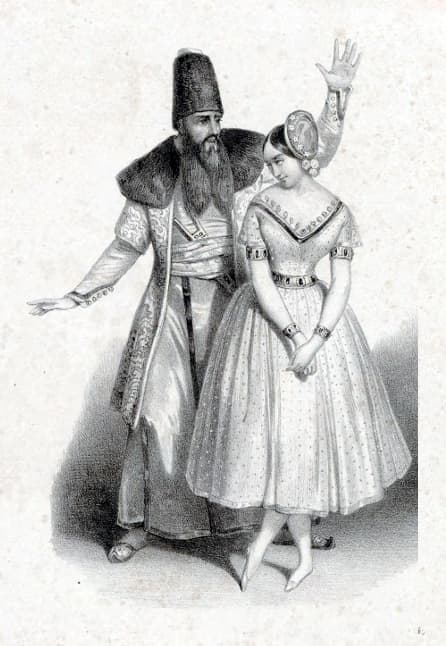
Jules-Robert-Pierre-Joseph Challamel after Marie-Alexandre Alophe — Bibliothèque nationale de France · Public domain
Le Diable amoureux is a three-act, eight-scene ballet-pantomime made for the Paris Opera in 1840, with choreography by Joseph Mazilier and music shared between François Benoist and Napoléon Henri Reber. The libretto, by Jules-Henri Vernoy de Saint-Georges, adapts Jacques Cazotte's 1772 occult tale The Devil in Love, giving the work its supernatural-romance plot of a spirit (Uriel) who takes female form (Lilia) to pursue a mortal man.
What is danced
The source article does not describe any choreography, step vocabulary, or set pieces — it records premiere and revival dates, cast names, and authorship only. No synopsis of the eight scenes is given, so nothing here can responsibly be said about what was actually danced, which passages were mimed versus danced, or what a performer or stager would need to prepare. This is a gap in the citable record, not a claim that the ballet lacked dancing: a work of this scale and period (Paris Opera, 1840, Mazilier as choreographer) would be expected to carry the full apparatus of Romantic-era ballet — corps de ballet ensembles, a demi-caractère or supernatural pas for the spirit figures, and a grand pas for the principals — but the article gives no textual basis to attach that vocabulary to any named code with confidence.
Context
The article situates the work at the Paris Opera in September 1840, staged by the same institution and dance-theatrical culture that would produce Giselle the following year, with Mazilier — a leading Paris Opera choreographer of the period — in the lead male role himself as well as directing the work. Its subsequent life passed into the hands of Marius Petipa, first as a dancer (Count Fabio in the 1848 Saint Petersburg revival, under the title Satanella) and later as its choreographer-reviver for the Imperial Ballet, making the piece a documented staging point in Petipa's own career trajectory from performer to house choreographer.
Staging history
The ballet was revived repeatedly by the Imperial Ballet in Russia under the title Satanella: first by Marius and Jean-Antoine Petipa in 1848 at the Bolshoi Kamenny Theatre with Yelena Andreyanova and Petipa himself dancing Count Fabio; then twice more by Petipa alone, in 1866 and 1868, each time with additional music by Cesare Pugni layered onto the Benoist/Reber score, and with Lev Ivanov as Count Fabio in both. A further revival of Petipa's version was mounted by Ivan Chliustin and Nicola Domashov for the Bolshoi Theatre in Moscow in 1897, with Lyubov Roslavleva. Each Russian staging added or revised music (Konstantin Liadov's orchestration in 1848, Pugni's additions in the 1860s) rather than leaving the original French score untouched.
How to watch it
As recorded, this is a plot- and cast-history rather than a choreographic one, so attend first to the fact of transmission: the same libretto and core score persisting across sixty years and two countries under two titles. Watch for the double casting convention in the revivals — Petipa and later Ivanov both appearing as Count Fabio opposite a succession of ballerinas as Satanella/Uriel — which signals how a single created role became a vehicle passed between leading danseurs.
Credits
- composer: François Benoist
- composer: Napoléon Henri Reber
Related works
Other staged works in the register connected to this one by author or lineage.


