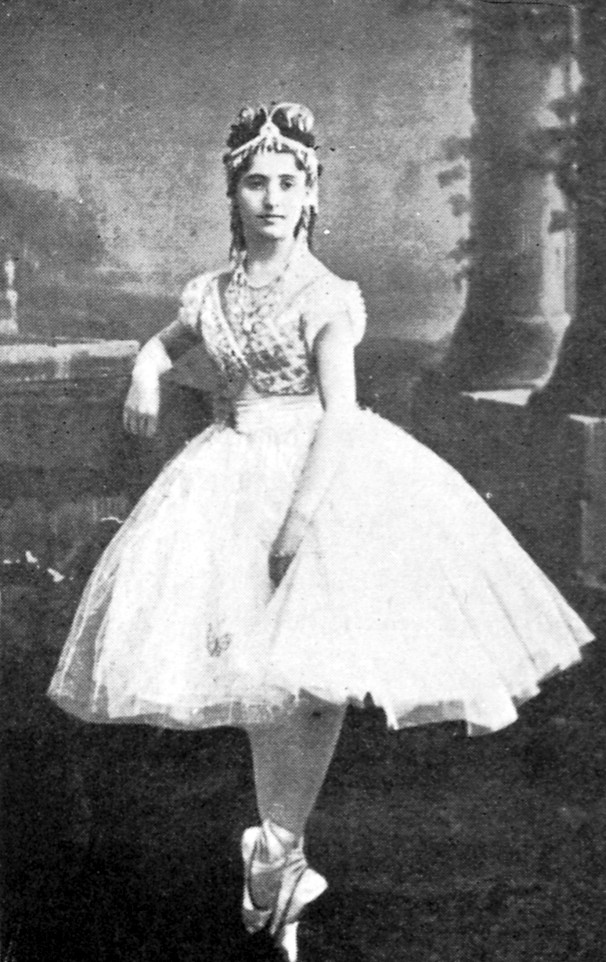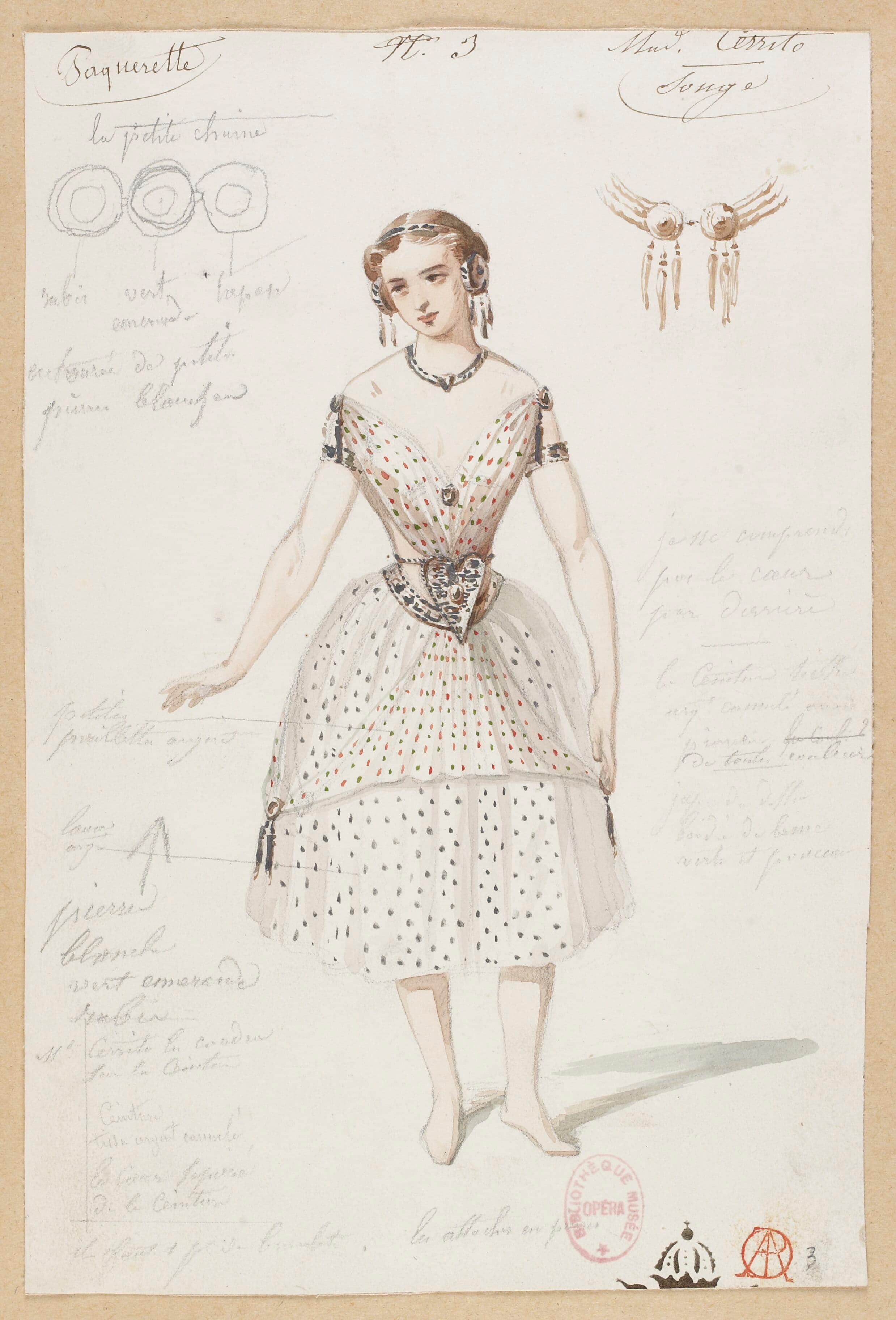
Paul Lormier · Public domain
Pâquerette is a three-act ballet first given by the Ballet of the Académie Royale de Musique (the Paris Opera) on January 15, 1851, with choreography by Arthur Saint-Léon and music by François Benoist. Saint-Léon made the title role for Fanny Cerrito, one of the reigning ballerinas of the Romantic era, and danced the male lead, François, himself — a common arrangement for Saint-Léon, who was both a virtuoso performer and a choreographer.
What is danced
The article records only credits and casting, not choreography: it tells us who danced which role and who composed or revised the score at each staging, but it gives no synopsis, no scene breakdown, and no description of steps, holds, or technique. A dancer or historian consulting this entry should know that nothing in the source lets us describe the actual vocabulary of the ballet — whether it leaned on pointe work for Cerrito, character or demi-caractère passages, mimed scenes, or set divertissements. That gap is real, not an oversight: the article is a bare production record (premiere details plus three restagings), and inventing choreographic content to fill it would misrepresent the source.
Context
The 1851 premiere falls at the tail of the great Romantic ballet period in Paris, when Saint-Léon was active as both dancer and choreographer and frequently built vehicles around leading ballerinas such as Cerrito, his former wife and longtime stage partner. The ballet's subsequent life in St Petersburg — restaged by Saint-Léon himself in 1860 with Cesare Pugni revising Benoist's score, then revived by Marius Petipa in 1882 with Léon Minkus doing the same — traces the well-worn pipeline by which French Romantic-era ballets were exported to the Imperial Ballet and rebuilt there with new dance music by the house composers of the day.
Staging history
After the 1851 Paris premiere, Saint-Léon restaged the ballet for the Imperial Ballet on January 28/February 9, 1860, at the Imperial Bolshoi Kamenny Theatre in St Petersburg, with Cesare Pugni adding to and revising Benoist's score. Marius Petipa revived it again for the same company on January 10–22, 1882, at the same theatre, with Léon Minkus making further additions to the score and Eugenia Sokolova and Pavel Gerdt in the leads. In 2012 the title was used for an unrelated hour-long duet with two nude performers at the Invisible Dog Art Center as part of the Queer New York Festival — a modern reuse of the name rather than a staging of Saint-Léon's ballet.
How to watch it
Little can be said here with confidence: the source gives no scene-by-scene account, so a viewer has to look to other scholarship for the actual choreography and mise-en-scène. What the record does support is watching for how the piece changed composers at each remounting (Benoist, then Pugni's additions, then Minkus's) — a useful reminder that Romantic ballet scores were routinely revised and expanded for new stagings rather than treated as fixed texts.
Credits
- composer: François Benoist
Related works
Other staged works in the register connected to this one by author or lineage.