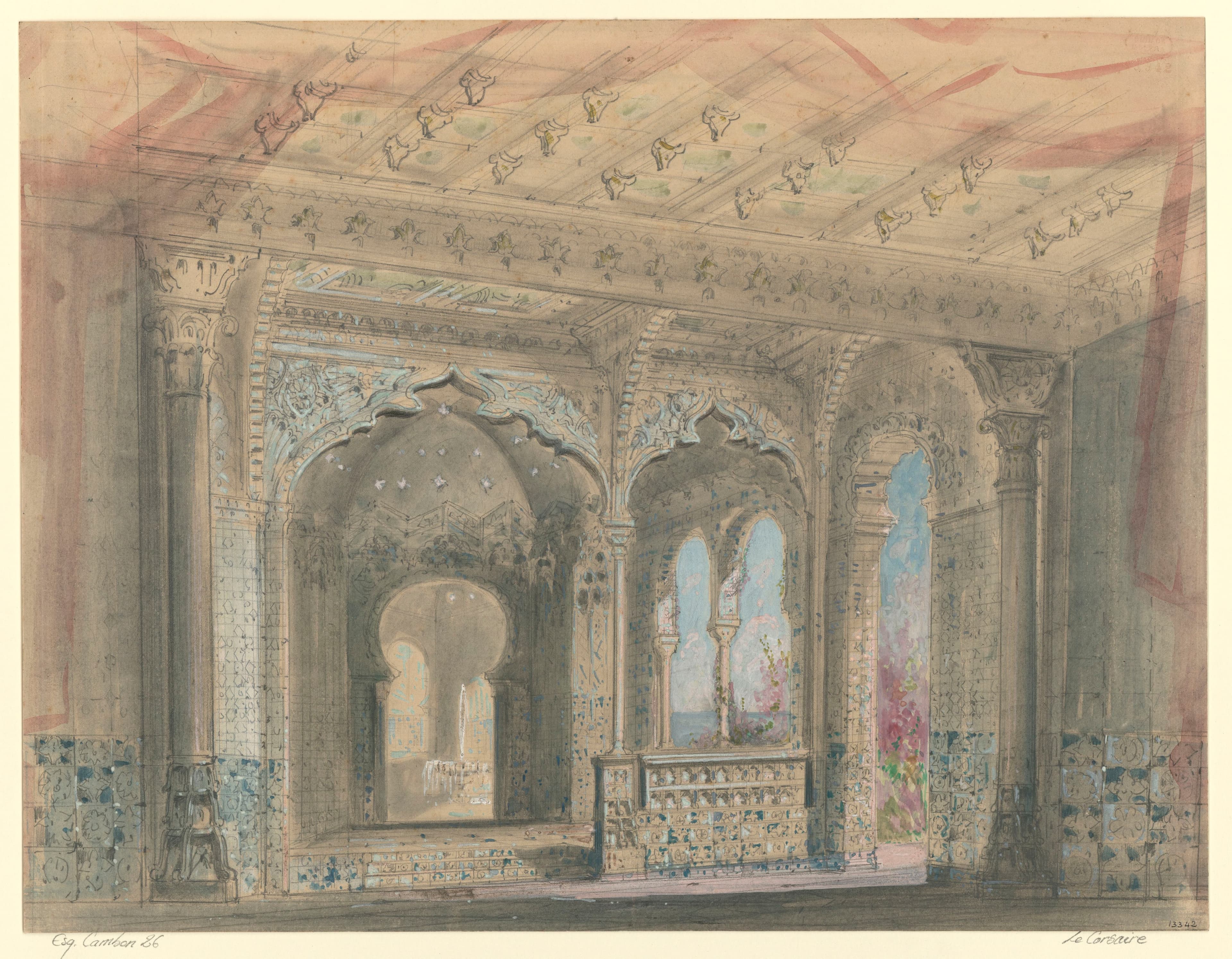
Charles-Antoine Cambon — This file comes from Gallica Digital Library and is available under the digital ID btv1b7000112f/f1 · Public domain
Le Corsaire is a three-act narrative ballet built on a libretto by Jules-Henri Vernoy de Saint-Georges, loosely drawn from Byron's poem The Corsair, telling of the pirate Conrad's rescue of his beloved Medora from a slave-trader and a lustful pasha. Joseph Mazilier choreographed the original production for the Paris Opéra in 1856, to music by Adolphe Adam and other composers; almost every production performed today, however, descends not from that original but from the successive revivals Marius Petipa mounted for the Imperial Ballet of St. Petersburg later in the century.
What it contains
- Classical Ballet · The Le Corsaire pas de deux, an excerpt performed independently of the full ballet — A bravura display pas de deux of the kind built for virtuoso partnering, turns, balances and jumps, treated as a stand-alone classical showcase. Source: "the so-called Le Corsaire pas de deux (music mostly by Riccardo Drigo), which is among classical ballet's most famous and performed excerpts"
- Romantic Ballet · Whole work, especially the role of Conrad as originally staged in 1856 — The leading male role was built on pantomime rather than steps; dancing and narrative mime were assigned to separate performers/roles in the Romantic-era manner. Source: "The role of Conrad—which contained no dancing in Mazilier's original staging—was created by the Italian Domenico Segarelli. Although he was an accomplished dancer, it was Segarelli's abilities as a mime artist that won him the many roles he created on the stage of the Opéra."
- Vaganova Method · Le Corsaire pas de deux, as staged in the Kirov Ballet's 1936 production — A specific 1931 choreographic revision of the pas de deux made for a graduation performance and later incorporated into full-length stagings, representing the codified Vaganova training lineage. Source: "This was the first production of the full-length work to include Vaganova's 1931 revision of Le Corsaire pas de deux as staged for Dudinskaya's graduation performance."
What is danced
The ballet's reputation in the studio and on the gala stage rests less on its plot than on a handful of extractable set pieces that have become independent repertory items: the corps-de-ballet vision scene Le Jardin animé, the Pas d'esclave, the Pas de trois des odalisques, and the Le Corsaire pas de deux (music mostly by Riccardo Drigo), described in the article as 'among classical ballet's most famous and performed excerpts.' These numbers carry the full weight of virtuoso classical technique — sustained balances, multiple pirouettes, high extensions and bravura male jumps in the pas de deux — and are frequently danced on their own at competitions and galas, detached from the surrounding mime-driven narrative.
Notably, the title role of Conrad was originally built entirely on mime rather than dancing: Domenico Segarelli, who created the part in 1856, was cast for 'his abilities as a mime artist' rather than his dancing, and it was 'not until many years later that the role of Conrad included any dancing.' This reflects the Romantic-era convention of splitting a ballet's cast into danced (usually female) and mimed (often male) roles, a structural feature a performer or stager of the piece needs to reckon with when deciding how 'danced' a Conrad should be.
Later Russian stagers layered in further set dances and national/character divertissements — a harem scene for odalisques and the Sultana Zulina, a bazaar divertissement for Turkish, Persian and Arabian slave-women (added by Gorsky in 1912), and a Chopin-Nocturne dream sequence — expanding the ballet's demand for demi-caractère and exotic-idiom dancing well beyond the 1856 original. The 1936 Kirov production is notable for introducing Agrippina Vaganova's 1931 revision of the Corsaire pas de deux, made for a graduation performance, which remains an influential staging of that excerpt.
Context
Le Corsaire belongs to the Romantic ballet's late flowering at the Paris Opéra in the 1850s, an era built on exotic, literary source material (here Byron), star ballerinas (Carolina Rosati), and a clear division between mimed leading men and danced heroines. Its real historical weight, though, comes from its migration to Russia: Jules Perrot staged it for the Imperial Ballet in 1858, and Marius Petipa — who danced the role of Conrad in that production before becoming Ballet Master — revised and expanded it four times over his career, turning a mid-century French vehicle into a showcase for the grander, more virtuosic idiom of the late Imperial Russian school.
Staging history
The Paris original was dropped from the Opéra's repertory after ballerina Adèle Grantzow's departure in 1868 and was never performed there again; all subsequent stagings trace back through St. Petersburg and Moscow. Petipa's four revivals (1863, 1868, 1880 and a definitive 1899 version for Pierina Legnani) are the ancestors of the modern text; the Bolshoi Theatre in Moscow developed its own parallel lineage through Petipa (1888), Ivan Clustine (1894, alleged by Petipa to be plagiarized) and a heavily reworked Alexander Gorsky version (1912) that added new music by Grieg, Glière, Chopin, Tchaikovsky and others and stayed in repertory until 1927. In the Soviet period Vaganova (1931), a 1936 Kirov production, Pyotr Gusev's rescored 1955 version (which discarded most of Adam's original score for other Adam works) and Konstantin Sergeyev's 1973 staging each altered the ballet further; Sergeyev's version, brought to the West via Boston Ballet and then American Ballet Theatre through Anna-Marie Holmes, is the basis of most current Western productions. More recent historically-minded reconstructions include the Bavarian State Ballet's 2006 staging (using Stepanov notation from the Sergeyev Collection) and the Bolshoi's lavish 2007 revival by Alexei Ratmansky and Yuri Burlaka, reported as the most expensive ballet production ever mounted; English National Ballet gave the work its first complete British staging in 2013.
How to watch it
Watch the split between mime and dance in the leading male role of Conrad, a Romantic-era convention that later productions gradually eroded by giving him more virtuoso material. In the extracted set pieces — Le Jardin animé, the Pas d'esclave, the Pas de trois des odalisques and the Corsaire pas de deux — look for the display values typical of Imperial Russian revision: sustained adagio balances, multiple turns, and bravura jumps built for a specific ballerina or partnership rather than for narrative logic. Because productions diverge so widely, it is worth noting which lineage (Petipa/Sergeyev via Boston-ABT, or Gusev via the Mariinsky/Kirov) a given staging follows, since the music, added dances and even the ending can differ.
Structure
- Act I · Scene 1In a seaport bazaar square, Conrad and his corsairs arrive; Medora signals Conrad, the wealthy Seyd Pasha buys her from Lankendem, and the corsairs abduct the slave girls, Medora and Lankendem.
- Act I · Scene 2In the corsairs' den, Medora dances for Conrad; drugged by a sleeping potion hidden in a flower, Conrad is overpowered and Medora is abducted by the corsairs opposed to him.
- Act II · Scene 3In Seyd Pasha's harem the odalisques and the Sultana Zulina dance and quarrel; the disguised corsairs storm the palace and are captured, and Conrad is sentenced to death.
- Act III · Scene 4Medora dances for Seyd Pasha to distract and disarm him; a substitution at the wedding ceremony frees Conrad and Medora escapes with him.
- Act III · Scene 5Aboard the corsair ship, Birbanto is thrown overboard during a storm and the ship wrecks; Conrad and Medora survive together on shore.
Structure read from an encyclopaedia article, not from a libretto or score we hold. Confirm against a programme before treating the numbering as authoritative.
Credits
- composer: Adolphe Adam
- composer: Léo Delibes
Related works
Other staged works in the register connected to this one by author or lineage.
 PaquitaBallet · 1846Mazilier · video
 Le diable à quatreBallet · 1845Mazilier
 Le Diable amoureuxBalletMazilier · video
 CoppéliaBallet · 1870Music by Delibes · video
 SylviaBallet · 1876Music by Delibes · video
 La sourceBallet · 1866Music by Delibes · video
 Square DanceBallet · 1957Same lineage · video
 Stars and StripesBallet · 1958Same lineage · video