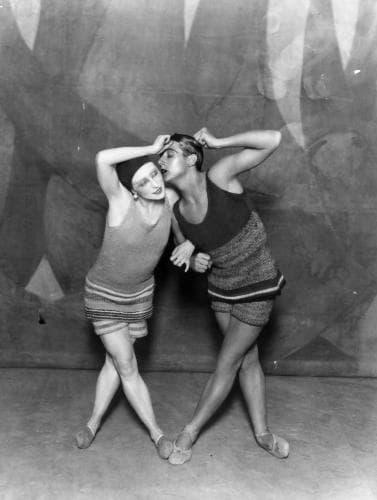
Sasha (Alexander Stewart) · Public domain
Le Train Bleu (1924)
Le Train Bleu is a one-act ballet made for Serge Diaghilev's Ballets Russes, premiered in 1924 with a score by Darius Milhaud. Its scenario, by Jean Cocteau, is a comic sporting tableau set on the French Riviera among the leisured young of the 1920s, and it is remembered as much for its visual production — a Cubist beach set by Henri Laurens, sportswear costumes by Coco Chanel, and a front curtain painted after a Picasso beach scene — as for its dance content.
What is danced
The article gives the ballet's scenario, cast and score structure but does not describe the choreographic vocabulary in technical terms — no steps, holds, or ballet-technique language are quoted. What can be established is the subject matter of the movement: the piece is built around sporting figures (swimmers, tennis players, golfers, weight lifters) and stock character types ('poules et gigolos', a 'Beau-Gosse', 'Perlouse'), suggesting a mime-and-gesture vocabulary drawn from contemporary leisure and sport rather than classical set pieces, with named numbers including an entrance for a tennis champion, an entrance for a golfer with a waltz, and a duet. Nijinska played a tennis player modelled on Suzanne Lenglen, indicating that at least one role was built around recognisable athletic gesture rather than balletic mime alone. Beyond this, the article does not support any claim about pointe work, partnering technique, or specific step vocabulary, so no coded style matches can be responsibly drawn from it.
Context
The ballet belongs to the Ballets Russes' Paris seasons of the early 1920s, when Diaghilev was pairing his choreographers with leading visual and fashion figures of the day — here Laurens, Chanel and (via the curtain) Picasso — to make ballet current with contemporary taste rather than historicist spectacle. The subject, modern sport and Riviera leisure culture, situates the work squarely within that decade's fascination with speed, athleticism and the fashionable body, themes the company explored in several works of the period.
Staging history
The article records only the original 1924 premiere, at the Théâtre des Champs-Élysées in Paris, with André Messager conducting and Nijinska, Lydia Sokolova, Anton Dolin and Leon Woizikovsky in the leading roles. It notes a documented error in Richard Buckle's Diaghilev biography, which misidentified the setting as Deauville rather than the Riviera resorts served by the actual Blue Train line — a correction relevant to anyone tracing secondary accounts of the work, but no later revivals or restagings are described.
How to watch it
Watch for how the sporting theme is translated into stage gesture — mimed tennis, golf and weightlifting postures standing in for balletic pas — rather than for a conventional divertissement structure. Attend also to the interplay between set, costume and curtain: the Laurens beach backdrop, Chanel's sportswear, and the Picasso-derived curtain image were as central to the original conception as the choreography itself.
Structure
- IntroductionOpening musical section of the score; the article does not describe specific staged action beyond the title.
- Choeur des poules et des gigolosA choral/ensemble number for the fashionable beach crowd of women and their escorts; no further movement detail given in the article.
- Entrée de Beau-GosseAn entrance number for the character Beau-Gosse; the article gives only the title.
- Entrée de PerlouseAn entrance number for the character Perlouse; the article gives only the title.
- Rentrée de Beau-GosseA return entrance for Beau-Gosse; no further detail is given.
- Choeur des poules et des gigolos (farce des cabines et scène de l'avion)A comic ensemble scene involving beach cabins and an airplane bit, per the section title; no choreographic detail is given.
- Entrée de la championne de tennis et couplets avec Beau-GosseAn entrance for the tennis champion character (played by Nijinska, modelled on Suzanne Lenglen) with a sung/danced exchange with Beau-Gosse.
- Entrée du joueur de golf et valse avec PerlouseAn entrance for a golfer character followed by a waltz with Perlouse, per the section title.
- Introduction et duo de Beau-Gosse et de PerlouseAn introduction leading into a duet for Beau-Gosse and Perlouse.
- Choeur des poules et des gigolos; Fugue de l'engueuladeA closing ensemble section followed by a musical fugue passage titled as a quarrel scene ('engueulade'); no staged detail given.
- Final du chapeauThe closing number of the ballet, titled around a hat ('chapeau'); the article gives no further description.
Structure read from an encyclopaedia article, not from a libretto or score we hold. Confirm against a programme before treating the numbering as authoritative.
Credits
- composer: Darius Milhaud
More from Darius Milhaud
Other staged works in the register connected to this one by author or lineage.


