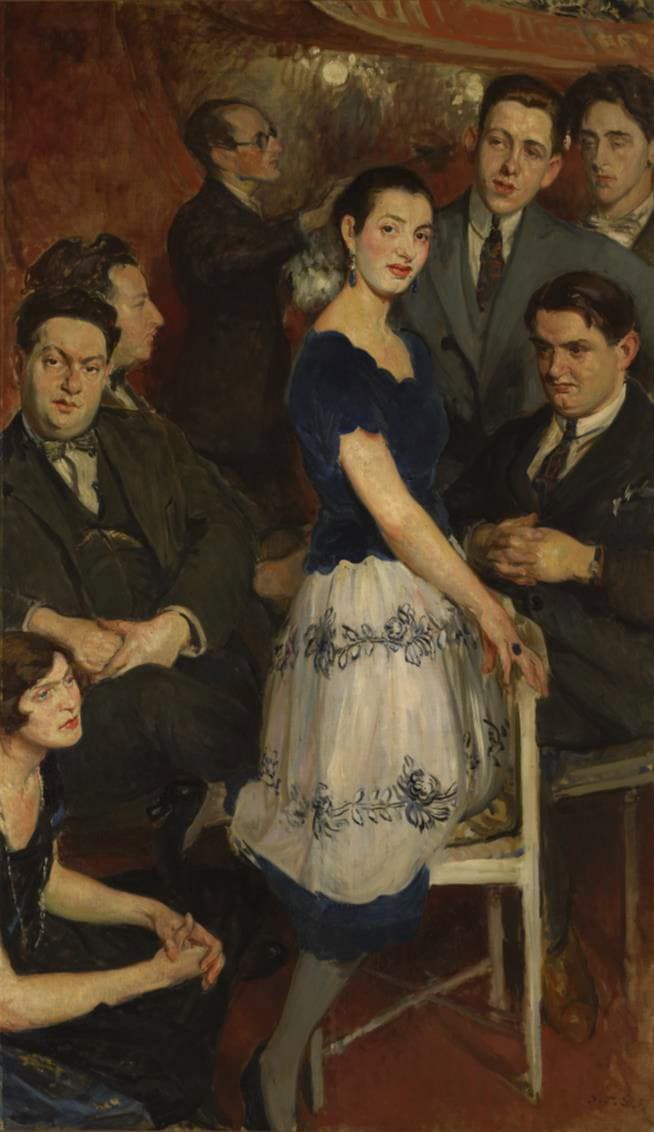
Jacques-Émile Blanche — Source: http://www.deauville.fr/sites/deauvillev4/files/20160501-exposition_jacques_emile_blanche_0.pdfPhotographic reproduction: © Musées de la ville de Rouen / Photographie C. Lancien / C. Loisel · Public domain
Les Mariés de la tour Eiffel is a 1921 ballet made for the Ballets suédois, with a libretto by Jean Cocteau, choreography by Jean Börlin, sets by Irène Lagut, costumes by Jean Hugo, and a score assembled from five members of the group Les Six (Auric, Honegger, Milhaud, Poulenc and Tailleferre), commissioned by the company's director Rolf de Maré. It sits in the catalogue as a landmark of Parisian avant-garde theatre-dance rather than as a repertory ballet in the classical sense: its interest for dance history lies as much in its production history and collaborative authorship as in any surviving choreographic text.
What is danced
The article does not describe Jean Börlin's choreography in terms of steps, holds or technique. What it gives instead is the score's structure: ten musical/narrated sections (Overture, Marche nuptiale, Discours du Général [Polka], La Baigneuse de Trouville, La Fugue du massacre, La Valse des dépêches, Marche funèbre, Quadrille, Ritournelles, Sortie de la noce) interleaved with 'narrated and acted scenes' delivered by two onstage narrators (Cocteau and Pierre Bertin at the premiere). Several of these numbers are explicitly titled after social dance forms (Polka, Quadrille, Marche, Valse), which suggests the staging drew on pastiche or parody of ballroom and processional dance conventions of the period, but the source gives no confirmation of what was actually danced within them, nor any account of Börlin's or the principal dancers' (C. Ari, J. Figoni, K. Vahlander) actual vocabulary.
Context
The work belongs to the Ballets suédois, the company Rolf de Maré ran in Paris in direct rivalry with Diaghilev's Ballets Russes in the early 1920s, and to the circle around Jean Cocteau that became known as Les Six after this very commission drew five of its members into a single collaborative score (Louis Durey being the sixth, who withdrew citing illness). The piece premiered at the Théâtre des Champs-Élysées in 1921 into 'a brief moment of fame and even scandal,' a réception typical of Parisian avant-garde stage works of the period that mixed literary absurdism, cabaret timing and concert music inside a ballet frame.
Staging history
The ballet premiered at the Théâtre des Champs-Élysées in Paris on 18 June 1921, conducted by Désiré-Émile Inghelbrecht, with Cocteau and Pierre Bertin as narrators. It was given in New York in 1923, then largely disappeared until a new New York production opened in 1988. The score itself went unpublished until a 1966 recording supervised by Darius Milhaud; later recordings include one by the Philharmonia Orchestra under Geoffrey Simon and a 1987 reduction for fifteen instruments by Marius Constant, recorded by the Erwartung Ensemble. An amateur Dutch-language staging was given by a student music company in Delft and Wageningen in 1975, and in 2003 Peter Dizozza produced an American adaptation, The Marriage at the Statue of Liberty, for a Surrealist exhibition in Brooklyn.
How to watch it
Because the surviving documentation is almost entirely musical and literary, a viewer of any modern staging should watch for how the choreography answers the score's own dance-form titles (Polka, Quadrille, Marche, Valse) and for the interplay between the two spoken narrators and the dancers, since the piece was built as narrated-and-acted scenes alternating with set musical numbers rather than as continuous danced narrative.
Structure
- Overture (14 July)Opening number by Georges Auric setting the Bastille Day wedding-breakfast scene.
- Marche nuptialeWedding-march number by Darius Milhaud; the article gives no detail of accompanying stage action beyond its title.
- Discours du Général (Polka)A guest makes a pompous speech, set by Poulenc as a polka-titled number.
- La Baigneuse de TrouvilleA Poulenc number; the article does not describe the associated stage action.
- La Fugue du massacreMilhaud's number accompanying the ballet's violent turn, in which a lion eats a guest and a 'child of the future' kills everybody.
- La Valse des dépêchesTailleferre's waltz-titled number, tied to the sudden appearance of a telegraph office on the platform.
- Marche funèbreHonegger's funeral-march number, quoting the Waltz from Gounod's Faust.
- QuadrilleA Tailleferre number named for the historic quadrille dance form; no description of the staged action survives in the article.
- RitournellesAuric's number; the article gives no further detail.
- Sortie de la noceMilhaud's closing number, corresponding to the wedding party's exit as 'the ballet concludes with the end of the wedding.'
Structure read from an encyclopaedia article, not from a libretto or score we hold. Confirm against a programme before treating the numbering as authoritative.
Credits
- composer: Arthur Honegger
- composer: Darius Milhaud
- composer: Francis Poulenc
- composer: Georges Auric
- composer: Germaine Tailleferre
Related works
Other staged works in the register connected to this one by author or lineage.


