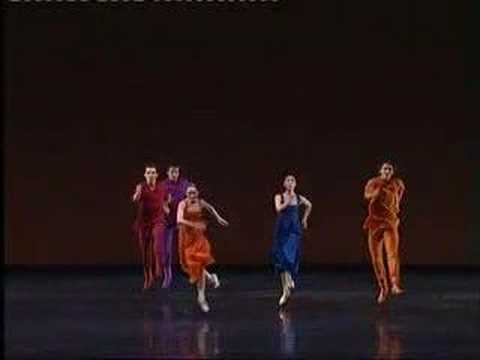
Russian Seasons is a plotless ballet in twelve sections made by Alexei Ratmansky to Leonid Desyatnikov's score of the same name, with costumes by Galina Solovyeva. It premiered at the New York State Theater on June 8, 2006, danced by the New York City Ballet, at a moment when Ratmansky was serving as artistic director of the Bolshoi Ballet in Moscow.
What is danced
The article gives only the structural bones of the piece: it is performed by six couples across twelve sections and is described as being about Ratmansky's Russian roots. It does not describe specific steps, holds, or technique used in any section, and does not name individual dances within the twelve. A reader relying on this source alone cannot determine whether the vocabulary is classical pointe work, character dance, folk-inflected movement, or a mixture, only that the ballet is structured episodically and cast for three couples doubled twice over (or some arrangement adding to six).
Context
The ballet was made for the New York City Ballet at a point when Ratmansky, though newly installed as artistic director of the Bolshoi Ballet, was also cultivating a working relationship with NYCB, having previously created a piece there through the New York Choreographic Institute. The commission situates the work at a crossing point between Moscow's Bolshoi tradition and the Balanchine-descended repertory of NYCB, made by a choreographer moving between both institutions in the same period.
Staging history
Beyond its 2006 NYCB premiere, the ballet has been revived by the Bolshoi Ballet and by the National Ballet of Canada. In 2020, in response to pandemic-era closures, New York City Ballet released archival video of excerpts rather than staging a live performance: a 2018 recording of part of the ninth section with Abi Stafford, Sara Mearns and Amar Ramasar, and 2017 footage of the tenth section featuring Taylor Stanley in a role debut.
How to watch it
Watch for the interplay among six couples across twelve short sections rather than a single narrative through-line; the piece is described as being about the choreographer's Russian roots, so listen for how Desyatnikov's score and the sectional structure might be read as seasonal or cyclical rather than dramatic. The article does not specify pointe versus character footwear or folk-dance quotation, so these are points to verify against a live viewing rather than assume.
Credits
- composer: Leonid Desyatnikov
More from Alexei Ratmansky
Other staged works in the register connected to this one by author or lineage.


