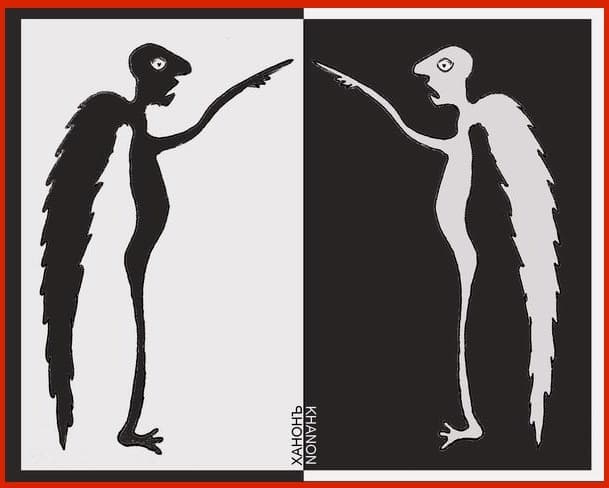
photo & esquize: canonic Yuri Khanon — Own work · CC BY-SA 3.0
Middle Duet (also called The Middle Duo in some sources) is a ten-minute one-act ballet made by Alexei Ratmansky to the first movement of Yuri Khanon's Middle Symphony, premiered at the Mariinsky Theater in November 1998. It was Ratmansky's first work as choreographer at that house, made while he was still a soloist with the Royal Danish Ballet, and it grew quickly from a single number on an evening of new ballets into the piece most associated with his early career.
What it contains
- Contemporary Ballet · The whole ten-minute one-act duet — A single pas de deux on pointe: the man uses pulsating, containing gestures while the woman moves continuously on pointe through sharp, sensual, technically dense steps, described in reviews as vocabulary equal to international contemporary-ballet standards. Source: "to the sounds of a piano and orchestra, the partner, with pulsating gestures, tries to hold his partner, who continuously moves on pointe shoes, weaving a complex a web of sharp and sensual steps."
What is danced
The ballet is built around a single pas de deux performed under a ray of light, described by the article as a male partner using "pulsating gestures" to try to hold a partner who "continuously moves on pointe shoes, weaving a complex web of sharp and sensual steps." This places the core vocabulary firmly in pointe-based partnering: sustained on-pointe phrasing for the woman set against a man attempting containment and support rather than conventional lifts, producing a tense, unresolved adagio dynamic rather than a display duet. A review quoted in the article calls the choreography "dynamic, intense, integral, in vocabulary in no way inferior to world standards," suggesting a contemporary-ballet idiom rather than period or character dance.
Context
The piece was made in 1998, near the end of a decade in which Russian companies were reopening to Western contemporary-ballet influences after Soviet isolation; Ratmansky was working outside Russia (Royal Danish Ballet) and brought that outside vantage point back to the Mariinsky. The choreographer's own account frames the commission explicitly as a search for "a modern ballet to beautiful modern music," and he sought out Khanon specifically because his score for Sokurov's film Days of Eclipse had struck him as "conceptual, theatrical, melancholy and rhythmic." Reviewers situated the result against the Mariinsky's traditional full-length repertory, one describing it as looking "like a Givenchy dress among the rags of a flea market" next to the house's older productions.
Staging history
After its 1998 Mariinsky premiere the work spread rapidly as a concert number performed without sets by touring soloists and at independent enterprises, reportedly becoming one of the most performed short ballets from Russia in the early 2000s, with dozens of dancers including Diana Vishneva, Svetlana Zakharova and Natalia Osipova passing through the central roles. Ratmansky brought it to the Bolshoi Theater main stage in January 2006 after becoming that company's chief choreographer, and to New York City Ballet later in 2006, where it was danced by dancers including Maria Kowroski and Albert Evans. The work was withdrawn from all stages around 2009–2010 after composer Yuri Khanon, who had not been party to any contract, forced a ban on public performance following what the article describes as a decade of unlicensed use by the Mariinsky, Bolshoi and other companies.
How to watch it
Watch the central pas de deux for what is withheld rather than displayed: the man's gestures are described as attempts to hold or contain his partner rather than to lift or showcase her, and she moves continuously on pointe in a tense, uninterrupted current of steps. The staged version added scenery and two silent "creatures with wings" who do not take part in the action but were conceived by Ratmansky as figures observing the duet from outside it — worth noting in productions that retain the original design.
Credits
- composer: Yuri Khanon
More from Alexei Ratmansky
Other staged works in the register connected to this one by author or lineage.
 Pictures at an ExhibitionBallet · 2014Ratmansky · video
 Concerto DSCHBallet · 2008Ratmansky · video
 Russian SeasonsBallet · 2006Ratmansky · video
 West Side StoryMusical theatre · 1957Same lineage · video
 SylviaBallet · 1876Same lineage · video
 Carmen SuiteBallet · 1967Same lineage · video
 Moon WaterBallet · 1998Same lineage · video
 The CageBallet · 1951Same lineage · video