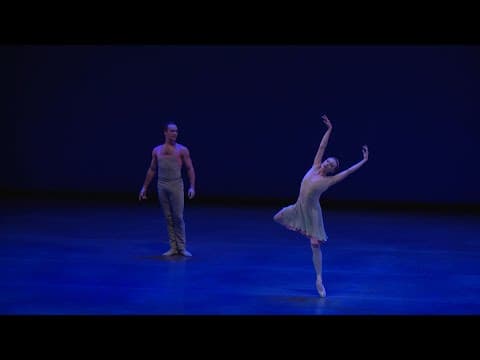
Concerto DSCH is a plotless ballet Alexei Ratmansky made for New York City Ballet in 2008, set to Dmitri Shostakovich's Piano Concerto No. 2 in F Major, Op. 102. Its title refers to the composer's own musical monogram, DSCH (D-Es-C-H), a cipher Shostakovich embedded in several scores; the ballet does not tell a story but is built directly on the concerto's three-movement structure.
What is danced
The source article does not describe the choreography itself — no synopsis, step vocabulary, or scene-by-scene breakdown is given, so nothing here should be read as a movement description drawn from the text. What can be established structurally is that the ballet is danced by an ensemble anchored by named principal and soloist roles: the world premiere cast alone lists five principals (Whelan, Bouder, Millepied, De Luz, Garcia), and every subsequent premiere cited follows the same five-dancer configuration, suggesting a piece built around multiple demi-soloist pairings rather than a single central couple. The one specific detail the article gives about the dancing is that the ballet's second movement was danced by Wendy Whelan at her farewell performance, which points to that movement functioning as a distinct, extractable adagio or pas de deux within the larger structure.
Context
The article situates the work only by date and company: a 2008 premiere at the New York State Theater for New York City Ballet. Beyond that, placing it in a wider dance-historical frame (Ratmansky's move from the Bolshoi to residencies with Western companies in the 2000s, or NYCB's continuing use of Shostakovich after Balanchine) is my own inference and not something the article supports directly.
Staging history
Beyond the 2008 NYCB premiere, the article records three further company premieres: Pacific Northwest Ballet in 2011 (Körbes, Imler, Cruz, Orza, Bold), La Scala Theatre Ballet in 2012 (Zakharova, Vassallo, Nezha, Sutera, Fresi), and the Mariinsky Ballet in 2013 (Kondaurova, Batoeva, Ermakov, Sergeyev, Tkachenko). A filmed record exists: NYCB released a recording made on October 5, 2018, featuring Mearns, Angle, Bouder, Garcia and De Luz, put out during the COVID-19 pandemic when the article notes performing-arts organizations turned to archival footage.
How to watch it
Follow the ballet against the three-movement shape of Shostakovich's concerto rather than any narrative — the second, slower movement is the section singled out in the article as capable of standing alone (as Whelan's farewell excerpt), so watch for a shift there from the surrounding ensemble writing to something more intimate. Track the five principal/soloist roles named across every cast list given, since the piece appears to be built on that same five-dancer core wherever it is staged.
Credits
- composer: Dmitri Shostakovich
Related works
Other staged works in the register connected to this one by author or lineage.
 Middle DuetBallet · 1998Ratmansky · video
 Pictures at an ExhibitionBallet · 2014Ratmansky · video
 Russian SeasonsBallet · 2006Ratmansky · video
 The Golden AgeBallet · 1930Music by Shostakovich · video
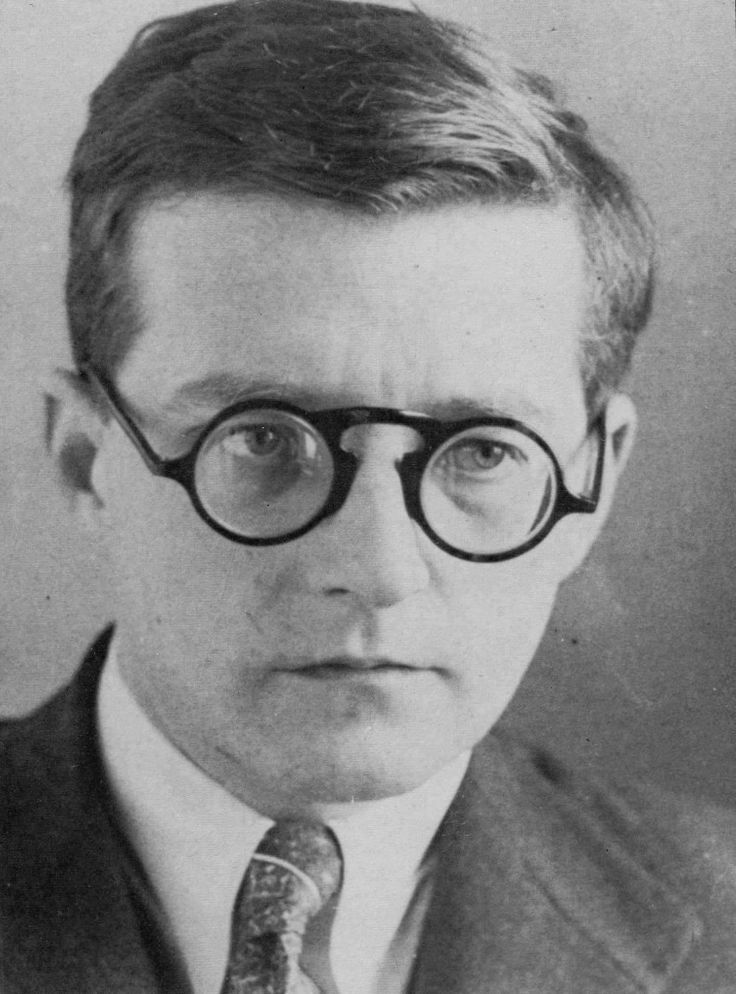 The Limpid StreamBallet · 1935Music by Shostakovich · video
 ConcertoBallet · 1966Music by Shostakovich · video
 Mercurial ManoeuvresBallet · 2000Music by Shostakovich · video