Barre
Also known as: Barre Fitness, Ballet Barre Workout, Lotte Berk Method
- Origin
- London, England; commercialised in the United States from 1971
- Era
- 1959–Present
- Rhythm
- Pulse-count driven rather than step-driven; movement is timed to the beat in small increments, typically eight- or sixteen-count sets
- Tempo
- Music usually 110-135 BPM, though the pulse is often executed at half or double time against it
- Character
- Controlled, precise, quietly brutal, aesthetically balletic
History & Cultural Context
Barre is the ballet-derived strength and conditioning format, and its lineage is unusually well documented. Lotte Berk, a German-born dancer who fled Nazi persecution for England in 1938, rebuilt her body after a back injury by combining ballet barre work with rehabilitative exercise, and in 1959 opened a studio in a London basement. Her American student Lydia Bach acquired the North American rights to the name and opened The Lotte Berk Method in Manhattan in 1971 — the first US barre studio, which ran for over three decades before closing in 2005. The modern franchise generation descends from it: Burr Leonard's The Bar Method (San Francisco, 2001), reworked with physical therapists for joint safety; Carrie Rezabek Dorr's Pure Barre, opened in Michigan in 2001 and franchising from 2009; Physique 57, launched in 2006 by Jennifer Vaughan Maanavi with former Lotte Berk instructor Tanya Becker; and Sadie and Chris Lincoln's Barre3, founded in Portland, Oregon in 2008. A class uses the barre as a support rather than a dance apparatus: small-range isometric pulses, very high repetition, plié and passé shapes, thigh and seat work, and stretching between sets. Ballet supplies the positions and the aesthetic; the training effect is muscular endurance, not dance technique.
Cultural Significance
Barre carries ballet's cultural prestige into a fitness setting, which is central to both its appeal and its critique: it sells the aesthetic of the dancer's body to people who will never take a ballet class. Studios cluster in affluent urban markets and price accordingly.
Characteristic Movement & Technique
Small-range isometric pulses and holds at a fixed barre, in turned-out plié, relevé and passé positions, plus seat, thigh, arm and core sets taken to muscular fatigue, with stretching between each block.
Partnering Dynamics
None. The barre substitutes for a partner as a point of support and balance; participants work individually facing or holding the barre.
Competitive Context
Non-competitive. Studios and franchises run instructor certification and class-attendance milestones, but there is no barre competition circuit.
Regional Variations
The UK Lotte Berk tradition retained more of the original bawdy, idiosyncratic exercise naming; US descendants split between the alignment-and-safety emphasis of The Bar Method and the faster, higher-repetition Pure Barre style, with Barre3 adding functional and athletic movement.
Common Misconceptions
That barre teaches ballet — it does not, and does not aim to. It is also frequently conflated with Pilates because both emphasise core work and small-range control, but the two have separate lineages and Pilates is not a dance form.
Peak Popularity
Signature Figures
- Lotte Berk
- Lydia Bach
- Burr Leonard
- Carrie Rezabek Dorr
- Tanya Becker
- Jennifer Vaughan Maanavi
- Sadie Lincoln
Notable Codifiers
- The Lotte Berk Method
- The Bar Method
- Pure Barre
- Physique 57
- Barre3
Barre Music & Tempo
Drawn from 15 Barre tracks in the LODance music library.
Example tracks at practice tempo
- Easy Love (Workout Mix 124 BPM) — Power Music Workout124 BPM
- Break the Rules (Workout Mix 124 BPM) — Power Music Workout124 BPM
- Too Good (Workout Mix 124 BPM) — Power Music Workout124 BPM
- Rather Be (Workout Mix 125 BPM) — Power Music Workout125 BPM
- Down on My Luck (Workout Mix 123 BPM) — Power Music Workout123 BPM
- Stuck on a Feeling (Workout Mix 128 BPM) — Power Music Workout128 BPM
Who governs Barre
Federations, councils and examining bodies with a recorded role in this style. No single organisation can tell you this — each one knows only itself.
What to Wear
Attire guidance for Barre and other Dance Fitness & Movement Wellness dances. Each card below is sized to the moment — class, practice, social, or competition — because the wardrobe shifts as the stakes do.
Reading the cards
In Class
Ordinary workout clothes are fine — breathable, sweat-wicking, a supportive sports bra, layers you can drop. Footwear is the one genuinely technical choice: running shoes are built for straight-line motion and grip the floor hard, so pivots and lateral steps torque the knee instead of releasing. Look for a dance sneaker or cross-trainer with lateral support and a smooth pivot spot under the ball of the foot (Ryka, Bloch and Capezio make dedicated ones). Check the format before you go — barre, Nia and many floor-based wellness classes are barefoot or grip-socks, and shoes are not welcome.
Social Dancing
There is no dressed-up context; the class is the context, and nobody is looking at you. Themed and event classes (glow nights, charity rides, outdoor summer sessions) invite bright colours or costume if you want to join in, and are equally fine to skip. Outdoor sessions need a shoe you don't mind chewing up on grass or asphalt — keep the studio pair for the studio.
Competition
This is a non-competitive family of formats by design; the point is participation, not adjudication. The nearest equivalents are instructor certification, convention weekends and master classes, where teachers typically wear branded kit and a mic belt and participants wear exactly what they'd wear to any class. If you are being filmed for a promo or teaching from the front, choose a solid colour that contrasts with the studio wall so your movement is legible on camera.
Shoes
A dance sneaker or cross-trainer with lateral support and a smooth pivot point under the ball of the foot — Bloch, Capezio Dansneakers, Ryka and Nfinity all make them, and a low-tread cross-trainer works fine. Running shoes are the one genuinely risky choice: they are engineered for straight-line motion, and their grippy tread holds the foot to the floor while the body turns, sending the twist through the knee. Barre, Nia and most mat-based formats are barefoot or grip socks and shoes are unwelcome, so check the format before you go. Replace shoes when the cushioning flattens, not when they look scruffy.
In Practice
There is no performance tier for most participants, so practice means the same clothes with more attention to sweat: technical fabric rather than cotton, a genuinely supportive bra, a towel, and more water than you think. If you are training to teach, dress as you will lead — a solid colour that contrasts with the studio wall so the back row can read your body — and add a sweat-proof mic belt. Rotate two pairs of shoes if you are in class most days; the foam needs a day to recover.
Common Pitfalls
- ✗Wearing running shoes: the tread grips through pivots and turns the knee instead of the foot. This is the most common injury in the whole category.
- ✗Dancing in shoes whose cushioning has collapsed — they look fine long after they have stopped absorbing impact.
- ✗Cotton tees in a high-sweat class; they soak, chill you, and chafe.
- ✗Showing up in shoes to a barefoot format, or barefoot to a high-impact shoes format — check which you have booked.
- ✗Skipping proper chest support in a high-impact class.
Price Range
- Budget: Any workout clothes you own plus a low-tread cross-trainer, roughly $50–80. Grip socks for barre are $10–20.
- Mid: Purpose-built dance sneakers roughly $70–120 (Bloch, Capezio Dansneaker, Ryka), a high-support sports bra $40–70, a large towel and a litre bottle.
- Premium: Two rotating pairs of dance sneakers, technical fabric kit, and — if you teach — certification, a mic belt and branded instructor wear, which is the only genuinely expensive part of this genre.
Key Terms
- Pivot point
- Smooth circular patch under the ball of the foot on a dance sneaker, letting you turn without the sole gripping.
- Lateral support
- Sidewall structure that holds the foot during side-to-side movement — what running shoes lack and dance formats demand.
- Sagittal plane
- The forward-and-back plane running shoes are designed for; dance fitness uses all three planes, which is why the shoe choice matters.
- Grip socks
- Socks with rubberised soles used in barre, Pilates-adjacent and mat formats where shoes are not worn.
- Mic belt
- Sweat-resistant belt holding a headset transmitter — instructor gear, never needed by a participant.
Quick Tips
- •Suede-soled shoes allow controlled sliding and pivoting — essential for most partner dances.
- •Avoid rubber soles on dance floors; they grip too much and can cause knee injuries.
- •Bring a separate pair of clean shoes for the dance floor to keep it in good condition.
Sources & Further Reading
Cultural & Historical Context
Barre emerged from London, England; commercialised in the United States from 1971 during 1959—present day. Understanding the cultural roots, musical traditions, and social circumstances of this era enriches appreciation for the dance's characteristics and significance.
Formative Influences
Codifiers & Standardizers:
The Lotte Berk Method, The Bar Method, Pure Barre, Physique 57, Barre3
Signature Movement Vocabulary:
Lotte Berk, Lydia Bach, Burr Leonard, Carrie Rezabek Dorr, Tanya Becker, Jennifer Vaughan Maanavi, Sadie Lincoln
Primary Source Documents
The Library of Dance contains public-domain primary sources for dance history. Copyrighted modern syllabi are indexed with purchase links to their respective copyright owners. Search by dance name or codifier to discover primary source documents.
Last reviewed: September 2026 — This dance profile synthesizes historical research, cultural documentation, and contemporary practice knowledge to provide authoritative context.
Related Dances
More in Dance Fitness & Movement Wellness
Jazzercise
The founding dance-fitness format, created in 1969 by jazz dancer Judi Sheppard Missett, who reframed her technique class as a follow-along workout for recreational students.
Nia Technique
A barefoot, sensation-led movement practice created in 1983 by Debbie Rosas and Carlos AyaRosas, blending martial arts, dance arts and healing arts into a non-impact class.
Dance Cardio
The generic, unbranded studio format in which choreographed dance sequences serve as the delivery mechanism for sustained aerobic work, with no single founder or trademark.
Zumba
The world's most widely distributed dance-fitness brand, built by Colombian choreographer Beto Perez on four Latin rhythms and licensed to instructors rather than sold to gyms.
Cardio Hip-Hop
Hip-hop dance vocabulary adapted for aerobic group exercise, arranged into repeatable counts and taught without the battle, cypher or freestyle context of the source form.
Masala Bhangra
A trademarked dance-fitness program created by Sarina Jain in 1999, built on Punjabi bhangra and Bollywood movement and the first Indian dance format to enter US fitness at scale.
Dance Fitness & Movement Wellness in art
Browse the gallery →Works from the wider Dance Fitness & Movement Wellness tradition — we have not yet identified enough that depict Barre specifically.
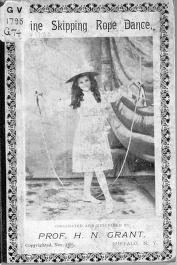
Irine skipping rope dance,
Unknown artist · 1895
Public Domain
Continue Exploring
Lineage of Dance
500 years of dance evolution
Champions of Dance
Winners of marquee national & world titles
Language of Dance
161 dance terms & translations
Listening of Dance
Tempo, timing & musicality tools
Gallery of Dance
5,700+ artworks from museum collections
Attire of Dance
Evolution of dance dress across eras
Keep the thread going
Dance history, technique, and the occasional rabbit hole — in your inbox. Thoughtful, infrequent, unsubscribe anytime.
Free. No spam. One click to leave.