49 works in this view — arrow keys or swipe to move between them.
Dance in Art · 1895
Irine skipping rope dance,
Unknown artist
- Source:
- Library of Congress
- Rights:
- Public domain — free to use, share and adapt.
- Recorded as:
- Public Domain
This work documents a transitional moment in dance history: the emergence of non-balletic bodily movement as a subject for serious performance and documentation. It shows how skipping rope—an everyday activity—was elevated to the status of formal performance by professional instructors, anticipating the early modern dance movement's interest in ordinary movement and athletic physicality. For historians of physical culture, gymnastics, and performance, it provides concrete evidence of what professional physical training looked like at the turn of the 20th century.
What you are looking at
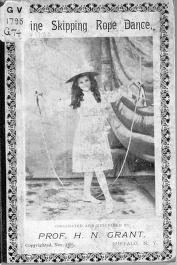
A young woman in late Victorian dress performs a skipping rope exercise or dance against a plain background. She wears a dark jacket or bodice with long sleeves, a white high-collared shirt, and a long skirt that extends to her ankles—typical gymnasium or performance costume of the 1890s. Her body is captured mid-motion: one leg is raised high in front, the other extended behind, and her arms are positioned to work the rope. The photograph has the quality of a studio portrait, with even lighting and a neutral backdrop that emphasizes the figure and the mechanics of the movement. The image carries a label identifying the subject as "Prof. H.N. Grant," suggesting this documents a specific performer or instructor demonstrating the activity.
The dancing
A single female figure dominates the composition, photographed in profile or three-quarter view to show the full extension of limbs and the rope work. The weight appears to be on one leg while the other drives upward in a high knee position—characteristic of vigorous rope-jumping athleticism. Her posture is upright and controlled, with the arms raised to shoulder height or above, clearly managing the rope. The overall frame suggests dynamic motion frozen at its peak moment, conveying both strength and precision.
The dance depicted
This is not classical theatrical dance but rather a documented skipping rope exercise or demonstration, likely part of a physical training or gymnastic display popular in the late 19th century. The label "Prof. H.N. Grant" suggests an instructor demonstrating or performing the movement for instructional or promotional purposes. Skipping rope was a standard component of physical education curricula and performative physical culture movements of the 1890s, often presented as both exercise and entertainment. The photographic documentation indicates this was considered worthy of formal recording, suggesting it held status as a public demonstration or performance activity rather than mere casual play.
How it was made
This is a black-and-white photograph, most likely a silver gelatin print or albumen print typical of the 1890s. The even lighting, sharp focus on the figure, and studio setting are consistent with professional portrait photography of the period. The photograph was clearly made from glass plate negatives that allowed for reproduction and distribution—as evidenced by its presence in an archive accessible through the Library of Congress. The medium allowed the capture of a fleeting moment of athletic motion with clarity that painting or engraving could not match, making it valuable for documenting physical training and performance technique.
About this work
This photograph documents a skipping rope exercise or performance by or attributed to Prof. H.N. Grant, likely from the 1890s. It belongs to a body of late Victorian photographic records of physical culture, gymnastics, and athletic performance—a category of imagery that occupied an ambiguous space between instructional documentation, promotional portrait, and performance art. The work preserves a moment of the period's fascination with codified physical training and the display of the disciplined body in motion. It represents an important precursor to modern dance and contemporary physical theater in its treatment of non-narrative bodily movement as something worthy of formal documentation and public attention.
How to look at it
Attend to the moment chosen by the photographer: the peak of the jump, when one leg is fully extended upward and the body is most dramatically extended. This choice emphasizes the dynamic lift and control of the movement. Notice the careful composition that frames the full body against an empty background, making every line of the figure legible. The photograph presents this as a moment of disciplined power—the body performing according to precise mechanical principles—which was central to late Victorian physical culture ideology. The formal studio setting and professional presentation signal that this was not casual activity but formalized, documented training or performance.
The artist
The photographer is not identified in the catalogue record. The subject is identified as "Prof. H.N. Grant," suggesting a professional instructor or performer in physical culture or gymnastics. Grant may have been associated with a gymnasium, dance studio, or theatrical training institution, though without additional records the specific context remains unclear.
The period
The 1890s saw a widespread movement in Europe and North America toward physical culture, scientific gymnastics, and the reform of bodily training. This period witnessed the rise of professional physical educators, the systematization of athletic training, and growing interest in demonstrating the human body in controlled motion. Photography had become the standard medium for documenting and publicizing such activities, and theatrical performance increasingly incorporated athletic and gymnastic movement. This was also the era in which ballet was beginning to absorb more varied movement vocabularies, and when pedagogues and performers were experimenting with movement outside traditional balletic forms.
Where it lives
The source is listed as the Library of Congress (LOC). This is a single photograph in an archive of images related to dance and physical performance, though specific holding information and accession details are not provided in the catalogue record.
Dance in this work
Questions about this work
Is this actually dance?
This is a borderline case between exercise and performance. Skipping rope was demonstrated and taught as a formalized physical activity by professional instructors like Prof. Grant, photographed as performance or instructional documentation. It sits at the edge of what we now call dance—it shares the era's interest in codified bodily movement, professional instruction, and public documentation, but lacks the narrative or aesthetic intention we typically associate with dance proper. It is historically important precisely because it challenges those boundaries.
Who was Prof. H.N. Grant?
The catalogue record does not identify Grant beyond the title. The "Prof." designation indicates a professional instructor or performer, likely in physical education, gymnastics, or physical culture. Without additional archival information, the specific details of Grant's career and reputation remain unknown.
Why would skipping rope be photographed and labeled this way?
In the late 1890s, physical culture was a serious movement with professional practitioners who demonstrated and taught systematic bodily training. Professional demonstrations were photographed for promotional purposes, for instructional documentation, and for circulation in fitness and athletic communities. The formal portrait-style photograph suggests this was considered worthy of the same documentation as theatrical performance.
What does the rope tell us about the movement?
The rope indicates vigorous, rhythmic, controlled jumping—the kind of exercise prescribed in physical training curricula of the period. The rope itself is barely visible in the photograph, but its presence transforms casual hopping into a formalized, measurable activity: skipping rope was systematized with variations, speeds, and techniques, much like gymnastic exercises. This formalization is part of what elevated it to something worth documenting as performance.
More dance artwork





