25 works in this view — arrow keys or swipe to move between them.
Dance in Art
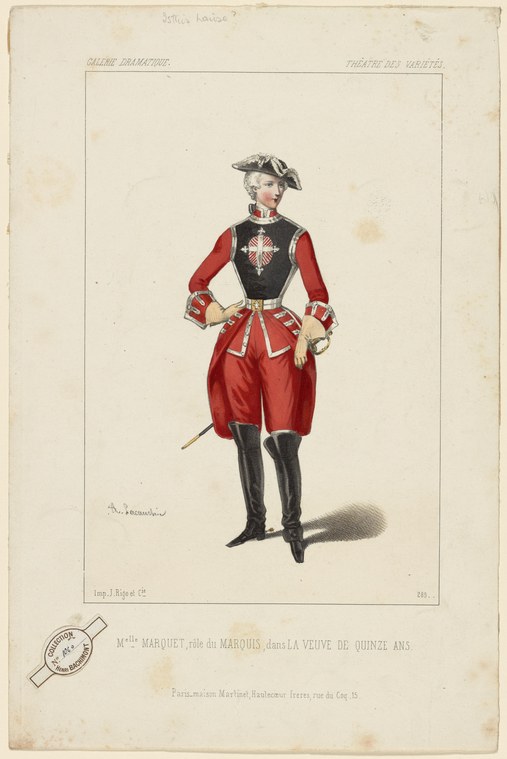
Melle Marquet, rôle du marquis, dans La veuve de quinze ans
Unknown artist
- Collection:
- Prints depicting dance
- Source:
- New York Public Library
- Rights:
- Public domain — free to use, share and adapt.
- Recorded as:
- Public Domain
This work documents the costume conventions and character presentation of 19th-century theatrical comedy, showing how aristocratic identity was visually constructed on stage. It also records the career and fame of a specific performer (Melle Marquet) and her celebrated role, making it valuable evidence for theater historians studying performance history and the celebrity system of the period. As a printed costume study, it demonstrates how theatrical roles were promoted and preserved in an era before photography became dominant.
What you are looking at
A single female figure stands in a formal three-quarter pose against a plain background, wearing an elaborate theatrical costume of the late 19th century. The dominant color is a brilliant red: a voluminous skirt with deep pleats and a high waistband, paired with a striking red velvet or silk jacket with long sleeves. Over the jacket is a black velvet bodice or corset front, fastened with ornate gold and jeweled buttons arranged in a cross pattern. A white shirt or chemise shows at the neck and wrists. The figure wears a black three-cornered hat tilted at a jaunty angle, and black stockings and shoes. The pose is statuesque and dignified—feet planted firmly, one hand resting at the hip, the other at the side—as if presenting the costume for inspection. She stands holding a thin sword or épée at her side. The figure's bearing is aristocratic and confident, the costume suggesting the role of a nobleman or marquis.
The dancing
The single dancer is presented in an iconic standing pose rather than in motion, which was conventional for theatrical costume studies of this era. Her weight is evenly distributed on both feet, the body held upright with shoulders back and chest forward. The arms hang naturally at the sides in a relaxed but dignified manner; there is no dynamic gesture or held frame suggesting a partner dance. The pose is formal and presentational—a 'display' stance rather than a moment caught mid-movement. The figure does not appear to be in the act of dancing but rather dressed and posed to show off the costume and character.
The dance depicted
This is a costume study for a theatrical character role, specifically the marquis character from the operetta or comedic theatrical piece 'La veuve de quinze ans' (The Widow of Fifteen Years). The image documents the character costume and styling rather than a moment of actual dance. The dress suggests late 18th-century aristocratic male fashion as interpreted for stage—the red breeches (culotte), black coat, and decorative sword are attributes of an aristocratic gentleman. The pose and presentation are typical of theatrical costume documentation of the 19th century, when performers' portraits in full costume were common as promotional material and records of celebrated roles. This is not a depiction of a specific dance style but rather evidence of the theatrical conventions and visual presentation of character in comedic or operatic theater.
How it was made
This is a hand-colored engraving or lithograph, typical of 19th-century theatrical documentation. The work shows the precision of line and subtle modeling characteristic of engraving, with color applied by hand in a controlled and uniform manner. The technique allowed for relatively inexpensive reproduction, making it ideal for theatrical promotion and circulation in programs, journals, or as collectible prints for fans and scholars of theater. The quality of execution and the formal presentation suggest this was a professional studio production made for publication, likely from a theater company or print publisher specializing in theatrical documentation. Such prints served as records of celebrated performers in famous roles and as promotional material for theatrical productions.
About this work
This is a theatrical costume documentation in hand-colored engraving from the 19th century, depicting the marquis costume from 'La veuve de quinze ans,' performed by an actress identified in the caption as 'Melle Marquet.' The work belongs to a well-established tradition of theatrical costume studies—images made to preserve the visual appearance of stage roles and celebrate celebrated performers. While the image shows a figure in formal dress rather than in the act of dancing, it is historically important to understanding the aesthetics, conventions, and social presentation of theatrical performance in the mid-to-late 19th century. Such prints document not only the costume and styling of the period but also the structure of character roles and the visual language through which theatrical identity was communicated to audiences and preserved for posterity.
How to look at it
The figure is presented not in a moment of dance but in a formal posed stance—a convention of theatrical costume documentation that prioritized clarity and visibility of the costume over capturing movement or dramatic action. Observe how the artist has used line and color to articulate the distinct planes of the costume: the voluminous red skirt, the jeweled bodice front, the black coat, and the decorative sword. The pose is aristocratic and dignified because it must convey the character's identity and social status. The stillness and formality are intentional: the work aims to document the costume and character type rather than to animate a particular moment of performance. For a viewer accustomed to seeing dance in motion, this emphasizes how much 19th-century theatrical culture valued the visual documentation and circulation of costume and role as distinct from the act of performance itself.
The artist
The artist is not recorded in the catalogue. The signature visible on the print suggests a professional studio engraver or lithographer working in Paris, likely in the mid-19th century. The quality and style suggest someone trained in the conventions of theatrical costume documentation and commercial print production. Such prints were frequently created by theater studios or commercial publishers with access to stage productions and performers.
The period
In the mid-to-late 19th century, theatrical costume studies became an important and collectible form of documentation. Lithography and hand-colored engraving allowed for relatively affordable mass production, making images of celebrated performers and roles widely available to theater enthusiasts and the general public. The aesthetic of this work reflects the conventions of theatrical realism and historical costume drama that dominated European theater in this period. Theater was a major form of public entertainment and social engagement, and images of performers in famous roles were treated as valuable records and promotional materials. The operetta and comedic theater thrived during this period, and 'La veuve de quinze ans' appears to have been a popular and often-performed work.
Where it lives
This print is part of the New York Public Library's collection of prints depicting dance and theatrical performance. It appears to have been acquired or catalogued as a dance-related artwork, though it is more accurately a theatrical costume study. The work represents the kind of popular theatrical ephemera that circulated widely in the 19th century—prints made for promotion, collection, and archival record of celebrated performances.
Questions about this work
Is this person actually dancing?
No. This is a theatrical costume study—a formal portrait in character dress. The figure is posed for documentation and display, not captured in the act of dancing or in a dramatic moment from the performance. Such portraits were standard in 19th-century theater promotion and archival practice.
What is 'La veuve de quinze ans'?
This was a comedic or operatic theatrical piece performed in the 19th century. The title translates to 'The Widow of Fifteen Years.' Melle Marquet performed the role of the marquis (a male aristocratic character), likely as a comedic cross-dressed or trouser role, which was a popular theatrical convention of the period.
Why is an actress playing a marquis?
In 19th-century theater, actresses frequently performed male roles, particularly in comedic and operatic works. Breeches roles (where actresses wore male costume) were a celebrated and popular theatrical convention, allowing for comedic variation, audience engagement, and showcase of the performer's versatility and figure.
What does this tell us about dance in this era?
While this is not a dance image per se, it documents the theatrical context in which dance existed—operettas and comedic theater frequently included musical numbers, dances, and musical interludes. It also shows how theatrical roles were visually documented and circulated, and how performance culture valued the preservation and promotion of celebrated roles and performers.
More dance artwork





