49 works in this view — arrow keys or swipe to move between them.
Dance in Art
Lucile Grahn
Unknown artist
- Collection:
- Prints depicting dance
- Source:
- New York Public Library
- Rights:
- Public domain — free to use, share and adapt.
- Recorded as:
- Public Domain
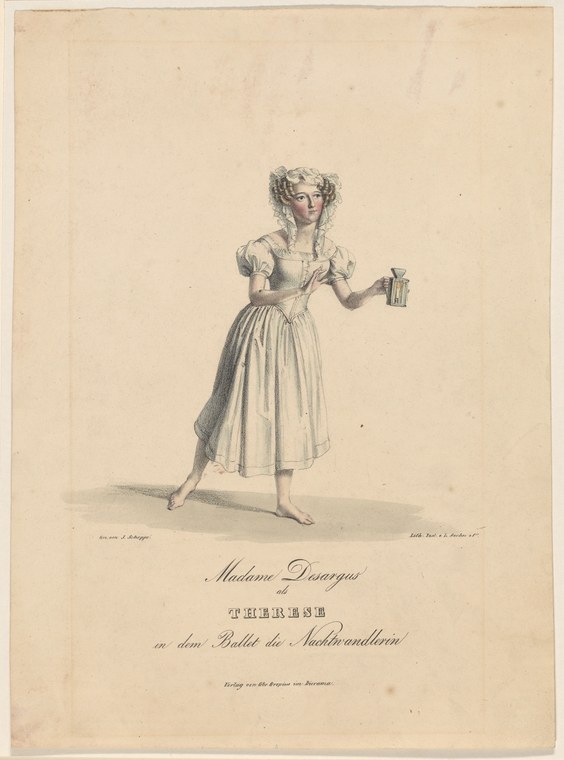
Lucile Grahn was among the most celebrated dancers of the Romantic ballet era, and this portrait captures how the star system worked—the dancer's face and fashionable appearance were as much the product as her technique. The print demonstrates the importance of lithography and engraving in building and sustaining a dancer's public persona in an age before photography.
What you are looking at
A three-quarter-length portrait of a young woman seated against a softly shaded background, her body angled to the right while her gaze turns toward the viewer. She wears a pale, off-shoulder ball gown with voluminous puffed sleeves gathered at the elbow with ruffled cuffs, the bodice fitted and the skirt falling in deep, regular folds to her ankles. Her dark hair is smoothed back and adorned with white flowers tucked behind her ear. Her left arm rests naturally across her lap while her right dangles over the chair arm; her pose is one of composed rest rather than active movement. The engraving technique creates soft gradations of tone, particularly in the shadows around the figure and the fabric's volume, suggesting this is a formal portrait print made for circulation among theater-going audiences.
The dancing
The sitter is shown in a state of repose—seated, composed, with no indication of active dance movement. Her posture is upright but relaxed; her arms and hands are placed with the studied elegance expected in portrait convention of the period. There is only one figure. The pose suggests a between-moments intimacy, as if the artist has caught her in a moment of stillness during or after performance.
The dance depicted
The inscription identifies this as Lucile Grahn, a celebrated Romantic-era ballerina of the mid-19th century. Grahn was known for her roles in Romantic ballet, particularly for her work with Auguste Bournonville in Denmark and her appearances in major European houses. This portrait presents her not mid-performance but as a society figure, dressed in the fashionable ball gown of the 1830s–1840s. The image celebrates her as an artist and celebrity rather than capturing her in the act of dancing; it is a publicity portrait, the kind produced and sold to make her face and figure familiar to admirers.
How it was made
This is a lithograph or steel engraving (the technique is not recorded but the image's characteristics—fine line work, subtle tonal modeling, the crisp signature at lower right—suggest engraving). The medium allowed for mass production and wide distribution; such prints were sold to theater patrons and collectors, making the dancer's image a commodity as important as her performances. The delicate handling of light and shadow, and the careful rendering of fabric texture, indicates skilled execution and a work aimed at an educated audience.
About this work
This is a formal portrait engraving of Lucile Grahn, a principal Romantic ballerina, presented in the fashionable dress of the 1830s–1840s. Rather than depicting her in dance, it shows her as a society celebrity and object of admiration—the kind of image sold to theater audiences and collectors to cement her fame and desirability. The work belongs in a gallery of dance in art not because it shows the dance itself, but because it reveals how Romantic-era dancers were commodified and presented to the public, and how the female ballet body was packaged and circulated as an image distinct from the performance.
How to look at it
Attend to the tension between stillness and grace: this is not a dance pose, but a pose designed to suggest the dancer's refinement and allure. The careful arrangement of the fabric, the studied hand positions, and the direct but serene gaze are all conventions of mid-19th-century celebrity portraiture. Notice how the artist has emphasized the delicacy and femininity associated with Romantic ballet through the rendering of the pale gown and smooth modeling of the face, creating an image of aspiration rather than action.
The artist
The artist is not identified in the catalogue record. The signature visible at lower right of the print may provide attribution, but cannot be confidently transcribed from this image. The print itself is likely a commercial publication, made by a printmaker working from a painting or drawing, following the standard 19th-century practice of creating and selling celebrity portraits to a paying public.
The period
This portrait dates to the height of Romantic ballet in Europe, roughly the 1830s–1850s. During this period, ballet transitioned from court spectacle to commercial theater, and dancers became stars whose images were as marketable as their performances. The off-shoulder ball gown shown here was fashionable in this era and conveyed both elegance and the feminine ideal of the Romantic period. Lithography and steel engraving had made high-quality portraiture affordable and widely available, allowing dancers and opera singers to build fan bases through the circulation of their printed likenesses.
Where it lives
The print is held by the New York Public Library in their collection of prints depicting dance. It is labeled as a gift of Lillian Moore, a major dance historian and collector who donated her materials to NYPL, making this part of an important archival collection documenting the history of dance in America and Europe.
Questions about this work
Who was Lucile Grahn?
Lucile Grahn (c. 1819–1907) was a Danish-Swedish dancer and one of the principal ballerinas of the Romantic era. She performed across Europe, most notably in Copenhagen with choreographer Auguste Bournonville, and was celebrated for her roles in ballets including La Sylphide. She was known for her technical skill and her ability to embody the ethereal, otherworldly characters that defined Romantic ballet.
Why does the portrait show a ball gown instead of a ballet costume?
Romantic-era celebrity portraits often presented dancers in fashionable street or evening dress to emphasize their status as sophisticated society figures, not just performers. The ball gown situates Grahn within the world of fashion and gentility, making the portrait appeal to a broad audience of admirers and collectors. This was standard practice for marketing theater stars.
Is this a painting or a print?
This is a print—most likely a lithograph or steel engraving, created for mass reproduction and sale. The technique allowed fine detail and subtle toning while keeping the cost low enough for ordinary theater patrons to purchase. This made celebrity portraits economical to produce and distribute.
What was Lillian Moore's role in collecting dance materials?
Lillian Moore (1911–2001) was an American dancer, historian, and librarian who assembled one of the largest private collections of dance-related prints, manuscripts, and memorabilia. Her collection, donated to the New York Public Library, became a foundational resource for dance scholarship and is still widely consulted by researchers.
More dance artwork