49 works in this view — arrow keys or swipe to move between them.
Dance in Art
Fanny Cerrito St. Léon
Unknown artist
- Collection:
- Prints depicting dance
- Source:
- New York Public Library
- Rights:
- Public domain — free to use, share and adapt.
- Recorded as:
- Public Domain
Fanny Cerrito was one of the four great ballerinas of the Romantic era (alongside Taglioni, Elssler, and Grahn), and her image documents the standardized silhouette and visual codes of mid-nineteenth-century classical ballet. Engravings of this kind were the primary way audiences encountered and collected images of celebrated dancers, making them crucial documents of how dance was mediated, consumed, and remembered in the era before photography became dominant.
What you are looking at
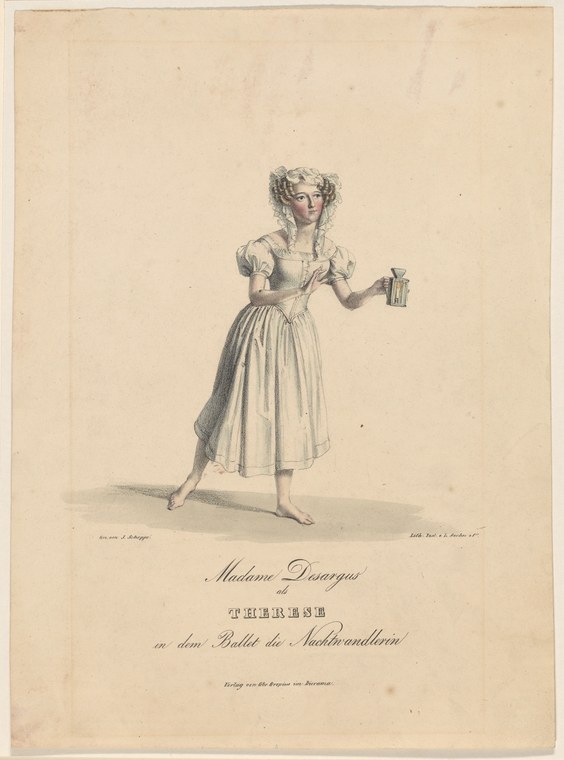
A young woman stands in three-quarter view against a plain background, gazing toward the left. She wears a romantic-era ballet costume: a white muslin chemise with short puffed sleeves, a corseted bodice in a contrasting tone (darker in the shading), and a full skirt of moderate length—ending well below the knee but not to the ankle, typical of mid-nineteenth-century stage dress. Her hair is dark and arranged with a decorative net or snood pulled back from her face, with a small feathered ornament or jeweled circlet on top. She wears a simple pearl necklace. Her posture is composed and frontal, weight evenly distributed, hands clasped loosely at her waist. The engraving uses fine cross-hatching and tonal gradation to model the fabric and create atmospheric depth; the figure stands isolated, without dancers, musicians, or scenery to situate the moment.
The dancing
The single figure demonstrates the upright carriage and modest deportment expected of a Romantic-era ballerina. Both feet appear to be in a neutral stance rather than a classical turnout position. The arms hang naturally, neither in classical ports de bras nor in dramatic gesture, conveying an impression of stillness or a pause rather than a moment of sustained movement. The overall impression is of a portrait or costume study rather than a snapshot of active dancing.
The dance depicted
This is a costume and portrait study of Fanny Cerrito, one of the major Romantic ballet dancers of the 1840s–50s. The dress—the white muslin skirt, the fitted bodice, the short sleeves, and the headdress—conforms to the standard Romantic ballet aesthetic established by Marie Taglioni and followed by her contemporaries. However, the image captures no active moment of performance: the figure is posed for documentation rather than depicting a specific choreographed phrase or character from a known ballet. It is a professional portrait of a dancer in her theatrical costume, likely created for circulation among audiences and theatre patrons.
How it was made
This is an engraving—a fine-line print technique using parallel and crossed hatching to create tone and form. The delicate modeling of the fabric, the subtlety of the face, and the refined tonal range suggest a skilled reproductive engraver working from a drawing or painting. The technique allowed wide distribution of the dancer's image and was a standard way of circulating portraits of celebrated performers in the nineteenth century. Engravings like this were pasted into theatrical playbills, sold as separate prints, or bound into illustrated periodicals and annuals, making them accessible to the theatre-going public.
About this work
This is a portrait engraving of Fanny Cerrito, a celebrated Romantic-era ballerina, shown in the costume of her period: white muslin skirt, fitted bodice, and decorative headdress. The image is not a depiction of a dance in progress, but rather a costume study and celebrity portrait—a record of how the performer appeared to her audience and how her theatrical dress was understood and valued. As such, it belongs in a gallery of dance in art as an artifact of theatrical culture and the commodification of the dancing body in the nineteenth century, and as documentation of the aesthetic of Romantic ballet in its canonical form.
How to look at it
This is a static portrait, not a dynamic action scene, so the viewer should attend to costume and carriage rather than footwork or partnering. Notice the proportions of the skirt—how its fullness is managed by the corseted waist and how it falls without stiffness. Observe the refined face, the delicate necklace, the decorated headdress: these details convey the dancer's status as a celebrated artist and a figure of refined beauty. The engraver's technique of fine cross-hatching creates an illusion of translucent muslin and silk, qualities that were central to the Romantic ideal. This is a portrait of a performer as a visual object, not as a mover.
The period
This engraving dates from the height of the Romantic ballet era, roughly 1840s–1850s, when a small number of female dancers achieved celebrity status and international touring fame. The Romantic movement in ballet emphasized otherworldliness, ethereal femininity, and the illusion of weightlessness—values visually encoded in the white tulle skirt, pale palette, and upward-gazing demeanor of the period. Engravings and lithographs of famous dancers circulated as commodities (sold as loose prints, bound into gift-books and theatrical annuals, pasted into scrapbooks), creating a culture of fan appreciation that prefigured modern celebrity culture. The image reflects the ascendancy of ballet as a visual and sensual spectacle aimed at a bourgeois audience.
Where it lives
This engraving is held in the New York Public Library's Prints depicting dance collection, part of a substantial archive of nineteenth-century theatrical prints, playbills, and dance-related ephemera. Such prints were typically published in limited runs for sale to the theatre-going public and are now scattered across institutional and private collections.
Dance in this work
Questions about this work
Was Fanny Cerrito a famous dancer?
Yes. Cerrito was one of the four greatest Romantic ballet dancers of the nineteenth century, alongside Marie Taglioni, Fanny Elssler, and Carlotta Grahn. She was known for her technical brilliance, her Italian dramatic style, and her success as a performer and choreographer across Europe and America from the 1830s to 1860s.
Why is she dressed but not dancing?
This is a costume portrait, a deliberate genre in nineteenth-century theatrical culture. Dancers and opera singers were depicted in their stage dress to preserve and circulate their image to audiences. It functioned as both a souvenir and a promotional object, allowing theatregoers to collect and remember their favourite performers.
What is the white skirt made of?
Romantic-era ballet skirts were made of tulle (a fine silk netting), often in multiple layers, which created the lightweight, ethereal effect visible in the engraving. The skirt length—ending below the knee—was standard for the period and allowed visibility of the dancer's legs and footwork while maintaining an impression of delicate femininity.
Is this engraving unique or was it mass-produced?
It is a reproductive engraving, a print made from a plate, so multiple impressions were produced. Such prints were sold individually or bound into theatrical annuals and illustrated periodicals. Different engravers and publishers created similar portraits of the same dancer, so multiple versions of Cerrito's image exist.
More dance artwork