49 works in this view — arrow keys or swipe to move between them.
Dance in Art
No. 96, Tyrolienne
Unknown artist
- Collection:
- Prints depicting dance
- Source:
- New York Public Library
- Rights:
- Public domain — free to use, share and adapt.
- Recorded as:
- Public Domain
The Tyrolienne is a crucial case study in how 19th-century ballet borrowed from and transformed folk and regional idioms for urban theatrical consumption. This print is a primary document of how the dance was actually dressed, posed, and presented to audiences—not a description, but a souvenir made for people who had seen it performed. For dance historians, it offers direct evidence of the gesture vocabulary, costuming, and performance ethos of a now-extinct genre.
What you are looking at
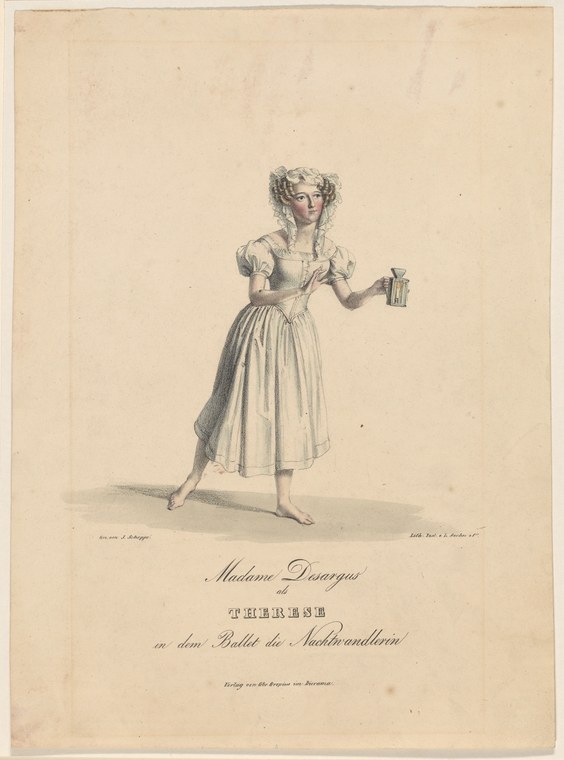
A single female dancer stands in three-quarter view against a plain ground, captured in a moment of arrested motion characteristic of 19th-century theatrical portraiture. She wears a pale muslin skirt with a fitted bodice in darker fabric (likely silk or cotton damask), with short puffed sleeves and a deep neckline. Her hair is elaborately dressed and pinned with what appears to be a decorative comb or ornament. She holds her arms in an open, expressive position: one raised to shoulder height with the hand gesturing outward, the other extended at a similar level to the side. A small bouquet or garland hangs from her wrist. Her weight appears centered over her legs, with her body tilted slightly forward in a posture of animated presentation. The figure is rendered in black ink with careful attention to the fall of fabric and the play of light across her dress, using fine cross-hatching to create volume and shadow. The image has the quality of a stage performer captured mid-gesture, as if acknowledging applause or engaging with an unseen partner.
The dancing
A single female dancer dominates the composition. Her frame is open and presentational—chest lifted, shoulders back—with both arms raised to approximately shoulder height in an attitude of welcome or expression. The raised arm has the hand turned outward with fingers extended; the other arm extends to her side. Her stance is upright and relatively still, with weight evenly distributed, suggesting a moment between movements rather than mid-leap or turn. The pose emphasizes the display of the costume and the dancer's upper body carriage, typical of early 19th-century theatrical dance where the figure was presented frontally to the audience.
The dance depicted
This is almost certainly a Tyrolienne, a popular theatrical dance of the Romantic era (1820s–1850s) that drew on Alpine folk traditions but was adapted for the European stage. Tyroleennes were typically performed by female dancers in light, picturesque costume and characterized by a cheerful, rustic demeanor: bright arm movements, open posture, and an air of naive charm. The title "Tyrolienne" on the print confirms this identification. The costume here—the pale muslin skirt and fitted bodice—matches the conventions of the genre exactly. The dancer's animated gesture and direct presentation to the viewer suggest the flirtatiousness and theatrical directness that made the Tyrolienne a vehicle for solo and ensemble display in ballet and opera throughout the period.
How it was made
This is a lithograph or engraving, executed in black ink on paper; the technique cannot be definitively determined from the image alone, but the fineness of line and the quality of tonal modeling using parallel hatching suggest engraving or possibly chalk lithography. The image shows evidence of careful hand-working—the dress is rendered with particular attention to fabric weight and the fall of folds—and the overall finish indicates a professional commercial print. The composition is framed with a thin ruled border, standard for theatrical prints of the 1820s–1840s, and the title is lettered by hand below the image. This was a type of mass-produced souvenir, sold at theaters and in print shops to memorialize celebrated dancers and roles.
About this work
This is a souvenir print documenting a Tyrolienne, one of the most popular theatrical dances of the Romantic ballet era. It records a single performer—likely a celebrated dancer of the 1820s–1840s, though the artist and subject remain unidentified—in the costume and characteristic pose of the genre: a woman in pale muslin, arms open in animated gesture, presenting the cheerful, rustic persona that made the Tyrolienne a staple of European stage entertainment. The print belongs to a large body of theatrical portraiture that circulated to document specific dancers in specific roles, serving both as advertisement and souvenir. Such prints were often sold in the theater lobby or through print dealers and constituted a significant visual archive of Romantic-era dance practice.
How to look at it
Notice the precise moment the artist chose: not a leap or a pirouette, but a moment of open, frontal presentation—the dancer acknowledging the audience or preparing to move. This reflects the structure of Romantic-era dance, which often alternated between episodes of virtuosic movement and moments of stillness and direct address. The hand positions and arm carriage tell the story: the raised arm with extended hand is a gesture of gaiety and openness, while the open chest and upright posture convey the "innocent" cheerfulness that was essential to how audiences read the Tyrolienne. The muslin skirt is rendered with careful attention to its weight and drape—this was a deliberate choice, meant to display the fabric's translucence and the dancer's line beneath it, a key element of Romantic-era female ballet costume.
The period
The Tyrolienne emerged in the 1820s as part of the broader Romantic embrace of folk culture, peasant costume, and Alpine scenery. It appeared in ballets and operas across Europe—notably in Auber's *La Muette de Portici* (1828) and in numerous ballet d'action productions—and became a vehicle for female dancers to display technical skill within a narrative frame of innocent rusticity. The costume (pale muslin, fitted bodice, simple hair ornament) deliberately mimicked what European audiences imagined Alpine peasant dress to be: the muslin skirt was especially prized for its ability to show the line of the leg and the delicacy of footwork. The 1820s–1840s were the commercial heyday of theatrical portraiture; prints of celebrated dancers in famous roles were produced in large numbers and sold as commodities, making this image part of a significant infrastructure of theatrical publicity and fan culture.
Where it lives
This print is held by the New York Public Library as part of its collection of theatrical and dance imagery. The catalogue record offers minimal information: the title "No. 96, Tyrolienne" and a reference to a print collection, with no artist, date, or subject identified. The numbering suggests it was part of a series—possibly a numbered suite of theatrical portraits—but the series itself remains untraced in the present record.
Dance in this work
Questions about this work
What is a Tyrolienne?
A Tyrolienne is a theatrical dance that emerged in the 1820s, drawing aesthetic inspiration from Alpine folk traditions but performed on the European stage in ballet and opera. It was typically a solo or ensemble piece for female dancers, characterized by bright, open arm gestures, an upright carriage, and a cheerful, rustic persona. The costume—pale muslin skirt, fitted bodice, simple ornaments—was designed to evoke Alpine peasant dress and to display both the dancer's line and the fabric's delicacy. The Tyrolienne was one of the most popular character dances of the Romantic era.
Who danced this role and when?
The catalogue record does not identify the dancer or the date of performance. The style of the print and the fashion of the costume suggest the 1820s–1840s, but without additional information on the series to which this print belonged or the theater or publisher that commissioned it, the specific identity cannot be established. The numbering ("No. 96") indicates it was one of a series, but that series has not been traced.
Why does the dancer have her arms raised like that?
The pose captures a moment of presentation or greeting, characteristic of the Tyrolienne's performance style. The raised arm with extended hand gestures outward in a movement of openness or gaiety; the other arm, extended to the side, completes a balanced, open frame. This posture allowed the dancer to display both the costume and her own carriage to the audience, and it conveys the cheerful, engaging persona that was central to how the Tyrolienne was understood. It is not a technical step, but a moment of display and direct address.
What does the print tell us about Romantic-era dance?
This image documents how Romantic-era ballet presented and consumed folk-inspired material. It shows that the Tyrolienne was danced in relatively simple, transparent costume (pale muslin was chosen deliberately to show the leg line), with emphasis on open arm work and upright carriage rather than extreme technical display. The fact that such prints were produced commercially in series indicates that individual dancers in famous roles became minor celebrities, and that images of performances circulated as theatrical merchandise—an early form of fan culture.
More dance artwork