26 works in this view — arrow keys or swipe to move between them.
Dance in Art
Vestris
Unknown artist
- Collection:
- Prints depicting dance
- Source:
- New York Public Library
- Rights:
- Public domain — free to use, share and adapt.
- Recorded as:
- Public Domain
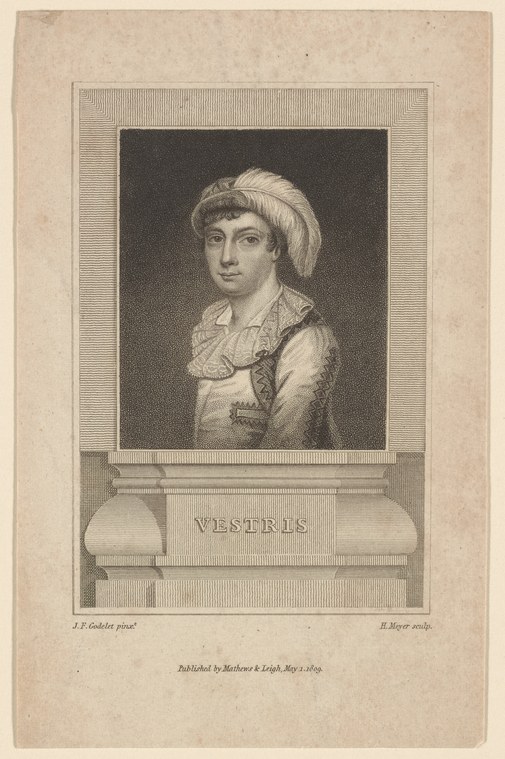
This portrait reveals the extraordinary cultural prestige of the Vestris family at the height of the 18th-century ballet world—famous enough to be commemorated in print in the manner of great poets and historical figures. It also shows that dance portraiture of the period was often formal and static rather than narrative or action-based, concerned with presenting the dancer as a refined personage rather than capturing technique or performance.
What you are looking at
A three-quarter-length portrait of a young male dancer set within a neoclassical stone plinth inscribed 'VESTRIS'. The figure wears the formal court dress of the late 18th century: a fitted coat with embroidered or patterned sleeves, a white cravat at the neck, and a white cap or headpiece that sits atop his styled hair. His pose is elegant and composed, weight distributed evenly, one arm held with natural grace. The background is rendered in deep shadow, throwing the figure into sharp relief. The plinth below—complete with projecting base and capital—transforms the portrait into a memorial or celebratory monument, suggesting this depicts a dancer of considerable fame and status. The engraving technique creates fine linear hatching that models the fabric, face, and musculature with precision. The overall effect is one of dignified restraint; this is not a narrative scene but an icon.
The dancing
A single standing figure in a relaxed but dignified stance, neither in active movement nor in a specific dance position. The body is upright with shoulders held naturally; the arms hang at the sides or rest lightly, without tension or extension. The weight appears evenly distributed, and there is no visible turnout or balletic frame. The face is rendered with classical idealization—fine features, gentle expression—gazing slightly downward or into the middle distance. This is a posed presentation rather than a captured moment of dancing.
The dance depicted
The inscription 'VESTRIS' and the format—a commemorative portrait within a plinth—almost certainly refers to a member of the Vestris family, the most celebrated dancers of the 18th century. The Vestris name dominated European ballet from the 1740s onward; the most famous were Gaëtan Vestris (le dieu de la danse, 1729–1808) and his son Auguste (1760–1842). Without further inscription or attribution, the identity cannot be certain from the image alone, but the neoclassical dress and styling suggest a date in the late 1700s. The portrait style—formal, commemorative, lacking any depiction of actual choreography—treats the subject as a cultural icon rather than as a dancer in performance. No specific dance technique is legible in the pose.
How it was made
This is an engraving, executed with fine parallel lines (hatching and cross-hatching) to create tone and volume. The shallow plinth and inscription suggest this was part of a series of portrait prints, likely produced for circulation among the educated and theatre-going public. The scale, format, and technique place it within 18th-century print culture—affordable, repeatable, and suited to both framing and album inclusion. The quality of line-work and the classical restraint of the composition suggest a professional metropolitan engraver working from a drawing or painting, possibly by a celebrated portraitist.
About this work
This is a commemorative engraved portrait of a celebrated 18th-century dancer, almost certainly a member of the Vestris family who dominated European ballet in their era. The work places the dancer within a neoclassical architectural frame—a convention borrowed from antiquity and applied to contemporary cultural figures. Rather than depicting a moment of choreography or performance, it presents the subject as a timeless exemplar of grace and refinement, dressed in the formal court style of the period. The engraving format meant it circulated widely and could be owned and displayed by admirers and fellow professionals alike. It stands as evidence of the celebrity status dancers had achieved by the late 1700s, worthy of the same monumentalizing treatment as poets, statesmen, and philosophers.
How to look at it
The power of this portrait lies in what it does not show: no choreography, no action, no evidence of the dancer's technique. Instead, attend to the formal dignity of the presentation—the classical plinth, the ideal proportions, the refined costume. This communicates that the dancer is worthy of the same memorial treatment as a statesman or scholar. The engraving technique, with its precise linear hatching, creates an image that is both accessible (as a print) and durable (as an engraved plate could be printed in multiple states and editions). The downcast gaze and composed posture suggest introspection and nobility rather than performative energy.
The artist
The print bears signatures indicating it was drawn and engraved by professionals: 'J.J. Galdins pinxt' (painter) and 'E. Mayer sc.' (engraver). These are known practitioners of the 18th-century print trade in France, producing high-quality reproductive engravings for the cultural market. The work sits within the tradition of celebrity portraiture that flourished in the 1700s, when dancers, actors, and musicians became the subjects of prints and paintings distributed to an eager public.
The period
The late 18th century saw ballet established as a major European art form, centered in Paris and dominated by a handful of family dynasties. The Vestris family—beginning with Marie-Anne Vestris and Gaëtan Vestris (dit l'Aîné)—were the reigning stars of the Opéra for decades. By the 1780s and 1790s, dancers had achieved a celebrity status rivaling that of singers and actors, and were commemorated in engravings, paintings, and sculptures. The neoclassical style of this plinth reflects the broader aesthetic turn toward antiquity that dominated the visual arts in the 1770s–1790s. Portraiture of dancers at this time was typically formal and genteel, emphasizing beauty and refinement rather than athletic prowess or virtuosity—reflecting the values of aristocratic and upper-middle-class audiences.
Where it lives
The work is held in the New York Public Library's collection of prints depicting dance. It was published by Messieurs & Leigh on May 1, 1809, according to the inscription at the base. As a reproductive engraving from the professional print market, it was one of many such portraits distributed to the public during and after the subject's lifetime.
Questions about this work
Who was Vestris?
Vestris was almost certainly a member of the Vestris family, the most celebrated dancers of the 18th century. Gaëtan Vestris (1729–1808), known as 'le dieu de la danse' (the god of dance), and his son Auguste (1760–1842) were the most famous. Without an additional inscription identifying which Vestris is portrayed, the exact subject cannot be determined from the image alone, but the neoclassical styling and late-1700s dress suggest it is one of these two major figures.
Why is a dancer shown in formal dress rather than in a dance pose?
This reflects the aesthetic conventions of 18th-century portraiture and the values of the period. Dancers of high status were presented as refined gentlemen and women of society, not as athletes or performers. The formal court dress and dignified pose emphasize social status and character rather than technical skill. Dance imagery of this era often prioritized gentility and beauty over the depiction of actual choreography.
What does the plinth signify?
The neoclassical plinth inscribed with the subject's name transforms the portrait into a commemorative monument, a form usually reserved for historical figures, great thinkers, or statesmen. Its presence here indicates that the dancer had achieved extraordinary cultural prestige—worthy of monumentalization and immortality through both the image and the engraved plate.
What was the purpose of this print?
This was a commercial reproductive engraving made for public distribution and sale. Such prints were framed and hung in homes, collected in portfolios, and displayed in print shops. They allowed admirers and fellow theatre-goers to own an image of a celebrated performer. The reproducibility of the engraved plate meant the portrait could be printed in many copies and distributed widely, making the dancer's image accessible beyond the theatre itself.
More dance artwork





