27 works in this view — arrow keys or swipe to move between them.
Dance in Art
Prints after William Hogarth
Unknown artist
- Collection:
- Prints depicting dance
- Source:
- New York Public Library
- Rights:
- Public domain — free to use, share and adapt.
- Recorded as:
- Public Domain
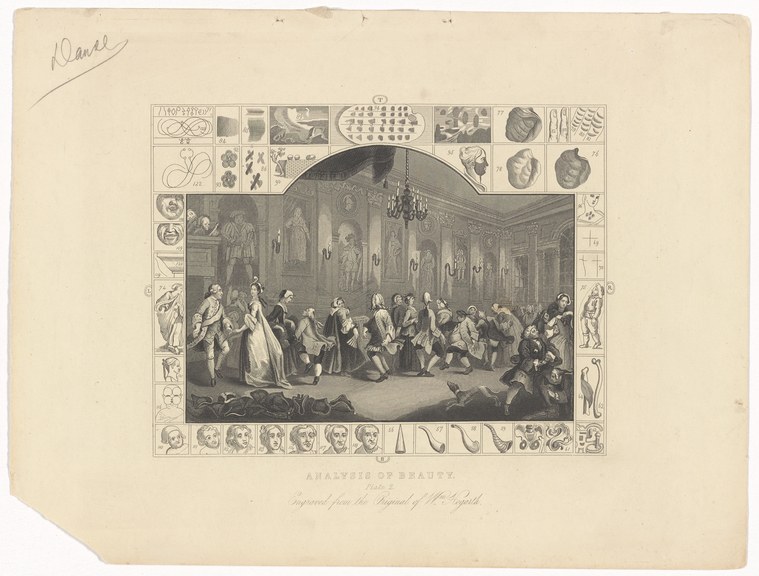
Hogarth's prints are among the most vivid surviving records of eighteenth-century social life and the body practices embedded in it. This image shows how elite bodies were positioned and displayed in formal interiors, the relationship between spectator and performer, and the blurred boundary between dance and non-dance gesture. For historians of dance and manners, it is invaluable evidence of the visual culture within which historical dancing took place.
What you are looking at
A formal assembly in an elegant rococo interior: a crowd of fashionably dressed figures fills a high-ceilinged room with ornate wall panels, a curved vault, and a chandelier. In the center, a woman in a white gown stands with arms raised or extended, apparently the focus of the gathering. The surrounding figures—men in breeches and coats, women in full skirts—are positioned in loose clusters, some watching, some engaged with one another. The light falls evenly across the scene, clarifying the architectural detail and the rich fabrics of dress. This is neither a theatrical stage nor a dance floor in the modern sense, but rather a moment of social spectacle within the domestic or civic sphere, the kind of gathering where display, wit, and rank intersected in eighteenth-century life.
The dancing
The central female figure has her arms raised or extended outward, drawing the eye; her posture suggests a moment of address, demonstration, or performed gesture rather than an active step or turn. The surrounding figures are variously oriented—some face toward her, some toward one another, few in obvious contact. There is no visible closed hold or partner position. The grouping is theatrical in its composition but not balletic in its frame; the bodies are upright and posed rather than in the flow of sustained movement.
The dance depicted
The image does not depict a codified dance in the modern sense. Instead, it captures a moment of social performance, possibly gesture, pantomime, or ceremonial assembly common to elite gatherings of the rococo era. The raised central figure and the watching crowd suggest a practice closer to court ritual or theatrical tableau than to ballroom dancing. Without specific costume indicators (feathered headdresses, rigid arm positions, recognizable footwork), the precise form cannot be identified.
How it was made
This is an engraving or etching, established by the fine linear hatching visible in the architectural shadows and the modulation of tone through line rather than wash. The decorative vignettes surrounding the main scene—profile heads at the bottom, ornamental motifs and anatomical sketches at the sides and top—are characteristic of instructional or satirical prints of the eighteenth century, particularly those after Hogarth, where marginalia and supporting imagery comment on or extend the narrative of the central scene. The technique allowed for wide circulation through the print trade and positioned the work for viewers of modest means as well as collectors.
About this work
This is a print after William Hogarth—a major source of satirical and narrative imagery in the eighteenth century. The composition depicts an aristocratic or wealthy gathering in an interior of obvious expense and refinement, with a central figure commanding attention through gesture or pose. The surrounding vignettes and the narrative precision of Hogarth's style suggest this records not simply a dance, but a social scene in which appearance, wit, and spectacle converge. Hogarth's prints were among the most widely consumed images of the period and shaped how his contemporaries understood fashion, manners, and the artifice of polite society.
The work belongs in a dance gallery as a document of how bodies moved and were displayed in high society, and as evidence of the proximity between dance, gesture, and theatrical performance in the social imagination of the period. It is not a depiction of dance steps, but rather of the occasion and company in which dancing occurred and of the formal arrangement of bodies that preceded, framed, or substituted for it.
How to look at it
Attend first to the central female figure and her raised arms—this is the moment of spectacle that structures the composition and draws every other gaze. Then follow the sight-lines of the surrounding figures to understand who is watching whom and what the social hierarchy of the gathering might be. Note the precision of the architectural setting and the richness of the dress; Hogarth was meticulous about these details as markers of status and pretense. Finally, examine the marginal vignettes—they may reference or comment on the central scene, as was Hogarth's practice, and reward close study.
The artist
William Hogarth (1697–1764) was an English painter, printmaker, and social commentator. He is best known for series of prints depicting scenes of contemporary life—moral tales, social satire, and portraits of manners—executed in a narrative style that anticipated the novel. He pioneered the use of engraving and etching as vehicles for social critique and achieved unprecedented circulation for his work through the print market. His images shaped how the eighteenth century saw itself and were consumed across Europe as documents of English life and character.
The period
The eighteenth century saw the codification of ballroom dances (minuet, cotillion, country dances) and their integration into aristocratic social ritual. At the same time, the rococo aesthetic in art emphasized ornament, informality, and the pleasures of social life. Hogarth's work emerged in this context, recording the manners and gathering-places of the gentry and merchant classes. Print culture was expanding rapidly, and satirical or documentary prints of social scenes reached a much wider audience than painted history or portraiture could.
Where it lives
The work is held in the Prints collection at the New York Public Library. This is part of a larger holding of prints depicting dance, which suggests it was acquired for its documentary value as a record of body practice and social display, rather than as a work of fine art alone.
Questions about this work
Is this an actual depiction of a dance?
Not of codified dance steps. Rather, it shows a formal social gathering in which gesture, display, and the arrangement of bodies were themselves a form of performance. Hogarth captures the moment before, during, or instead of dancing—the ritual context in which dancing took place. The raised central figure suggests a moment of address or ceremonial gesture rather than a step or turn.
Who is the central figure?
The print does not identify her, and Hogarth's satirical method typically aimed at type rather than individual portraiture. She is a woman of obvious wealth and status, and her central position and raised arms mark her as the object of attention—possibly a hostess, a woman of fashion, or a figure of ridicule, depending on the satire at work.
Can you identify the room or occasion?
The setting is a rococo interior of considerable expense—likely a town house or assembly room of the wealthy. The occasion appears to be a formal gathering or assembly, possibly a ball or rout, at which social display and the scrutiny of others was the point. The precise occasion and location are not stated in the print.
What can this image tell us about dancing in the 1700s?
It shows that dancing was embedded in formal social gatherings and that the body practices of these occasions were not confined to steps and figures. Gesture, pose, and the arrangement of figures in space were as much a part of social performance as the dances themselves. The print is evidence of how bodies were expected to look and move in elite society, and of the self-consciousness and display that attended such occasions.
More dance artwork





