29 works in this view — arrow keys or swipe to move between them.
Dance in Art
Prints after William Hogarth
Unknown artist
- Collection:
- Prints depicting dance
- Source:
- New York Public Library
- Rights:
- Public domain — free to use, share and adapt.
- Recorded as:
- Public Domain
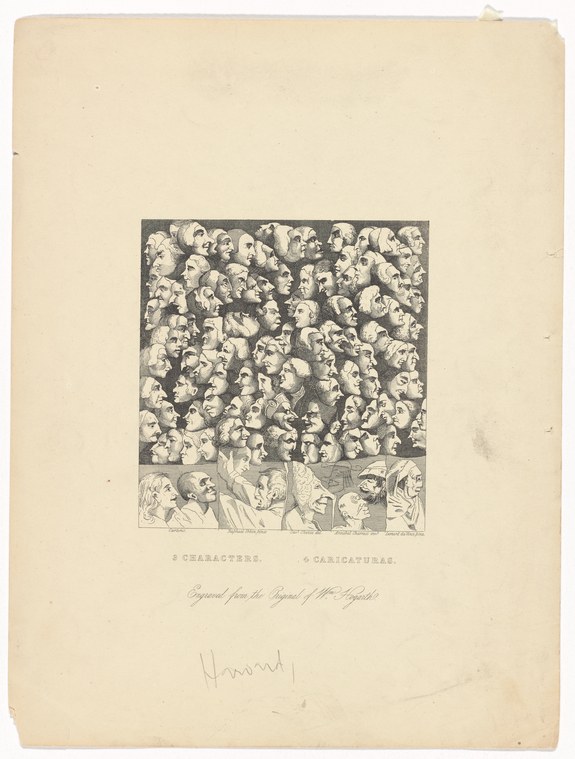
This work is catalogued as 'Prints depicting dance' but contains no recognizable dance imagery. It exemplifies how 18th-century social genre scenes can be misidentified as dance documentation when they depict animated social gatherings or moment of liveliness. The work is valuable not as dance history but as evidence of how contemporary audiences understood gesture, character, and bodily expression in non-theatrical contexts.
What you are looking at
This engraving presents two distinct compositional registers stacked vertically. The upper half is densely packed with approximately 60–80 human heads and faces in profile and three-quarter view, rendered in fine parallel hatching that creates remarkable tonal variety—some faces deeply shadowed, others bright and prominent. The heads are arranged in no spatial order, overlapping and interlocking to fill the entire rectangular field, creating the impression of a crowd or gathering seen from multiple angles simultaneously. The lower half is divided into six smaller framed vignettes, each roughly 2 by 3 inches, showing genre scenes: figures in interiors and domestic settings, rendered with similar fine detail and hatching. The whole is printed on cream paper with a subtitle in script beneath reading 'Engrav'd from the Original After Hogarth,' establishing the work as a reproductive print after William Hogarth's compositions.
The dancing
The upper register makes gesture and movement difficult to isolate—the work is a study of physiognomy rather than choreography. Individual heads show alert expressions, some animated, some slack or distressed, suggesting psychological states rather than bodily coordination. In the lower vignettes, figures are shown in static social postures: seated, standing, gesturing in conversation. No extended limbs, no shared hold, no synchronized movement. The work documents social interaction and emotional register rather than the mechanics of dance.
The dance depicted
This is not a dance image. The catalogue record labels it 'Prints depicting dance,' but the visual content contradicts that classification. The work is a study of character types and social behavior—what Hogarth called 'characters'—organized by emotional and physiognomic theme rather than by choreographic action. The lower vignettes are genre scenes of domestic life, tavern scenes, or social gatherings, but none shows recognizable dance movement, formation, or costume. The upper register is pure character study, possibly related to Hogarth's theory of expression and the 'line of beauty,' not to dance documentation.
How it was made
This is a line engraving, recognizable by the fine parallel hatching (cross-hatching and parallel lines) that creates tone and shadow without solid fill. The technique allows remarkable detail and tonal subtlety even in small vignettes, and the fine lines suggest a skilled reproductive engraver working after Hogarth's designs or paintings. Line engraving was the primary print medium for circulating fine art in the 18th century, and reproductive engravings like this one had wide distribution among educated audiences and collectors. The subtitle confirms this is a commercial reproductive print, not an original work by the engraver.
About this work
This work is a reproductive engraving after William Hogarth, presenting a dense study of human character and social behavior rather than dance. The upper half catalogs approximately 60–80 heads and expressions in varied states of animation and emotion, rendered through meticulous hatching to suggest psychological states. The lower half shows six framed domestic and social scenes with figures in conversation, relaxation, or daily activity. The whole exemplifies Hogarth's practice of embedding moral and psychological observation in visual form, and his interest in cataloging the full range of human expression and social type. The work circulated widely in 18th-century Britain and Europe as a print-market commodity, introducing Hogarth's ideas to audiences beyond painted originals.
How to look at it
Attend to the upper register first: the almost scientific cataloguing of human facial expression and emotional state. Notice how Hogarth varies the depth of shadow and the direction of gaze to suggest psychological difference rather than narrative sequence. Then examine the lower vignettes: these are snapshots of social moment—a woman primping, figures in conversation, a man gesturing—that capture liveliness and social interaction without choreography or formation. The work asks you to read character and mood from posture and expression, not to trace the grammar of movement.
The artist
William Hogarth (1697–1764) was an English painter, printmaker, and theorist who pioneered the narrative print cycle and the systematic study of human expression. He developed both original compositions and theoretical frameworks for understanding visual meaning, publishing his *Analysis of Beauty* in 1753 to explain his ideas about line, proportion, and expression. Hogarth's work was widely disseminated through reproductive engravings made by himself and by professional engravers who licensed his designs, making him one of the most widely reproduced artists of his era. His focus on social satire, character, and moral observation made his work enormously popular among the emerging middle-class print market.
The period
In the 1740s–1760s, when Hogarth's character studies were in circulation, English society was experiencing rapid urbanization and the growth of a consumer print market. Dance in this period was dominated by aristocratic forms (minuet, cotillion, country dance in formal settings) and by pantomime and comic opera in the theaters. Hogarth's work documented social life outside these formal contexts—taverns, streets, domestic interiors—where gesture and expression mattered more than choreographed movement. His systematic cataloguing of human character influenced both artistic and proto-scientific approaches to understanding expression; his work prefigured 19th-century studies of physiognomy and later photography of movement.
Where it lives
The work is held in the New York Public Library as part of a collection of prints depicting dance. It is a reproductive engraving, likely mid-to-late 18th century, made after Hogarth's original compositions or paintings. The attribution to Hogarth and the statement 'Engrav'd from the Original' indicate the print's status as a commercial circulation of his designs by a professional engraver.
Questions about this work
Is this actually a dance print?
No. The catalogue classifies it as depicting dance, but the image shows character study and social genre scenes with no choreographed movement. The work is valuable as an example of how 18th-century social animation can be misidentified as dance documentation.
What is Hogarth's 'characters' study?
Hogarth developed a systematic approach to human expression and character type, cataloguing faces and postures to illustrate emotional and moral states. This work shows that practice in action—the upper register as a typology of expression, the lower as scenes of social and psychological interaction.
Why are there six small scenes at the bottom?
These vignettes exemplify the character types and emotional registers shown in the upper study, demonstrating how expression and posture operate in social context. They function as application or proof of the character theory shown above.
More dance artwork





