30 works in this view — arrow keys or swipe to move between them.
Dance in Art
Prints after William Hogarth
Unknown artist
- Collection:
- Prints depicting dance
- Source:
- New York Public Library
- Rights:
- Public domain — free to use, share and adapt.
- Recorded as:
- Public Domain
This print is essential for understanding 18th-century vernacular dance practice—how ordinary people actually danced, how their movement was perceived by artists and educated audiences, and the moral anxiety surrounding popular festivity. It also demonstrates how engraving was used to narrate and satirize English social life, making the dance itself a vehicle for commentary on class, morality, and national character.
What you are looking at
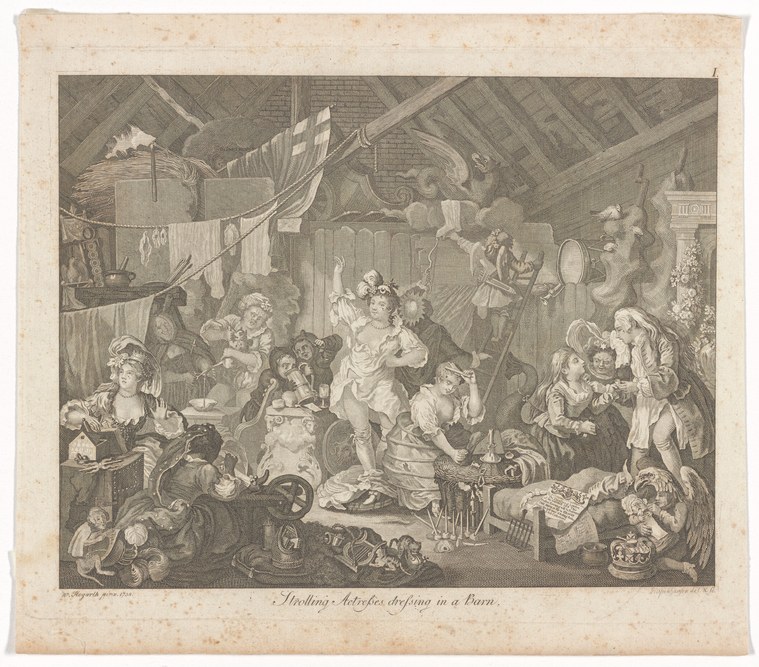
A crowded barn interior teeems with figures engaged in boisterous revelry. The wooden ceiling and walls, rendered with precise crosshatching, establish the humble rural setting. At the center, musicians—a piper and drummer visible at left—provide music for dancing couples and clusters of spectators. The composition is densely packed with overlapping figures: men and women in 18th-century dress (breeches, jackets, caps, long skirts, bonnets) occupy every plane of the image. Some couples embrace in active dance; others sit, drink, gesture animatedly, or attend to children. A barrel sits prominently, and various props—a hat, a jug, scattered objects on the ground—suggest the informal, uninhibited nature of a village celebration. Light enters from an opening at upper left, picking out figures and creating a sense of theatrical drama in what is clearly meant to be a scene of rustic mirth and sexual transgression.
The dancing
The dancers are depicted in relatively close contact—some couples appear to be in a loose embrace, swaying or stepping together. Postures are ungainly and exaggerated rather than refined: bodies lean, torsos twist, legs extend at awkward angles. One figure at center appears to leap or kick. The artist has emphasized the carnivalesque abandon—flailing limbs, unstable balance, and the interpenetration of bodies suggest drunkenness or lack of restraint rather than controlled technique. Children and onlookers cluster around the dancers, intensifying the sense of a community occasion rather than a formal performance.
The dance depicted
This appears to depict a Merrymaking or Harvest Dance of the kind common in 18th-century English rural life—likely a mop fair, harvest festival, or tavern dance. The title 'Merryings Arbuckles [sic] Doings in a Barn' (difficult to read with certainty) suggests licensed festive chaos. The dance style shown is not ballet or court dance, but vernacular social dancing: couples dancing for pleasure and courtship in close, informal contact. The deliberate unskilfulness of the postures—the awkwardness, the overlapping figures, the sense of chaos—is typical of how 18th-century satirists and moralizers depicted popular dancing, often with disapproval. The setting and composition mark this as documentary-satirical rather than celebratory.
How it was made
This is an engraving, recognizable from the fine parallel lines (hatching and cross-hatching) used to create tone and shadow throughout. The technique allows for precise rendering of complex composition and narrative detail, and suggests this was a commercial print, likely created for a middle-class audience familiar with satirical social commentary. The meticulous handling of light and the dense composition are characteristic of 18th-century narrative engraving, a medium that could be mass-produced and distributed. The style is consistent with the prints of William Hogarth and his contemporaries or followers, who used engraving to narrate moral tales of English social life.
About this work
This is an engraved print depicting rural festive dancing in an 18th-century English barn, likely after or in the manner of William Hogarth. The work captures a moment of boisterous, uninhibited social dancing among common people—a harvest celebration or fair marked by music, drink, courtship, and transgression. The engraving technique and dense, narrative composition are characteristic of satirical social prints of the period, which often presented popular customs with a mixture of humor and moral critique. The work belongs in a dance history context both as a document of how vernacular social dancing was actually performed (in close, relatively untrained partnership) and as evidence of how artists and the educated classes viewed and represented working-class festivity. It reveals the stark contrast between courtly, trained dance and the spontaneous, anarchic dancing of villages and taverns.
How to look at it
Attend to the deliberate awkwardness and spatial confusion of the figures. This is not accidental but intentional satire—the artist has chosen to show dancing as ungainly, intoxicated, and chaotic precisely to make a moral point. Notice the role of music (the piper and drummer) and the mix of active dancers with drinking, eating, and spectating onlookers. The composition is crowded and difficult to parse, which mirrors the sensory overload of an actual festive occasion. Look at the body contact between dancers: it is close, frontal, and unmodulated—quite unlike the refined, distanced partnering of courtly dance. The children and the presence of family members suggest that this is a community occasion, not a private or elite event.
The artist
The catalogue attributes this to William Hogarth or to prints after Hogarth. Hogarth (1697–1764) was an English painter and printmaker famous for his satirical, moralistic narrative sequences—series of paintings or engravings that told stories of English social vice and virtue. He pioneered the use of engraving to reach a broad audience and often depicted popular entertainments, street life, and festive occasions with sharp social observation. Whether this engraving is by Hogarth himself or by a later printmaker copying his style and moral vision, it exemplifies the 18th-century satirical tradition of using dance and festivity as a mirror of social disorder.
The period
In the 18th century, vernacular dancing was a frequent subject of both artistic and moral concern. The aristocracy and gentry were trained in refined social dances (minuets, country dances, cotillions) performed in formal settings with strict rules of decorum. Working-class and rural dancing, by contrast, was seen as chaotic, sexually suggestive, and morally dangerous. Engravers and painters, especially those in the Hogarth tradition, used such scenes to comment on class difference and to satirize both rustic vulgarity and the hypocrisy of their betters. The barn setting and the deliberate lack of skill in the figures are artistic choices meant to emphasize the 'low' or 'base' nature of the entertainment. At the same time, these prints are invaluable historical records: they show us actual dance posture, clothing, musical practice, and the communal nature of dancing in rural and urban working-class life.
Where it lives
The New York Public Library catalogue records this as a print depicting dance, held as part of their Prints collection. The catalogue entry attributes it to 'Prints after William Hogarth' and does not provide a specific date, artist attribution, or accession details beyond the general collection designation.
Dance in this work
Questions about this work
Is this Hogarth himself or a later copy?
The catalogue states 'Prints after William Hogarth,' which typically means the work is either by Hogarth or by a later printmaker copying his designs. Without additional documentation or inspection of the plate, it cannot be determined definitively. What is clear is that the work is in Hogarth's satirical tradition and style.
What kind of dancing is this supposed to be?
This is vernacular social dancing of the working classes, likely a harvest festival, fair, or tavern entertainment. It is not trained or courtly dance, but the spontaneous, physical coupling of men and women for pleasure, courtship, and community celebration. The unrefined postures and close contact are characteristic of how such dancing was both actually performed and how it was caricatured by satirical artists.
Why does the artist make it look so chaotic and ugly?
The chaos and lack of grace are deliberate moral and social commentary. Hogarth and his followers used satire to critique popular vices and follies. By depicting rural dancing as rowdy, drunken, and sexually loose, the artist was making an argument about class, morality, and the danger of unregulated festivity to social order. At the same time, these exaggerated depictions provide historians with genuine evidence of how people actually danced and gathered.
What is the barn and why is it significant?
The barn setting marks this as rural and working-class, not urban or courtly. Barns were common sites for village celebrations, dances after harvest, and other festive gatherings. The humble architectural setting is part of the satire: it emphasizes the 'low' and 'base' nature of the entertainment in contrast to the refined settings of aristocratic dance.
More dance artwork





