34 works in this view — arrow keys or swipe to move between them.
Dance in Art
Prints after William Hogarth
Unknown artist
- Collection:
- Prints depicting dance
- Source:
- New York Public Library
- Rights:
- Public domain — free to use, share and adapt.
- Recorded as:
- Public Domain
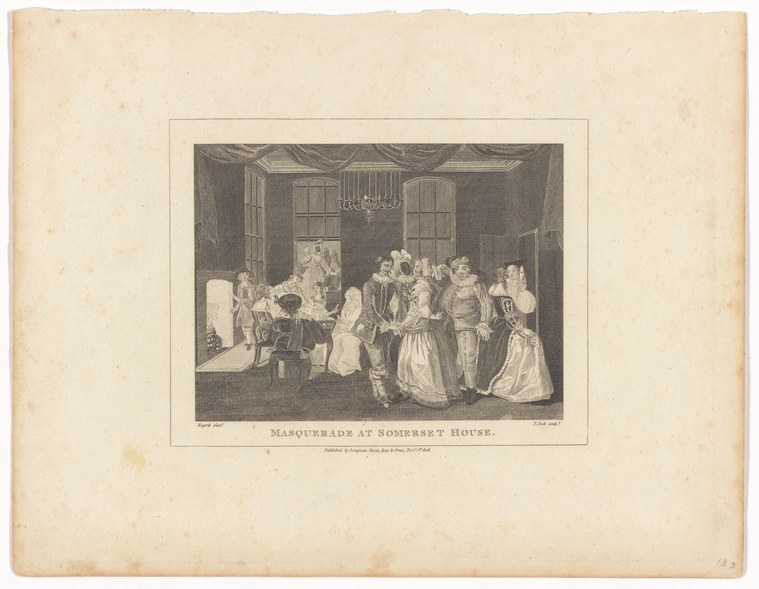
For dancers and historians, this print is valuable as evidence of how 18th-century ballrooms were arranged, how people dressed, and what the social context of formal dance looked like from the outside. The engraving shows the setting and costume conventions that shaped the minuet, cotillion, and country dances of the period, and reveals the masquerade as a distinct social form—a context in which dance occurred but also in which other kinds of encounter and display took precedence.
What you are looking at
An engraved interior scene shows a masquerade at Somerset House, a fashionable London venue. The composition is crowded with figures in 18th-century dress, many wearing masks and elaborate costumes typical of masquerade balls. The space is a grand room with panelled walls, tall windows with drapes, and a coffered ceiling. A chandelier hangs centrally. The figures are distributed across the floor in clusters of conversation and motion, creating a sense of social animation. Some stand in pairs or small groups; others are positioned as if moving or turning. The lighting is achieved through careful tonal gradation, with darker areas of shadow creating depth and allowing the lighter figures to advance. The print technique allows fine detail in the costumes—elaborate gowns with panniers, coats, masks, and head ornaments—and captures the texture of fabrics and the minute gestures of social interaction.
The dancing
The bodies are rendered in upright, formal postures consistent with 18th-century ballroom deportment. No figure is shown in extended limbs or acrobatic suspension; all stand or move with controlled verticality. The women wear full-skirted gowns that hang from fitted bodices; the men are in coats and breeches. Arms are mostly at the sides or raised in gentle gestures of conversation and greeting rather than dance movement. The density of figures and the spatial composition suggest social mingling rather than organized dance steps. Where couples or pairs appear, they stand face-to-face or side-by-side in the manner of social encounter, not in a dance hold or frame.
The dance depicted
This is not primarily a depiction of active dance, but rather of the social and festive context in which dance occurred. The masquerade ball was the setting for various dances—country dances, minuets, cotillions—but this print captures the promenade, the masking, the flirtation, and the social assembly rather than a specific choreography. The title identifies it as a masquerade at a real and prestigious location, implying that the print documents fashionable leisure and social custom rather than technical dance execution. No visible footwork, partnering, or formal dance structure is evident; the focus is on costume, mask, and social interaction.
How it was made
This is an engraving, a reproductive print technique that allowed wide circulation and ownership. Engravings were made from copper plates by hand-incising lines; the fineness of the line and the density of hatching control tone and modeling. This technique was ideal for rendering intricate costume detail and the play of light across a crowded interior. The print would have been hand-coloured after printing (as suggested by the warm cream tone of the paper and traces of pigment visible in reproduction). Engravings after Hogarth's designs circulated widely among the London print-buying public, making them accessible to a broad audience interested in contemporary manners and fashionable society.
About this work
This engraved print documents the masquerade ball as a fashionable social spectacle in 18th-century London. Masquerades were a recognized form of elite leisure that combined costume, anonymity, flirtation, and music—conditions within which formal dances took place, though they were not dances themselves. Hogarth's compositions of masquerade, theatre, and assembly were celebrated for their satirical or observational detail: the print shows the ritual and costume of the event with precision, capturing both the grandeur of the setting (Somerset House, a prestigious address) and the minor comedies of social interaction. The work documents not a dance performance but the social world that generated the demand for dance, the musicians, the assembly, and the fashionable display.
How to look at it
Attend to the costume and mask: note the variety of dress styles and the deliberate theatrical excess. Look at the composition's density and the distribution of light: Hogarth uses shadow and highlight to guide the eye and suggest social clustering. Observe the absence of formal dance posture: these are figures in social assembly, not in the strict frame or footwork of a minuet or cotillion. The title's specificity—*Somerset House*—invites recognition of a real place and a fashionable event, making this as much a document of social geography and custom as an image of spectacle.
The artist
William Hogarth (1697–1764) was an English painter and printmaker celebrated for satirical and observational scenes of contemporary London life. His series paintings—such as *A Rake's Progress* and *Marriage A-la-Mode*—were engraved and printed, reaching a large audience. Hogarth's aesthetic combined fine detail, narrative complexity, and moral or social commentary. His prints after his own paintings were works of business as well as art: he championed the circulation of his designs through print and played a role in copyright protection for artists. The masquerade scenes are among his well-known urban subjects.
The period
The masquerade ball was a fashionable diversion in 18th-century London, reaching its peak in popularity from the 1720s onwards. These events were held in public and semi-public venues; opera houses, pleasure gardens, and hired rooms hosted masked assemblies that drew the curious and socially ambitious. The masquerade was celebrated in literature and visual art as a space of transgression—where rank could be obscured and social rules loosened—but also as a target of moral criticism. Contemporaneously, formal ballroom dances (minuet, cotillion, country dance) were highly codified and required instruction; the masquerade provided a more fluid social setting. Hogarth's engravings of masquerade scenes coincide with the height of the masquerade's fashionability and moral controversy in London.
Where it lives
The work is catalogued as part of a collection of prints depicting dance held at the New York Public Library. It is a reproductive engraving, likely from Hogarth's original design, part of the wide circulation of Hogarth prints in the 18th and 19th centuries.
Questions about this work
Is this a depiction of actual dancing?
Not primarily. The print shows a masquerade ball—the social gathering and costume spectacle—rather than a choreographed dance. Dances would have taken place at such events, but this image captures the promenade, flirtation, and masked interaction rather than a specific dance form or technique.
What is a masquerade and why were they important?
A masquerade was a fashionable assembly in which participants wore masks and elaborate costume, allowing a degree of anonymity and social transgression. They were held in London's fashionable venues from the 1720s onwards and were celebrated as exciting but also criticized as morally suspect. They were settings for social encounter, music, and dance, but the masquerade itself was the primary attraction.
Why is Somerset House specified in the title?
Somerset House was a real and prestigious location on the Strand in London, associated with artistic and fashionable use. The specificity suggests Hogarth is documenting an actual kind of event at a real and recognizable venue, lending the print the status of social documentary as well as satirical or observational art.
How does the engraving technique serve the subject?
Engraving allowed fine detail and tonal control, making it possible to render crowded interiors, elaborate costume, and the play of light across a complex social scene. As a reproducible print, it also allowed the image to circulate widely among London's print-buying public, making contemporary manners and fashionable spectacle accessible to a broad audience.
More dance artwork





