37 works in this view — arrow keys or swipe to move between them.
Dance in Art
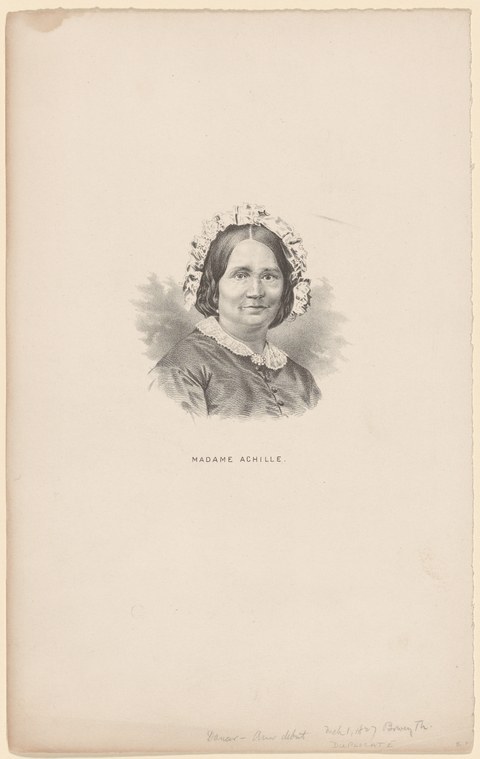
Madame Achille
Unknown artist
- Collection:
- Prints depicting dance
- Source:
- New York Public Library
- Rights:
- Public domain — free to use, share and adapt.
- Recorded as:
- Public Domain
The print records the identity and likeness of a woman named Madame Achille during a period when few dancers' names and faces were systematically preserved in high-quality engraved form. If Achille was indeed a performer, this portrait is evidence of the standing women dancers could achieve in the nineteenth-century theatrical world, even if the portrait itself does not show her dancing. The work exemplifies how theatrical celebrities were circulated and canonized through print culture.
What you are looking at
A woman in mid-nineteenth-century dress is shown in a three-quarter view portrait, her upper body centered in the frame against a plain background with subtle shadow work. She wears a dark-colored dress with a white collar and a white lace cap or bonnet trimmed with lace and fabric bows, typical of the 1840s–1860s. Her dark hair is parted in the center and pulled back. The engraving technique creates soft modeling around her shoulders and neck, with careful attention to the texture of her fabric. The inscription "MADAME ACHILLE" appears below the image, identifying her as a known figure of the period. Her pose is formal and composed, appropriate for a theatrical or public portrait of the era. The work shows no indication of dance in progress; this is a society or theatrical portrait rather than a scene of performance.
The dancing
A single figure is depicted in a static, posed position rather than an active dance stance. The woman's shoulders are relaxed and squared to the viewer, her neck and head held upright with a calm, direct gaze. There is no visible weight transfer, turnout, or port de bras. The body is still, the expression serene. This is the formal presentation of a person for identification, not the capture of a dancer in motion.
The dance depicted
The image contains no depiction of dance. It is a portrait of an identified woman named Madame Achille—likely a performer, given her prominent enough standing to merit an engraved portrait—but nothing in the image shows her engaged in, or posed as though about to engage in, dance movement. The dress and bonnet are consistent with 1840s–1860s civilian fashionable wear rather than theatrical costume. Without additional context (inscription beyond the name, theatrical program, biographical record), the work cannot be assigned to any dance style.
How it was made
This is an engraving, identifiable by the uniform hatching, fine parallel lines, and careful tonal modeling characteristic of the medium. Engravings were labor-intensive and expensive, produced for circulation among educated audiences and institutions, suggesting that Madame Achille held sufficient public prominence to warrant this treatment. The technique allowed for fine detail in textile and facial features, supporting the work's function as a portrait circulating within theatrical or society networks. The quality of execution suggests a professional engraver of some skill working from a drawing or earlier portrait.
About this work
This is a portrait engraving of Madame Achille, a woman of apparent theatrical or social standing in the nineteenth century, rendered in the formal conventions of mid-century portraiture. Although the subject was prominent enough to merit publication in engraved form—a mark of fame or notable social status—the work itself depicts no dance. It belongs in a gallery of dance-related imagery primarily as a document of a historical figure (likely a dancer or performer) rather than as a representation of dance practice itself. The work's value lies in what it tells us about who was celebrated in the period and how they were visually presented to the public.
How to look at it
This is not a work of action; it is a work of identification. Look at it as you would look at a historical photograph: attend to the evidence of dress, hairstyle, and period detail that anchors it to a specific historical moment. The refinement of the engraving technique—the control of tone, the delicacy of the lace—speaks to the subject's standing and the investment in her public image. The calm, frontal gaze is a convention of nineteenth-century celebrity portraiture, asserting the subject's composure and dignity. There is no theatrical costume, no stage setting, no hint of performance—only a woman of the period, formally presented for remembrance.
The artist
The engraver is not recorded in the catalogue. The quality and style of the work suggest a professional printmaker working in the mid-nineteenth century, likely in France given the French name and the French tradition of engraving theatrical portraits. Without further research, the specific artist and workshop remain unidentified.
The period
This portrait belongs to the mid-nineteenth century (likely 1840s–1870s based on dress and engraving style), an era in which theatrical performers, especially dancers, enjoyed unprecedented celebrity and were widely reproduced in lithographs, engravings, and photographs for public consumption. The Romantic ballet was at or past its peak, and star dancers like Marie Taglioni, Fanny Elssler, and their contemporaries and successors were cultural icons whose likenesses were mass-circulated. Engraved portraits like this one were among the primary means by which audiences outside the theaters could see and remember the performers they admired. The formal, dignified presentation here reflects the period's convention of showing performers in civilian dress and composed bearing, affirming their status as respectable women despite their public work on stage.
Where it lives
The work is held in the New York Public Library's collection of prints depicting dance. As a catalogued item in a dance-focused collection, it has been identified as relevant to the history of dance through its subject, though the print itself depicts no dance.
Questions about this work
Is this a picture of someone dancing?
No. This is a formal portrait engraving of a woman named Madame Achille. She is posed standing still, in civilian dress, and there is no indication of movement or dance in the image.
Who was Madame Achille?
The inscription identifies her as Madame Achille, but the catalogue record contains no biographical information. The fact that she merited an engraved portrait suggests she held some standing in nineteenth-century theatrical or society circles, but her specific profession and achievements are not documented in the available record.
Why is this in a dance collection if it shows no dance?
The print is catalogued as dance-related because it is believed to depict a historical performer or figure of interest to dance history. However, the image itself is a society or theatrical portrait, not a depiction of dance practice or performance.
What period is this from?
Based on the dress, hairstyle, and engraving style, the work dates to the mid-nineteenth century, likely 1840s–1870s.
More dance artwork





