40 works in this view — arrow keys or swipe to move between them.
Dance in Art
Prints after William Hogarth
Unknown artist
- Collection:
- Prints depicting dance
- Source:
- New York Public Library
- Rights:
- Public domain — free to use, share and adapt.
- Recorded as:
- Public Domain
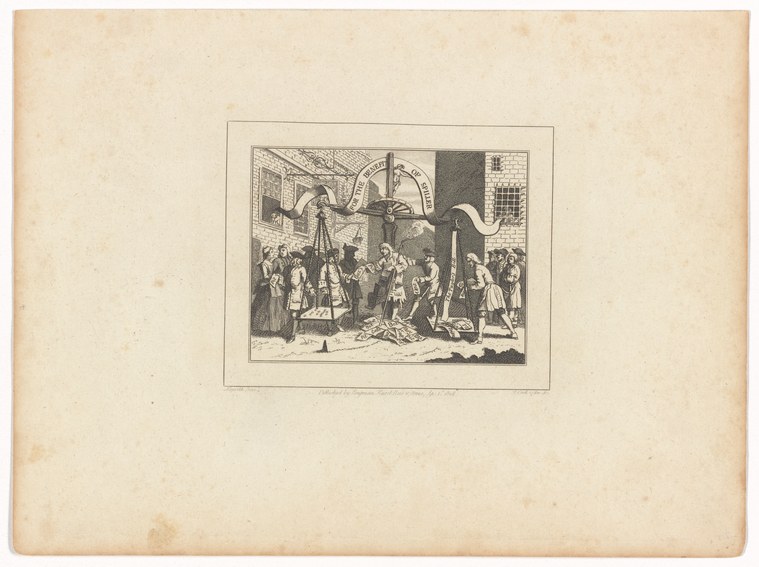
This print documents how ordinary people danced and gathered socially in the 18th century—a crucial corrective to the heavy historical emphasis on courtly and theatrical dance. The casual, energetic, mixed-gender and mixed-age participation visible here reveals the social function of dance as community ritual and stress-relief, not performance or courtship alone.
What you are looking at
This engraving depicts a crowded interior scene of social dancing and revelry, likely from the 18th century based on the style and costume. The composition centers on a raised platform or stage where a figure in dark clothing stands elevated above the crowd, possibly directing or observing the activity below. Multiple figures in period dress—women in full skirts and men in coats—are arranged throughout the space in various attitudes of movement and interaction. The setting appears to be a public or semi-public venue with architectural framing: a large arched doorway or window dominates the background, and a smaller window is visible in the upper right. The crowd density and the mix of engaged and idle figures suggest a scene of social disorder or carnival-like festivity. Light and shadow create depth through the engraving technique, with darker areas suggesting interior shadows and lighter areas highlighting the gathered figures.
The dancing
The figures are loosely grouped rather than arranged in formal dance couples. Several appear to be in motion with raised arms and turned bodies, suggesting active participation in dancing or related social activity. Many stand at angles to one another rather than in closed holds or the formal alignment of ballroom dance. The elevated figure on the platform observes or presides over the scene with a commanding posture. The variety of postures—some upright, some bent or gesturing—suggests spontaneous rather than choreographed movement. Children and adults of mixed ages appear throughout, typical of street or tavern scenes rather than formal dance instruction.
The dance depicted
This appears to depict a scene of popular or folk dancing, possibly a street festival, carnival, or tavern dance scene. The composition and crowded, informal arrangement suggest social rather than theatrical or courtly dancing. The figure on the platform may represent a musician, drunk, showman, or person of authority. Without more specific iconographic markers—musical instruments are not clearly visible, and the exact gesture vocabulary is difficult to parse in the engraving—the specific dance form cannot be identified with confidence. The scene is consistent with 18th-century depictions of lower-class or popular festivity, where dancing occurred in public spaces with minimal formal structure.
How it was made
This is an engraving, a relief or intaglio print technique that allowed mass reproduction. The fine line work and careful use of cross-hatching to create tonal gradation are characteristic of professional engraving. The technique's precision made it ideal for narrative clarity and the recording of detailed social scenes. The image's circulation as a print (likely a series or collection) suggests it was intended for a broad audience interested in social observation and satire. The style and execution are consistent with 18th-century commercial print production, which served both entertainment and documentary purposes.
About this work
This engraving records a moment of popular social dancing or festive gathering in what appears to be an 18th-century urban or public setting. The scene captures the informality and social mixing characteristic of non-courtly dance spaces, where multiple ages and social ranks participated together without formal choreography or instruction. The work belongs to a tradition of satirical or observational social prints that used dance and festivity as subjects to comment on contemporary life and morality. Such scenes were popular subjects in northern European printmaking, particularly in the Dutch and German tradition, and in English prints influenced by William Hogarth's satirical social narrative style.
How to look at it
Look at the range of body positions and the absence of uniform direction: no one is dancing with identical steps or alignment. The elevated figure commands attention but does not control the crowd's movement. Notice the children and mixed ages, unusual in ballroom or theatrical contexts. The artist has chosen a moment of peak activity and crowding, capturing festivity at its most chaotic rather than most orderly. The engraving's technique allows fine detail in individual figures while maintaining the impression of a dense, mobile crowd—a technical choice that serves the subject matter of social disarray.
The artist
The catalogue records this as a print after William Hogarth, though the engraver is not named. Hogarth (1697–1764) was an English painter and printmaker famous for satirical narrative series depicting 18th-century social life. His works often included scenes of dancing, drinking, and festivity as commentary on vice, folly, and social pretension. Whether this print is directly after a Hogarth painting or belongs to a series inspired by his style cannot be confirmed from the image alone. Hogarth's influence on social satirical prints was immense, and many later engravers worked in his manner.
The period
In the 18th century, popular or folk dancing underwent significant change as cities grew and public spaces for entertainment expanded. Taverns, gardens, and street festivals became sites where lower-class and working people danced to live musicians. Simultaneously, formal ballroom dancing became increasingly codified among the gentry, creating a stark contrast between 'polite' dance and popular festivity. Printmakers and painters documented both with equal interest, often using dance scenes to satirize social aspiration, drunkenness, or moral disorder. The popularity of such scenes in prints suggests a middle-class audience enjoying satirical observation of both their social superiors and inferiors.
Where it lives
The work is held in the New York Public Library's collection of prints depicting dance. It is catalogued as an engraving after William Hogarth, though the specific series, date, and engraver remain unrecorded in the provided metadata.
Dance in this work
Questions about this work
Is this a William Hogarth original?
The print is after a Hogarth composition—meaning an engraver reproduced a Hogarth painting or design. Hogarth often oversaw the engraving of his own works for sale, but this print's engraver is not identified in the catalogue record. The style is consistent with Hogarth's social satirical manner.
What kind of dance is shown?
The informal, crowded arrangement and mixed participation suggest popular or folk dancing in a public space—likely a tavern, street festival, or fair—rather than courtly or theatrical dance. The specific dance form cannot be identified from the visual evidence alone.
Why is there a figure standing on a platform?
The elevated figure may be a musician, a showman, an authority figure, or a drunk person of higher social rank. In satirical prints, such figures often represent folly or excess. The exact meaning depends on context within a series or accompanying text, which is not provided here.
When was this made?
The style, costume, and engraving technique are consistent with the 18th century, and the catalogue notes it after Hogarth. However, the exact date is not recorded. Hogarth worked 1720–1764; reproductions of his designs circulated for decades after his death.
More dance artwork





