42 works in this view — arrow keys or swipe to move between them.
Dance in Art
Prints after William Hogarth
Unknown artist
- Collection:
- Prints depicting dance
- Source:
- New York Public Library
- Rights:
- Public domain — free to use, share and adapt.
- Recorded as:
- Public Domain
While not a dance work, this engraving is significant for understanding how 18th-century artists used the body and gesture to convey narrative and emotion—skills that overlap with dance composition. For historians studying the visual language of gesture in this period, the work shows how Hogarth deployed pose, spatial arrangement, and facial expression to create dramatic intelligibility in a crowded social scene. It also documents how classical architectural space was imagined as a setting for human action.
What you are looking at
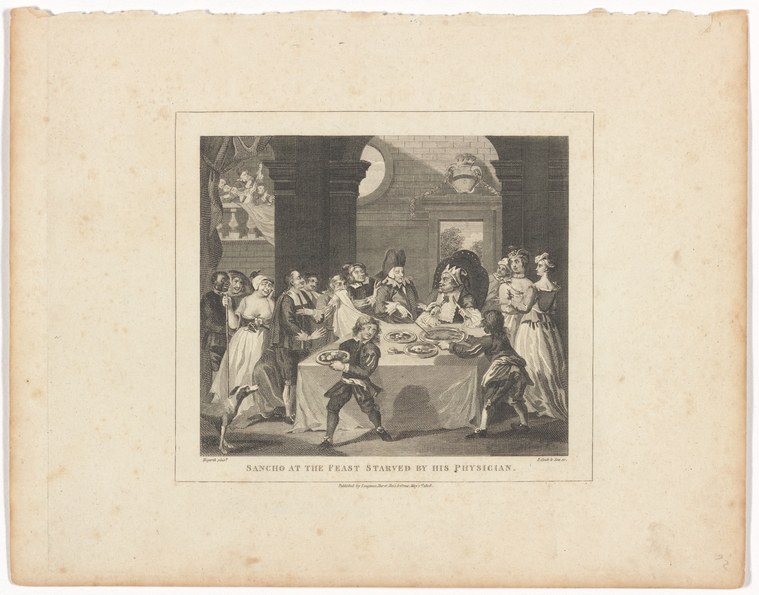
An engraved scene depicting a banquet or feast interrupted by a medical emergency. A man in dark clothing lies on the floor in convulsion or collapse, centre-right, attended by figures in light-coloured dresses. The setting is an ornate interior with classical architectural elements: a domed ceiling with a large circular opening, decorative wall panels, and sculptural details suggesting wealth and formality. A long table laden with food and vessels dominates the composition. Figures stand and gesture around the prone man with expressions of alarm and concern. The light is strongly contrasted, typical of engraving technique, with deep shadows defining the architectural space and dramatic illumination on the figures' faces and garments.
The dancing
The dominant figure is the collapsed man, whose body is stretched horizontally on the floor in a posture of distress. Women in high-waisted neoclassical dresses surround him with gestures of shock—hands to faces, arms raised in alarm. The figures frame the crisis in a tableau of concern: some lean forward, others turn away, one appears to be gesturing toward the man. The postures are theatrical and emphatic rather than naturalistic, characteristic of narrative engraving. No dance hold or frame is evident; the bodies express emotional response rather than coordinated movement.
The dance depicted
This does not depict dance in the conventional sense. The title 'Sancho at the Feast Starved by His Physician' suggests a narrative from Miguel de Cervantes' *Don Quixote* (Part 2, Chapter 47), in which Sancho Panza, as island governor, is presented with a feast but forbidden to eat by his physician, Don Pedro Recio. The image captures the moment of Sancho's collapse or illness, not a dance. The emotional and physical responses of the attendants are expressive and gestural but belong to narrative pantomime or theatrical rhetoric, not codified dance vocabulary.
How it was made
This is an engraving—established by the fine parallel lines (hatching and cross-hatching) that build shadow and form, the sharp linear definition of edges, and the monochromatic black-and-white contrast. The inscription at the base confirms it is 'after William Hogarth,' meaning this is a reproduction engraving, likely of one of Hogarth's narrative moral prints or series. Hogarth was famous for large satirical engravings of social scenes, and this plate was produced to circulate his composition widely. The technique allowed fine detail and dramatic tonal range, suitable for the complex architecture and emotional expression of the scene.
About this work
This is a narrative engraving after William Hogarth depicting a scene from Don Quixote: the collapse of Sancho Panza during a formal feast. Although the record labels it a dance image and the catalogue lists it under 'Prints depicting dance,' the work does not show dance in any recognisable form. It is instead a moment of dramatic social comedy rendered in one of the 18th century's most influential satirical visual narratives. The composition, architectural setting, and gestural language belong to the tradition of history painting and narrative engraving rather than dance documentation. Its presence in a dance collection likely reflects either a cataloguing error or a broader historical interest in how bodies and gesture were depicted in formal social settings.
How to look at it
The composition is organised around the horizontal line of the collapsed body, which disrupts the orderly gathering and draws the eye to a moment of crisis. Notice how the architectural frame—the grand dome and classical proportions—contrasts with the ungoverned human response below: formal perfection above, chaos and alarm below. The engraver's use of light isolates the central drama: the prone figure and the attending faces emerge from shadow. This is a key principle of Hogarth's design: clarity of narrative through compositional hierarchy and contrast.
The artist
William Hogarth (1697–1764) was an English painter, printmaker, and social satirist whose narrative moral prints made him one of the most influential visual artists of the 18th century. His works, including *A Rake's Progress* and *Marriage A-la-Mode*, combined meticulous observation of social behaviour with sharp satirical critique. Hogarth was celebrated for his ability to pack complex narratives into single images, using pose, expression, and spatial composition to guide the viewer's eye and interpretation. His engravings were widely circulated and admired, and numerous prints were made after his paintings to reach a broad public. This work exemplifies his interest in social folly and the human drama of ordinary (or ridiculous) situations.
The period
Hogarth's practice flourished in the mid-18th century, when narrative engraving was the dominant form of visual satire and moral instruction in Britain. The taste for literary subjects, especially comic ones derived from popular literature like *Don Quixote*, shaped the content of satirical prints. This was also an era when formal dining and social etiquette were subjects of both genuine concern and comic ridicule. The classical architectural vocabulary visible in the setting reflects the neoclassical taste dominant in the 1750s–60s. Dance, as a formal social practice and as a subject for visual art, coexisted with these narrative traditions, but narrative and moral satire occupied a different aesthetic sphere.
Where it lives
This print is held in the New York Public Library's collection of prints depicting dance. The work is catalogued as 'Prints after William Hogarth,' indicating it is a reproductive engraving made after one of Hogarth's original compositions, a common practice for disseminating his designs.
Questions about this work
Why is this in a dance collection if it's not a dance?
The cataloguing record labels this as a dance image, likely in error or based on a broader historical definition of 'dance' that includes gestural narrative and formal social scenes. The work may have been acquired as part of a larger collection of 18th-century social imagery, or there may be a connection to dance contexts in Hogarth's other works that led to its inclusion here. It is worth reviewing whether this record should be reclassified.
Is this the only known version?
The record indicates this is 'Prints after William Hogarth,' suggesting the design was made into multiple engravings or existed in different states. Hogarth's popular designs were engraved by several hands and issued in different formats and editions throughout the 18th and 19th centuries. Without further information in the record, we cannot determine how many impressions or versions exist.
What is the source for the title?
The inscription at the base of the print identifies the subject as 'Sancho at the Feast Starved by His Physician,' derived from Part 2, Chapter 47 of Cervantes' *Don Quixote*. This episode was a popular subject for narrative engravings and paintings in the 18th century.
More dance artwork





