43 works in this view — arrow keys or swipe to move between them.
Dance in Art
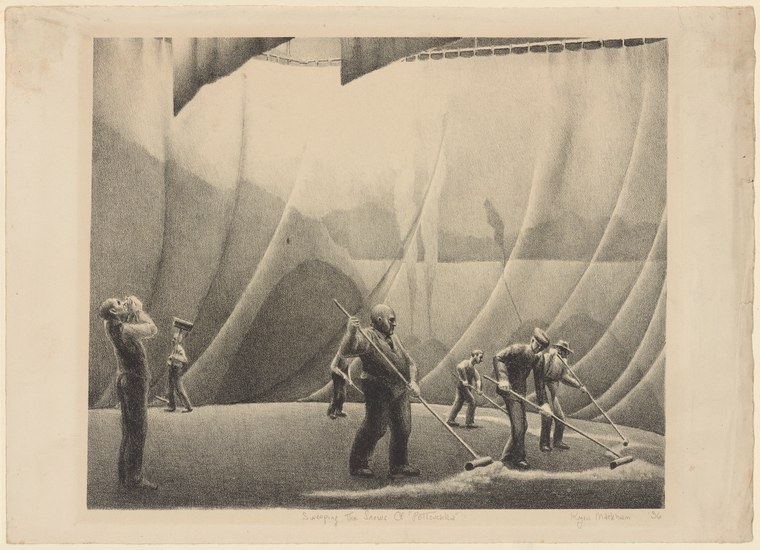
Sweeping the snows of Petrouchka
Unknown artist
- Collection:
- Prints depicting dance
- Source:
- New York Public Library
- Rights:
- Public domain — free to use, share and adapt.
- Recorded as:
- Public Domain
The print offers a counter-image to dance spectacle: it shows the labor, materials, and infrastructure that make theatrical magic possible. For historians, it documents the material conditions of early 20th-century theatrical production and the artist's interest in the backstage world as a subject worthy of serious visual attention.
What you are looking at
Five men in work clothes labor inside a vast industrial or theatrical space defined by enormous curved panels or sails that dominate the composition. The men are scattered across a flat floor, bent and leaning at steep angles as they work with brooms or rakes, sweeping or moving material across the ground. The curved forms behind them are rendered in sharp light and shadow, creating a sense of enormous scale and weight—they could be the interior of a zeppelin or airship, the hull of a ship under construction, or the interior of a theatrical dome. The title references Petrouchka, the Stravinsky ballet, suggesting this is a backstage or workshop scene. The print is executed in grayscale with strong tonal contrast, the light falling sharply to model both the architectural forms and the laboring bodies.
The dancing
The men are not dancing; they are in postures of labor—leaning, bending, pushing forward with effort. Their bodies are weighted and grounded, far from the weightlessness or extension of formal dance. One figure on the left leans heavily on or against a vertical form; others bend forward with their arms extended to work tools. The composition emphasizes strain and exertion rather than grace or control. The figures are modeled with anatomical care, but their gesture vocabulary is that of manual work, not trained movement.
The dance depicted
This does not depict dance in the theatrical or formal sense. The title 'Sweeping the snows of Petrouchka' alludes to Stravinsky's 1911 ballet, likely referring to a scene of domestic or backstage labor within or around that work's world. If there is dance content, it is implicit or conceptual—the reference to Petrouchka's puppet-theater setting and the visual pun of 'sweeping snows' suggests a connection to the ballet's themes of artifice and labor behind spectacle. The figures here are workers, not dancers, engaged in the unglamorous work that makes theatrical illusion possible.
How it was made
This is a lithograph or similar printmaking process, executed in grayscale. The medium allows for strong tonal control and the rendering of atmospheric depth through variations in gray. The technique emphasizes volumetric form—the curved panels are built up through careful shading to appear monumental and three-dimensional. The print's quality and distribution through institutional collections (NYPL) suggests it was a published work, likely from the early-to-mid 20th century, circulated to audiences interested in modern art or theater.
About this work
This is a print depicting laborers at work within a vast architectural or theatrical interior, titled with reference to the Stravinsky ballet Petrouchka. The image collapses the boundary between theater and labor, between the spectacular and the mundane, by showing the unglamorous work—literally sweeping—that sustains theatrical illusion. The enormous curved forms suggest either an industrial space (a zeppelin or ship under construction) or the hidden infrastructure of a theater. The work belongs in a dance gallery not because it shows dance, but because it engages with how dance and theater are produced, and because it makes a visual and conceptual argument about the relationship between performance and work.
How to look at it
Attend first to the scale and weight of the curved forms: the artist has made them monumental through shading and composition, so the small figures become even smaller by contrast. Notice the postures of the workers—they are angled and strained, not poised. Consider the title: it is a joke or a riddle, collapsing the ethereal world of the Petrouchka ballet into the physical reality of sweeping. The print invites you to see the work behind spectacle, and to ask whether that work itself has a kind of beauty or dignity the artist is claiming for it.
The artist
The artist is not recorded in the catalogue. The style and subject matter suggest a 20th-century printmaker with interests in industrial forms, modern theater, and the aesthetics of labor. The handling of volumetric form and atmospheric perspective suggests training in academic printmaking traditions adapted to modernist subjects.
The period
The title's reference to Petrouchka (premiered 1911) dates the work to the early-to-mid 20th century, when the Russian avant-garde and early modernism were reshaping both dance and visual art. This was a period of intense interest in theater as a total art form, in the visibility of stage machinery and costume, and in the collision between high art and manual labor. The print's monumentalization of working figures aligns with the visual politics of the 1920s–1940s, when many artists treated industrial and theatrical labor as subjects of dignity and formal interest.
Where it lives
The work is held in the NYPL's collection of prints depicting dance. It was likely acquired as part of a broader effort to document theatrical subjects and the visual culture of early 20th-century modernism.
Questions about this work
Is this actually a dance image?
Not in the conventional sense—the figures are laborers, not trained dancers. But it belongs in dance collections because it engages with dance and theater as subjects, and because the title anchors it to Stravinsky's Petrouchka. It represents a modernist interest in the backstage and infrastructural dimensions of theatrical production.
What does the title mean?
'Sweeping the snows of Petrouchka' likely alludes to scenes in the Stravinsky ballet set in a snowy Russian fair or square. The title may be literal (sweeping real snow) or metaphorical (sweeping away illusion or artifice). The pun collapses the ethereal world of ballet into the physical reality of manual labor.
When was this made?
The catalogue record does not provide a date, but the reference to Petrouchka (which premiered in 1911) suggests the work was made sometime after that year, likely in the 1920s–1940s based on the style and printing technique.
More dance artwork





