44 works in this view — arrow keys or swipe to move between them.
Dance in Art
Prints after William Hogarth
Unknown artist
- Collection:
- Prints depicting dance
- Source:
- New York Public Library
- Rights:
- Public domain — free to use, share and adapt.
- Recorded as:
- Public Domain
Although not a dance work itself, this print is significant for the history of representation of the body in eighteenth-century art and for understanding the theatrical conventions of social assembly that preceded and informed the development of narrative dance forms. Hogarth's careful attention to posture, gesture, and ensemble composition influenced how subsequent artists depicted group scenes and social interaction, including dance.
What you are looking at
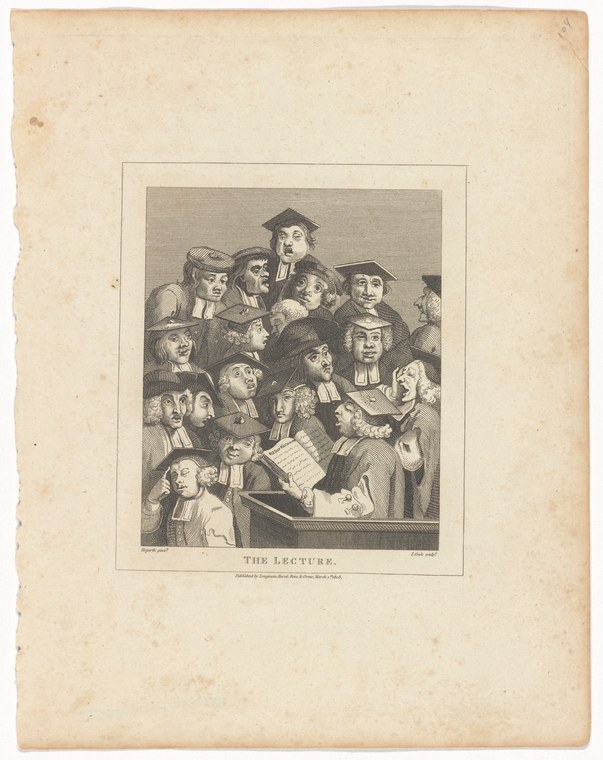
A crowded interior scene of a lecture or sermon, rendered in the satirical style characteristic of William Hogarth's moral commentary engravings. The composition is densely packed with figures of varying ages and social stations, all seated or standing in close proximity, their attention directed toward a pulpit or lectern at the composition's center-right. The figures wear eighteenth-century dress: men in tricorn hats, coats, and breeches; women in bonnets and long skirts. The setting appears to be a nonconformist chapel or dissenting meetinghouse, with high-backed pews and minimal architectural ornament. Light falls unevenly across the scene, emphasizing the theatrical intensity of the moment. The print is crowded with incident and physiognomy—faces betray smugness, zealotry, distraction, and hypocrisy, a hallmark of Hogarth's technique. The title inscribed below reads "THE LECTURE."
The dancing
The figures are static and posed rather than in motion; this is not a dance scene but an assembly scene. Bodies are seated, leaning forward intently or backward skeptically, heads tilted in various attitudes of attention. Arms are folded, raised in emphasis, or resting on laps. The postures communicate social rank and character: some figures display exaggerated devotion, others distraction or mockery. No footwork or dance hold is present; the bodies are arranged to reveal personality and social commentary rather than movement or partnership.
The dance depicted
This print does not depict dance. It is a satirical scene of social assembly—a lecture or sermon—presented as a study of human character and social hypocrisy. The title, "The Lecture," indicates the subject is intellectual or religious instruction, not movement or performance. The gathering and the gestures are those of an audience, not dancers.
How it was made
This is a line engraving, executed in the fine-line technique characteristic of Hogarth's reproductive prints. The work demonstrates the precision and control of eighteenth-century engraving: closely spaced parallel lines create tone and form, with careful modulation to suggest three-dimensionality and fabric texture. This medium allowed for wide circulation via printing and established Hogarth's moral narratives as accessible to a broad educated public. The technique's capacity for fine detail made it ideal for Hogarth's satirical purpose—the faces and garments carry legible social information.
About this work
This is a line engraving after William Hogarth, whose narrative and satirical moral prints were among the most celebrated and widely reproduced works of eighteenth-century British art. "The Lecture" belongs to Hogarth's tradition of social commentary through densely populated interior scenes, where character is revealed through posture, expression, and costume. The work critiques contemporary religious enthusiasm and intellectual pretension by presenting a crowded assembly of figures whose varied reactions to a lecture betray their hypocrisy and folly. It is not a dance image but a representation of social gathering and performance of belief.
How to look at it
Attend to the composition's density and the way each figure is individuated: Hogarth has frozen not a single moment of action but a moment of collective response, where each person's body language and expression reveals their character and social position. Notice how the artist uses posture and gesture to communicate moral judgment—the forward lean of the pious is indistinguishable from the studied posture of the hypocrite. The print rewards close viewing of faces and hands; the satirical meaning emerges from accumulated physiognomic detail rather than from a single dramatic gesture. This is drawing as moral anatomy, not as record of movement.
The artist
William Hogarth (1697–1764) was an English painter, printmaker, and social critic whose narrative moral scenes and satirical engravings defined the character of eighteenth-century British art. His prints were produced in large editions and disseminated widely, making them accessible to audiences beyond the wealthy collectors who could purchase paintings. Hogarth's method combined acute observation of contemporary life with allegorical and moral purpose. His compositions are crowded with incident, symbolic detail, and physiognomic characterization. He pioneered the 'modern moral subject' and established the print as a vehicle for social satire. His work influenced both the visual arts and the development of narrative sensibility in English culture.
The period
This work dates to the eighteenth century, likely the 1730s–1750s, when Hogarth was at the height of his productivity and influence. The period saw rapid growth in urban, middle-class audiences for art and literature, and a corresponding appetite for satirical commentary on contemporary manners and beliefs. Religious enthusiasm, particularly Methodist and nonconformist preaching, was a flashpoint of cultural anxiety and satire during this era. In the visual arts, this was the age of rococo refinement in France, but in Britain it was the era of Hogarth's unsentimental, morally engaged realism. The formal conventions of academic art—history painting, portraiture—were being challenged by the rise of comic and narrative prints that addressed everyday life and contemporary social issues.
Where it lives
The work is catalogued as a print after William Hogarth, held in the New York Public Library's Prints collection. It is part of a broader assembly of prints depicting dance and social gathering; its classification in that collection reflects the broader visual culture of dance and assembly in the eighteenth century, even though the work itself is not a dance scene.
Questions about this work
Is this a dance scene?
No. This is a satirical print depicting a lecture or sermon, a scene of religious or intellectual assembly. The figures are seated or standing as an audience, not engaged in dance. The work belongs to Hogarth's tradition of social satire through crowded narrative interiors, but its subject is the folly of human belief and pretension, not movement or performance.
Why is this in a collection of dance prints?
The inclusion reflects the broader eighteenth-century visual culture in which dance, assembly, and social gathering were closely related subjects. Scenes of gathering, whether for dance, lecture, or worship, shared compositional strategies and served similar documentary purposes. The print may have been catalogued alongside dance images because both represent collective social performance and the bodies of assemblies.
How can I tell this is after Hogarth?
The composition, style, and satirical content are unmistakably characteristic of Hogarth's narrative prints. The dense crowding, the attention to physiognomy and costume detail, the moral commentary encoded in gesture and expression, and the title inscription are all consistent with his method. The engraving technique is also characteristic of his reproductive prints, which allowed his designs to circulate widely.
More dance artwork





