45 works in this view — arrow keys or swipe to move between them.
Dance in Art
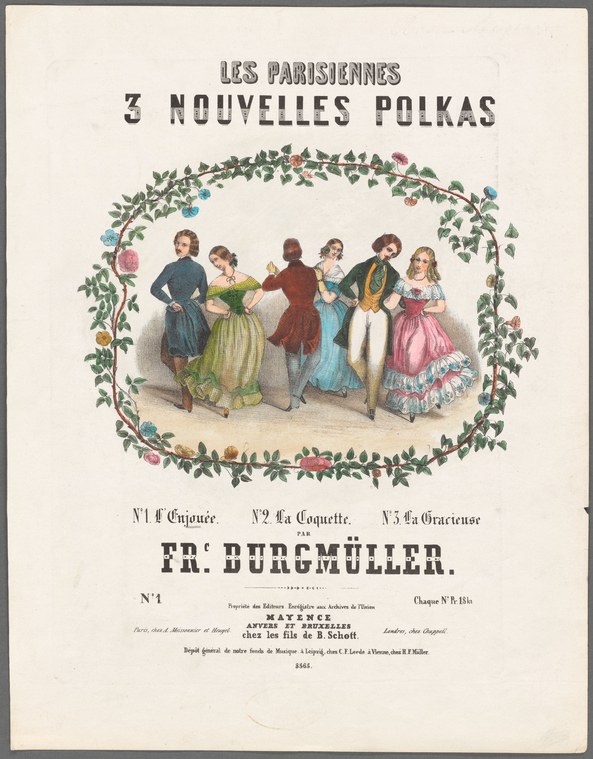
Les parisiennes, 3 nouvelles polkas ... par Fr[édéri]c Bürgmuller
Unknown artist
- Collection:
- Prints depicting dance
- Source:
- New York Public Library
- Rights:
- Public domain — free to use, share and adapt.
- Recorded as:
- Public Domain
This image documents the explosive popularity of the polka as a social dance in 1840s Paris and shows how dance music was marketed to a mass audience through visual spectacle and social coding. For historians of dance, fashion, and print culture, it reveals how music publishers packaged dance as aspirational entertainment, associating each musical variation with a social type (the sprightly girl, the coquette, the graceful lady) and implicitly instructing viewers on how to embody each style.
What you are looking at
Six figures in 1840s dress are arranged in a semicircle within an ornamental wreath of green leaves and scattered flowers, positioned against a plain cream background. From left to right: a woman in dark dress; a woman in a yellow-green dress with fuller skirt; a third woman in grey or muted blue; a man in red coat; a man in light breeches and dark jacket; and a woman in pink with gathered skirts. All six stand upright and appear to be posed rather than captured mid-motion. The composition is symmetrical and formal, more like a fashion plate or dance instruction diagram than a spontaneous scene. The wreath framing emphasizes the presentation of the figures as specimens or exemplars. Below the image, text identifies these as three polkas by Frédéric Bürgmuller: "N°1 L'Enjouée," "N°2 La Coquette," and "N°3 La Gracieuse."
The dancing
The six figures stand in neutral posture, neither leaning into partners nor touching. None adopt the closed or semi-closed holds characteristic of ballroom dance. Their arms hang at their sides or gesture loosely, without the frame tension of an actual waltz or polka. The spacing and frontality suggest these are representative types—illustrations of how dancers should dress for each named style of polka—rather than a snapshot of movement. The postures are upright and formal, consistent with the deportment codes of Regency and early Victorian ballrooms but not with captured motion.
The dance depicted
This is a polka publication, one of three named dances by the composer Frédéric Bürgmuller (1806–1874), a prolific pianist and composer of ballroom music. The polka was a new social dance craze in the 1840s, spreading from Prague across Europe and reaching Paris by 1844. Each figure pair or group shown here likely corresponds to a variation or character interpretation of the polka form—the sprightly ('enjouée'), the coquettish ('coquette'), and the graceful ('gracieuse'). However, the image functions as a title page or advertisement rather than a dance notation: it shows appropriate dress codes and social positioning for each type of polka, not the actual footwork or motion. The polka itself combined 2/4 time hopping steps, often danced by couples in a closed ballroom hold, but that hold and motion are entirely absent here.
How it was made
This is a hand-colored lithograph, a commercial print technique well suited to mass production and distribution of dance music. The color is applied by hand after the lithographic stone was printed in black or sepia, visible in the somewhat loose application of the greens of the wreath and the dress colors. Lithography allowed for finer detail and softer tones than engraving and was the dominant commercial process for sheet music covers and dance instruction materials from the 1830s onward. The ornamental wreath and decorative typography are typical of mid-19th-century commercial printing, designed to catch the eye of music buyers and dancers in search of fashionable new compositions.
About this work
This is a French commercial print advertising three polka compositions by Frédéric Bürgmuller, likely issued as a wrapper for sheet music around the mid-1840s. The polka was at the height of fashion in Parisian ballrooms during this period, and Bürgmuller was among the most prolific composers of ballroom music. The print does not depict an actual dance scene or moment; instead, it functions as a fashion and etiquette guide, showing the approved dress and deportment for dancers of each polka type. The work captures a specific moment in the history of dance publishing: the shift from austere musical notation to visually seductive marketing designed to appeal to the social aspirations of the urban bourgeoisie.
How to look at it
The viewer should note that this is not a dance scene but a dress code diagram. Attend to the neutral, frontally presented postures: none of the figures are mid-step, partnered, or in motion. The wreath is decorative framing, not setting. The real information lies in the costumes—the silhouettes, colors, and details of men's and women's dress—which signal social rank and marital status. The text at bottom names each polka type ('The Sprightly,' 'The Coquette,' 'The Graceful'), suggesting that the visual difference between the three groups is meant to convey personality and social role rather than technical dance variation. This is a guide to how to look while dancing the polka, not how to move.
The artist
Frédéric Bürgmuller (1806–1874) was a German pianist, conductor, and prolific composer of ballroom dances, quadrilles, galops, and polkas. He was one of the most commercially successful dance music composers of his era, publishing hundreds of works for the growing market of amateur musicians and ballroom dancers. His pieces were standard repertoire in European dance halls and were widely reprinted and adapted. While Bürgmuller himself may not have designed this print, it bears his name as composer and represents the visual branding of his commercial output.
The period
The polka emerged in Bohemia in the 1830s and became a continental craze by the 1840s, arriving in Paris around 1844 with explosive social impact. Unlike the waltz, which was still controversial for its close couple hold, the polka was energetic, accessible, and associated with youth and modernity. It displaced many older forms like the cotillion and quadrille in the social dance repertoire. The 1840s also saw the rapid expansion of commercial music publishing and visual marketing: lithographic sheet music covers became a major vehicle for promoting new dances and composers. This image exemplifies that commercial apparatus, using fashion illustration and social types to sell music to the rising bourgeoisie.
Where it lives
This print is held by the New York Public Library in its collection of prints depicting dance, catalogued as part of their general prints and photograph collection. It is a commercial lithograph, likely issued as a sheet music cover or advertisement, and represents the category of 19th-century ballroom dance ephemera that accumulated in institutional collections through donation and acquisition.
Dance in this work
Questions about this work
What is a polka and why was it so popular in the 1840s?
The polka is a lively ballroom dance in 2/4 time, characterized by a hop-step-close pattern, usually danced by couples. It originated in Bohemia but exploded in popularity across Europe in the 1840s because it was energetic, fun, and more democratic than the waltz—less technically demanding and less controversial (it involved less close contact). It became the dominant social dance in urban ballrooms and remained fashionable for decades.
Why are there three polkas shown, and why are they named?
Composers of ballroom music often wrote multiple variations on a single dance form, each with a different character or tempo. Naming each one ('The Sprightly,' 'The Coquette,' 'The Graceful') allowed musicians and dancers to request a particular mood or style. Buyers of sheet music could choose which version they wanted to learn or perform. This was a commercial strategy: sell three pieces instead of one.
Is this image showing how to dance the polka?
No. This is a fashion and etiquette illustration, not a dance instruction. The figures are posed statically to show appropriate dress for each polka type. Actual polka instruction would show footwork, body position in the dance, and the closed couple hold. This image is a marketing tool: it sells the music by associating it with fashionable dress and social sophistication.
Who was Frédéric Bürgmuller?
Bürgmuller (1806–1874) was a German-born pianist and one of the most prolific and commercially successful composers of ballroom dance music in the 19th century. He published hundreds of pieces, from polkas and quadrilles to galops and waltzes. His work was standard repertoire in European ballrooms and remains familiar to pianists today, particularly through his piano studies for students.
More dance artwork





