46 works in this view — arrow keys or swipe to move between them.
Dance in Art
Prints after William Hogarth
Unknown artist
- Collection:
- Prints depicting dance
- Source:
- New York Public Library
- Rights:
- Public domain — free to use, share and adapt.
- Recorded as:
- Public Domain
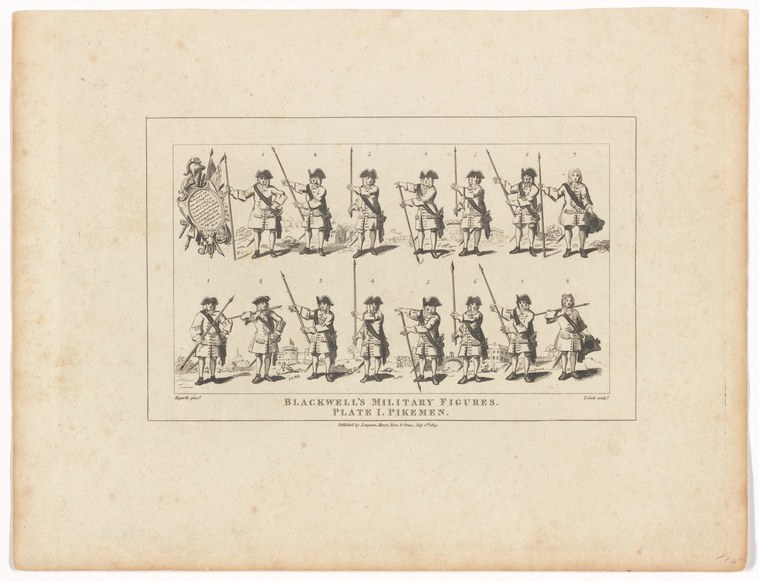
Military drill was one of the most visible and widely practiced forms of organized, choreographed movement in the 18th century, yet it is often excluded from dance history. This plate demonstrates that the vocabulary of formalized body control extended far beyond the theatre and ballroom into institutions that shaped hundreds of thousands of male bodies across Europe. Understanding drill as a form of movement practice illuminates how bodies were disciplined, displayed, and made uniform in the period—a counterpoint to the grace and individuality celebrated in theatrical dance.
What you are looking at
This engraving presents sixteen small military figures arranged in two horizontal rows of eight, each carrying weapons and wearing tricorn hats and military dress of the 18th century. The figures are highly schematic and uniform in size, standing in profile or three-quarter view against a plain background. They hold various weapons—muskets, pikes, swords, and what appears to be a drum or shield on the left—in a systematic demonstration. The composition reads as a instructional plate: each figure occupies an equal space and maintains an upright, formal posture. There is no landscape, no interaction between figures, and no sense of narrative moment; instead, the arrangement suggests a military manual or training guide laid out for clarity and reference. The engraving is finely detailed in the 18th-century manner, with careful cross-hatching to suggest form and fabric.
The dancing
All sixteen figures stand in military attention or parade positions, their bodies held rigid and formal. Arms are positioned to display weapon handling: some hold muskets at shoulder or port arms, others extend pikes or swords in prescribed angles. The feet are planted firmly; there is no sense of movement, weight shift, or dance-like grace. The figures are ordered and identical in their formality, suggesting they are meant to demonstrate a sequence of positions or drills rather than to show living, breathing motion.
The dance depicted
These figures do not depict dance in any conventional sense. They represent military drill, arms positions, and parade formations as they would be taught to soldiers. However, the image is titled as part of Blackwell's *Military Figures*, suggesting it is a training manual or reference plate. The geometric precision and the systematic arrangement of postures—each holding a different weapon or standing in a distinct formation—indicate this is instructional. If there is a connection to dance, it lies in the formalized, choreographed nature of military drill, which shares with dance the quality of learned, repeated, aesthetically ordered body movement performed in unison or sequence.
How it was made
This is an engraving, a relief printing technique that produces fine, durable lines through incising metal, in this case copper. The consistent, precise linework and the regularity of the cross-hatching are characteristic of 18th-century engraving practice. The technique allowed for mass reproduction and wide circulation of instructional material; military manuals and drill guides were among the most widely distributed printed works of the period. The plate's clarity and the uniformity of the figures suggest it was designed to be read clearly even in reproductions, making it suitable for military academies, officers' training, or general reference.
About this work
This is an engraved plate from *Blackwell's Military Figures*, a printed instructional series on military drill and deportment. It shows sixteen soldiers in prescribed positions, each demonstrating the handling of a specific weapon or formation stance. While not dance in the theatrical sense, the image records a formalized, learned system of body movement performed in unison—the drill ground's equivalent of choreography. Military drilling and dance share common ground in their emphasis on coordinated, repeated, aesthetically ordered movement of the human body. For a gallery of dance in art, this plate documents one of the period's most widespread and regimented forms of organized movement, one that shaped how bodies were trained and displayed in public space.
How to look at it
Approach this as you would an anatomical or technical diagram: each figure is a discrete unit demonstrating a single position or action. Notice how the artist has varied the postures slightly to show different weapon positions—the angle of a pike, the hold of a musket, the stance of a pikeman versus a drummer. The uniformity of the figures' proportions and spacing emphasizes that military training aimed at standardization, not individual expression. The precision of the engraving itself—every line deliberate, every angle exact—mirrors the precision demanded of the soldiers themselves.
The artist
The catalogue records this as 'Prints after William Hogarth,' but this plate does not appear to be from Hogarth's known works. The style is consistent with 18th-century military instruction manuals rather than Hogarth's satirical or narrative engravings. The attribution may be an error, or the plate may derive from a series only loosely associated with Hogarth's practice. Without additional provenance, the maker remains uncertain.
The period
In the 18th century, military drill was undergoing standardization and codification across European armies. Printed manuals on weapons handling, formations, and marching were in high demand as standing armies grew and officer training became more formalized. Simultaneously, dance was being systematized in written notation (Feuillet's choreographic system appeared in 1700) and taught through published instruction. Both systems—drill and dance—reflect an Enlightenment impulse to rationalize, record, and transmit embodied knowledge through print. This plate sits at the intersection of those projects, documenting the military body at the moment when it was becoming a subject of systematic instruction.
Where it lives
This engraving is held in the New York Public Library's collection of prints depicting dance. It is listed as part of a series attributed to or derived from William Hogarth, though the attribution appears questionable based on style and subject matter.
Questions about this work
Is this really a dance image?
Not in the theatrical sense, but it documents formalized, choreographed movement. Military drill shares with dance an emphasis on learned postures, coordinated action, and the aesthetic display of the trained body. Including it here acknowledges that dance history must expand beyond the stage to recognize all the systems by which bodies were organized and moved in public space.
What is the connection to Hogarth?
The catalogue attributes this to 'Prints after William Hogarth,' but the style and subject do not match Hogarth's known satirical or narrative works. The attribution may be an error, or this plate may come from a later 18th-century military instruction manual that has been loosely associated with his name. Further research is needed to confirm the source.
How would these positions have been taught?
Officers would demonstrate each posture in sequence, and soldiers would copy them. Printed plates like this served as reference materials for officers and as a way to standardize training across regiments. A soldier could consult the image to refresh their memory of proper form, much as a dancer might consult a choreographic notation or a fencing manual.
More dance artwork





