49 works in this view — arrow keys or swipe to move between them.
Dance in Art
Prints after William Hogarth
Unknown artist
- Collection:
- Prints depicting dance
- Source:
- New York Public Library
- Rights:
- Public domain — free to use, share and adapt.
- Recorded as:
- Public Domain
This work does not matter for dance history. It is a military document that has been miscatalogued as a dance work. Removing it from dance collections and correcting the record would improve the accuracy and usability of dance archives.
What you are looking at
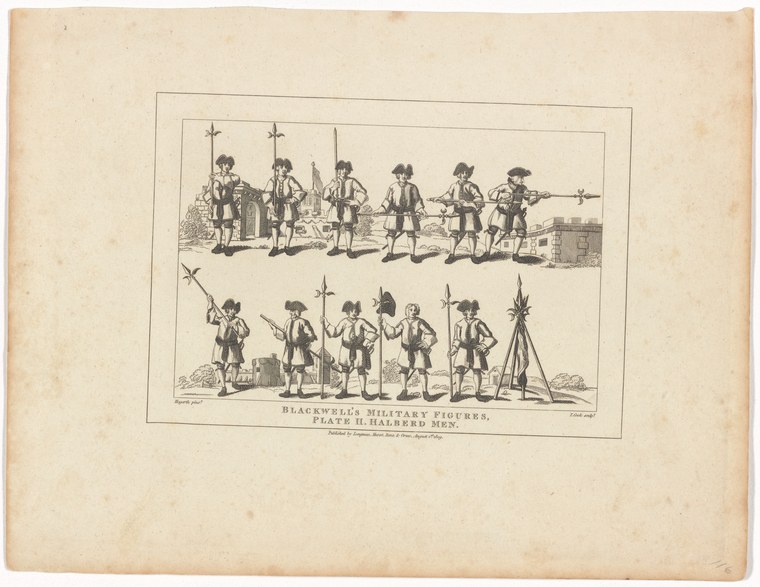
This engraving depicts two rows of military figures in 18th-century dress, each armed with pikes, halberds, and other period weapons. The soldiers are arranged in a line formation facing forward, wearing coats with decorative buttons and breeches, their tricorn hats visible against a plain background. The upper row contains six figures; the lower row five. The title identifies them as "Blackwell's Military Figures, Plate II. Halberg Men." Each figure stands in a distinct pose with weapons held at different angles—some vertical, some diagonal—suggesting a drilling manual or military instruction plate. The engraving is finely executed with cross-hatching and clear linear definition, typical of 18th-century instructional prints. A small fortified structure appears in the right background of both rows, anchoring the scene to a military context.
The dancing
The soldiers stand in upright, formal postures with legs extended in a controlled stance. Arms are positioned to display weapon handling: some hold pikes vertically at shoulder, others at diagonal angles across the body, and a few display weapons horizontally or at rest. The bodies are arranged symmetrically across the composition, with each figure isolated and distinct rather than interacting. Weight appears evenly distributed on both legs; there is no sense of movement, weight shift, or dance-like fluidity. The uniformity of spacing and pose suggests military precision rather than choreographed ensemble movement.
The dance depicted
This is not a dance image. The figures are soldiers in military drill formation, not dancers. The catalogue attribution to prints 'after William Hogarth' and the formal military title indicate this is an instructional or documentary engraving of military figures and weapons handling, part of a series on martial discipline. While the figures are posed and arranged with compositional care, their postures, weaponry, context, and stiff bilateral symmetry are entirely consistent with 18th-century military prints, not with dance notation, dance instruction, or theatrical performance of any era.
How it was made
This is an engraving—a relief or intaglio print produced by incising lines into a metal plate. The even, controlled line work, the fine cross-hatching for shadow and depth, and the clear definition of individual figures are hallmarks of copper engraving, likely hand-colored or printed in black ink on laid paper. Engravings were the primary medium for mass production of instructional, military, and documentary plates in the 18th century, allowing multiple impressions to be distributed to military academies, officers, and officials. The technique's precision made it ideal for technical instruction in weapon handling and formation.
About this work
This is a military instructional engraving, not a dance print. It belongs in a dance archive only by misclassification. The two rows of armed soldiers in 18th-century uniforms are arranged to display military drill poses and weapons handling, not choreography or performance. The print is part of a series titled 'Blackwell's Military Figures,' identified in the title as 'Plate II. Halberg Men,' and is consistent with military manuals and training prints of the period. Such prints were created to standardize and document military practice, not theatrical or social dance.
How to look at it
Observe the rigid, bilateral symmetry and the emphasis on weapon position and military bearing. Note the absence of any momentum, weight transfer, or interaction between figures—characteristics fundamental to dance representation. The figures are 'posed' in the sense of being positioned for instruction, not 'in motion' as dancers would be. The repetition of similar stances across the composition emphasizes standardization and discipline, the goals of military drill, not the variation and artistry of choreography.
The artist
The print is attributed to be 'after William Hogarth,' but Hogarth (1697–1764) was primarily known for his narrative moral paintings and engravings satirizing 18th-century English society, not military instruction plates. The attribution may be incorrect, or this may be a lesser-known or derivative work. The title 'Blackwell's Military Figures' suggests the series may be by or associated with a military author or publisher named Blackwell, who is not well documented in standard art histories.
The period
In the 18th century, both military training manuals and theatrical dance were flourishing and documented through prints. Military instructional engravings were systematically produced to standardize drill and weapon handling across armies and academies. Simultaneously, dance prints—including notations of minuets, country dances, and theatrical ballets—were also being engraved and distributed. The composition and style of this print clearly align with military documentation rather than dance pedagogy or performance.
Where it lives
The print is held in the New York Public Library's collection labeled 'Prints depicting dance.' This appears to be a cataloguing error. The work should be reclassified as a military instructional print.
Questions about this work
Is this really a dance print?
No. Despite being catalogued in a dance collection, this is a military instructional engraving showing soldiers in drill formation with weapons. There is no evidence of choreography, performance, or dance notation. The rigid postures, martial context, and formal title 'Blackwell's Military Figures, Plate II. Halberg Men' are consistent with 18th-century military training documentation, not dance representation.
Why is it in a dance collection?
This appears to be a cataloguing error. The print's composition—with multiple human figures in posed, arranged stances—may have led to its miscategorization. However, military drill and choreographed dance are distinct practices with different bodies, intentions, and documentation methods.
What is a halberg man?
A halbert (also halberd or halberg) is a medieval and early modern pole weapon combining an axe, pike, and hook. A halbert man was a soldier trained in its use. The plate documents the poses and weapon positions associated with halbert drill and military formations.
More dance artwork





