49 works in this view — arrow keys or swipe to move between them.
Dance in Art
Prints after William Hogarth
Unknown artist
- Collection:
- Prints depicting dance
- Source:
- New York Public Library
- Rights:
- Public domain — free to use, share and adapt.
- Recorded as:
- Public Domain
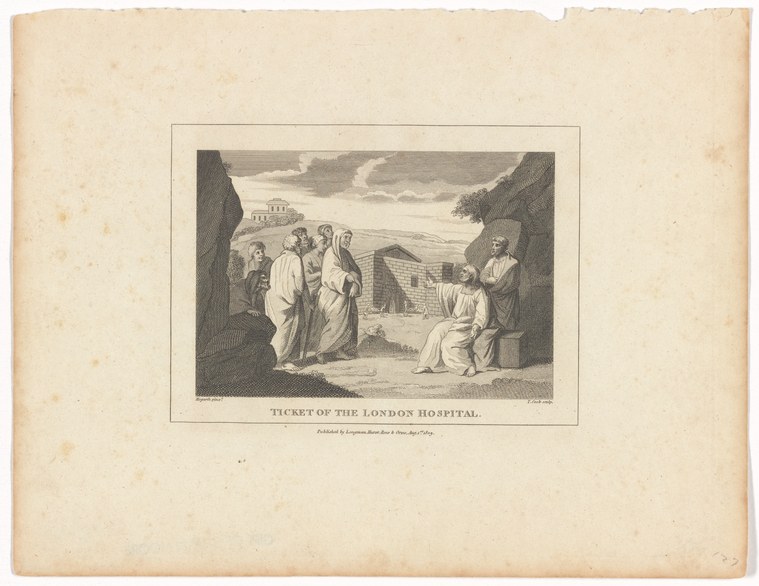
This work is a useful counterpoint: it demonstrates how 18th-century prints used the formal arrangement of bodies to convey meaning without depicting actual dance, and it shows the visual conventions that distinguished narrative tableau from dance representation in the period. Its inclusion in a dance collection highlights how easily formal gesture and bodily arrangement can be conflated with choreography when works are catalogued without rigorous examination of the image.
What you are looking at
This engraving depicts a scene set within a classical architectural space, with stone archways framing the composition on either side. The setting appears to be a hospital or place of healing, as indicated by the title. In the background, a domed structure is visible across an open landscape, establishing the work's neoclassical setting. The foreground shows multiple figures in 18th-century dress arranged in a narrative tableau. At left, a group of standing figures—men and women in flowing robes and period dress—gesture toward the center. A kneeling or seated figure dominates the middle ground, while at right another robed figure stands in an attitude of prayer or devotion. The composition uses strong linear perspective and classical restraint to organize the scene; the figures occupy distinct zones rather than overlapping dynamically, and the lighting is even and sculptural rather than dramatic.
The dancing
The bodies are arranged in a formal, hierarchical composition typical of neoclassical narrative engraving. No two figures are in direct physical contact or closed hold. The kneeling figure at center appears to be the focal point of the scene's moral or spiritual action, while surrounding figures gesture toward this center with extended arms in attitudes of appeal, instruction, or benediction. The postures are dignified and controlled; there is no suggestion of balletic extension or the tightly corseted carriage of theatrical dance. Instead, the figures embody the language of 18th-century history painting—the vocabulary of gesture used to convey emotion and narrative meaning without physical contact or rhythmic movement.
The dance depicted
This image does not depict dance. While the figures are arranged with deliberate gestures and formal positioning, these are the conventions of narrative tableau and moral instruction, not choreographed movement. The title references a hospital, suggesting a scene of charity, healing, or moral instruction—themes common in 18th-century prints addressing contemporary social institutions. The formal poses and theological or charitable intent of the composition place it outside the domain of dance representation entirely.
How it was made
This is an engraving, identifiable by the parallel hatching lines used to create tone and shadow, the crisp linear definition of forms, and the characteristic tonal range of the medium. The technique suggests professional production and wide circulation—engravings of this quality and size were intended for educated print collectors and could be bound into books or displayed framed. The controlled, linear style is well suited to narrative clarity and moral instruction, allowing the viewer to read the scene's didactic content without distraction from painterly effect.
About this work
This is a neoclassical engraving depicting a scene set at the London Hospital, a charitable institution. The work belongs to the 18th-century tradition of moral and social instruction through narrative prints, using the language of classical gesture and composition to elevate a contemporary institutional subject. Though the figures are posed with formal deliberation, the scene represents not dance but the visual rhetoric of 18th-century reformist narrative—the use of the human body and architectural setting to communicate values of charity, order, and civic virtue. The work is included here because it appears in a collection catalogued as depicting dance, but the image itself does not represent choreographed movement or any recognizable dance style.
How to look at it
Attend to the architectural framing—the archways establish a stage-like space, but the action within it is static and hierarchical rather than dynamic and rhythmic. Notice how the figures' gestures point inward or downward toward the kneeling figure at center, creating a radiating focal point typical of history painting rather than the symmetrical or revolving patterns of group dance. The even lighting and absence of shadows suggest a timeless, emblematic space rather than a fleeting moment of choreographed movement. The print's power lies not in capturing motion but in arresting the viewer's attention on a morally significant scene.
The artist
The print is attributed to Hogarth's circle or practice. William Hogarth (1697–1764) was the dominant English printmaker and painter of the 18th century, famous for satirical narrative series and moral instruction through visual storytelling. His prints circulated widely and influenced the aesthetic of English narrative engraving for decades. This particular work follows Hogarth's interest in contemporary social institutions and moral themes, though the classical restraint and neoclassical architectural setting suggest it may represent a later stage of practice or a follower working in his tradition rather than Hogarth himself in his most characteristic mode.
The period
This engraving dates to the mid-18th century, when England was undergoing significant expansion and reform of charitable institutions. The London Hospital (founded 1740) was a modern, ambitious charitable establishment, and prints depicting it or its charitable work were part of contemporary visual culture celebrating enlightened institutional progress. Simultaneously, theatrical dance and ballet were becoming more sophisticated and visible in London's cultural life, yet this image belongs entirely to the tradition of moral narrative rather than theatrical entertainment. The formal poses reflect the neoclassical aesthetic that was gaining influence in both art and architecture during this period.
Where it lives
This work is held by the New York Public Library as part of its Prints collection, which documents visual culture and graphic arts. It is catalogued as a print after Hogarth, indicating it is either by Hogarth's hand or made from his designs by a contemporary engraver—a common practice in 18th-century printmaking.
Questions about this work
Why is this in a collection of dance images if it does not depict dance?
The work is catalogued here because its title references a hospital, and broad cataloguing practices may have included it based on formal pose and gesture without examination of whether actual dance is represented. It is a useful reminder that formal arrangement of the body and theatrical composition do not necessarily indicate choreographed movement.
Could this be a masque or court entertainment?
Though the composition is theatrical in its use of architectural framing and formal gesture, nothing in the image—the charity-focused title, the institutional setting, the moral tone—suggests dance or entertainment. The poses are those of narrative instruction, not choreography.
What does this tell us about 18th-century social attitudes?
The image celebrates the London Hospital as an enlightened charitable institution, using neoclassical composition and noble, controlled gestures to elevate contemporary institutional work to the status of moral and civic virtue. It reflects an 18th-century belief that visual art and narrative could instruct viewers in proper conduct and proper social values.
More dance artwork





