49 works in this view — arrow keys or swipe to move between them.
Dance in Art
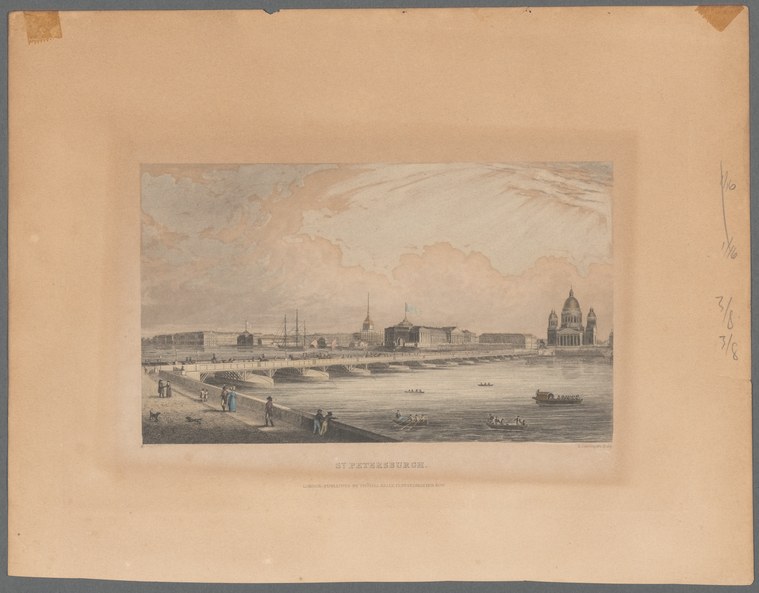
St. Petersburgh
Unknown artist
- Collection:
- Prints depicting dance
- Source:
- New York Public Library
- Rights:
- Public domain — free to use, share and adapt.
- Recorded as:
- Public Domain
While not itself a dance image, this work is valuable as a historical document of early nineteenth-century St. Petersburg—the cultural capital that hosted the Imperial Ballet. It provides context for the urban and architectural setting in which Russian dance was performed and patronized.
What you are looking at
A hand-colored engraving depicts St. Petersburg's riverfront, likely from the early nineteenth century. The view is taken from the Neva River, showing the city's north bank in the middle distance under a hazy sky. The composition is dominated by the water in the foreground, where several small boats and barges are visible—some with oars, some under sail. The far bank shows the distinctive silhouette of the city's major buildings: a row of palatial structures punctuated by church domes and a prominent spire (likely the Admiralty), all rendered in pale ochre and gray. In the immediate foreground at the lower left, figures stand on what appears to be a low embankment or beach: three or four people in period dress are positioned as if watching the river traffic or preparing to board a boat. Their posture is relaxed and informal. The entire scene is rendered in soft tones—pale yellows, grays, and blues—suggesting either dawn or overcast daylight.
The dancing
The figures in the foreground are small and distant, rendered with minimal anatomical detail. Two or three stand upright on the embankment, one appears to be bending or sitting. None are in any recognizable dance posture; they appear to be onlookers or travelers rather than performers. The poses are static and naturalistic, without formal positioning or the stylized frame expected of a dance scene.
The dance depicted
This is not a dance image. The work is a topographical engraving of St. Petersburg's cityscape and waterfront. While there are human figures present, they are incidental to the composition—functioning as scale markers and narrative elements (travelers, observers) rather than as dancers. There is no dance hold, formation, or movement suggested in their positioning.
How it was made
This is a hand-colored engraving, as evidenced by the fine line work, the soft tonal gradations achieved through hatching, and the delicate watercolor wash applied over the printed impression. The technique allowed for wide circulation as multiple impressions could be pulled from the plate, making this an affordable souvenir or topographical document for travelers or those with interest in Russia. The hand-coloring suggests this was a higher-end copy, not a plain print.
About this work
This is a view of St. Petersburg's Neva waterfront, a popular subject for topographical engravings aimed at travelers, cartographers, and armchair geographers. The catalogue record's classification under 'Prints depicting dance' appears to be an error of organization or indexing. The work belongs firmly within the genre of European topographical and urban landscape prints, a thriving commercial category in the eighteenth and early nineteenth centuries. It documents the cityscape and river activity of Russia's capital with the precision and aesthetic of the picturesque tradition.
How to look at it
View this as a document of urban space rather than as narrative art. Notice how the artist has chosen the vantage point to emphasize the city's architectural profile and the busy river traffic—conveying both the scale of the city and its role as a port. The small figures in the foreground serve a compositional purpose, providing a sense of human scale and activity without being the painting's subject. The soft palette and diffuse light suggest the clarity and low angle of light characteristic of northern latitudes.
The artist
The artist is not recorded. Topographical engravings of this period were frequently produced in publishing workshops and often issued anonymously or with only the engraver credited. The style and technique suggest British or Continental European production, likely from a publishing house specializing in travel views and maps.
The period
Topographical engravings of major European and world cities experienced peak commercial demand in the late eighteenth and early nineteenth centuries, coinciding with increased travel, mapping projects, and growing middle-class consumption of prints. Russia's opening to Western Europe following the Napoleonic era made St. Petersburg an especially desirable subject. The city was simultaneously being rebuilt and rationalized under Alexander I, and images of it conveyed modernity and imperial grandeur to Western audiences.
Where it lives
Held in the New York Public Library's collection of prints depicting dance, this work appears to be catalogued under that rubric in error. It is a topographical engraving, not a depiction of dance.
Questions about this work
Why is this catalogued as a dance print?
The catalogue appears to be in error. This is a topographical view with incidental human figures, not a depiction of dance. It may have been misfiled or caught in a broad indexing sweep.
What is the view showing?
The Neva River waterfront of St. Petersburg, viewed from the water looking north toward the city's major public buildings, churches, and palaces. The Admiralty building (with its prominent spire) is likely the central landmark.
When was this made?
The style and technique suggest the early nineteenth century, but the record does not provide a firm date. The cityscape and fashion of the figures are consistent with the 1810s–1830s.
Who made it?
The artist and engraver are not recorded. The work was likely produced in a European publishing workshop specializing in topographical prints for the international market.
More dance artwork





