49 works in this view — arrow keys or swipe to move between them.
Dance in Art
Prints after William Hogarth
Unknown artist
- Collection:
- Prints depicting dance
- Source:
- New York Public Library
- Rights:
- Public domain — free to use, share and adapt.
- Recorded as:
- Public Domain
For historians of dance and pageantry, this image documents the visual language of Renaissance civic spectacle and the formal arrangement of bodies in public ceremony—the ceremonial context in which dances like the pavane and galliard were performed. The print also illustrates how major printmakers of the early modern period rendered crowd scenes and architectural settings, a vocabulary that shaped how other ceremonial dances and court scenes were depicted in the visual record.
What you are looking at
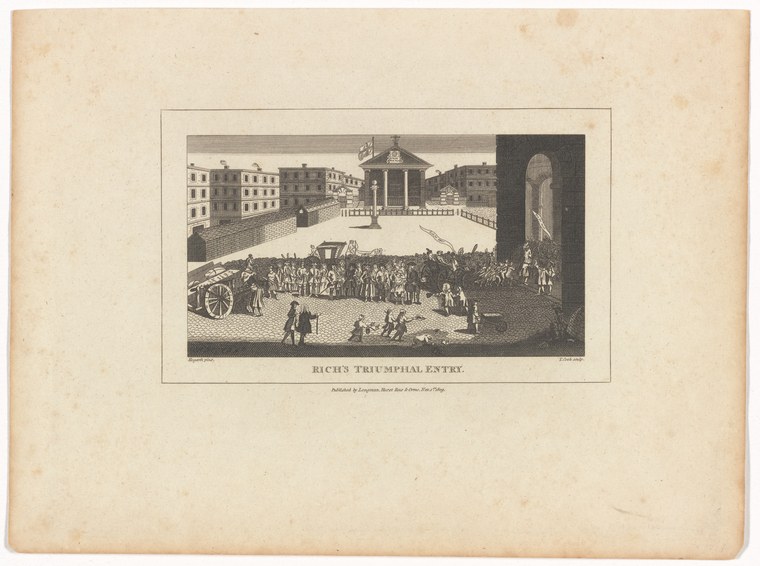
A crowded public square or plaza, likely in an Italian city given the Renaissance architecture. The scene depicts a formal ceremonial or triumphal procession: at the center-left stands an ornate wheeled vehicle or chariot bearing an armored figure (identifiable by the metalwork visible on the right side of the image). Dozens of figures in period dress—some in doublets and hose, others in longer garments—are gathered around the vehicle in organized groups. The plaza is bounded by three-story Renaissance buildings with regular window patterns. In the right foreground stands a tall draped structure or statue niche. The composition uses line and aerial perspective to suggest depth, with the figures arranged in distinct clusters that mark out the formal boundaries of the ceremonial space.
The dancing
The gathered figures stand largely stationary, arranged in loose groupings that suggest observation rather than active participation. No clear dance embrace or hold is visible. Some figures gesture toward the procession or the central figure, and scattered individuals appear to be in conversation or pointed observation. The overall body language is formal and restrained, appropriate to witnesses of a civic or military ceremony rather than dancers in motion. There is no evidence of coordinated movement, rhythmic spacing, or the characteristic frame and posture of ballroom, folk, or theatrical dance.
The dance depicted
This engraving does not depict a dance. It records a triumphal entry or civic procession—a theatrical and ceremonial event, but not one involving choreographed movement. The title "Rich's Triumphal Entry" (likely referring to a historical or fictional military triumph or pageantry) confirms that the subject is processional spectacle. The figures are participants in and witnesses to a public ceremony, not dancers.
How it was made
This is an engraving, identifiable by the precise parallel hatching, fine line work, and monochromatic tonal modeling characteristic of the medium. The technique allowed for detailed architectural rendering and the careful articulation of crowd and costume—essential to documenting a specific historical or theatrical event. The print format and formal composition suggest this was one of a series documenting a narrative or historical sequence, likely for a broad educated audience. The work's relation to William Hogarth (noted in the catalogue title) is unclear from the image alone, though the compositional clarity and crowd-scene sophistication are consistent with satirical or narrative printmaking of the 18th century.
About this work
This engraving documents a triumphal procession or formal civic ceremony in a Renaissance Italian setting, rendered in the detailed, crowd-filled style characteristic of narrative printmaking. The work belongs in a dance archive not as a depiction of dance itself, but as a historical record of courtly or civic spectacle—the elaborate theatrical performances and public rituals that formed the context in which Renaissance court dances and ceremonial movement took place. Understanding the visual conventions of such processions illuminates the formal vocabulary of Renaissance pageantry and the distinction between dance as social practice and dance as part of broader ceremonial theater.
How to look at it
Attend to the formal geometry of the crowd: the way figures are arranged in distinct groups or procession order, marking out the hierarchy and ceremonial structure of the event. Notice the contrast between the static, observing crowd and the movement implicit in the central procession and vehicle. The engraver has chosen to freeze a moment of formal assembly rather than depicting active motion, emphasizing the civic or military dignity of the occasion over the dynamic moment of a dance or entertainment.
The artist
The catalogue attributes this work to a series of prints after William Hogarth, the celebrated 18th-century English printmaker and painter. Hogarth pioneered the narrative sequence in printmaking and was celebrated for crowd scenes, moral narratives, and satirical depictions of contemporary life. These prints after his work would have circulated widely and been collected by educated audiences. However, whether Hogarth designed this particular composition or whether it reproduces an earlier historical print cannot be determined from the image alone.
The period
This engraving belongs to the tradition of historical or narrative printmaking that flourished in the 16th and 17th centuries, documenting historical events, triumphs, and ceremonies for both record and entertainment. In Renaissance and early modern Europe, such processions and triumphs were occasions for elaborate public dance and music. By the 18th century, when this print was likely made, such scenes had become subjects for antiquarian or theatrical interest—valued as documents of historical spectacle as much as contemporary reports.
Where it lives
This work is part of a collection of prints depicting dance held by the New York Public Library. It is catalogued as one of a series of prints after William Hogarth, though the specific date and original source are not recorded in the catalogue. The attribution to Hogarth and the formal historical subject suggest it was a published print, likely circulated to educated collectors in 18th-century Britain or Europe.
Questions about this work
Is there dancing in this image?
No. The image depicts a triumphal entry or civic procession—a ceremonial public event—but not a choreographed dance. The figures are witnesses to and participants in a formal ceremony, standing or walking in an organized procession rather than executing dance steps or formations.
Why is a picture of a procession in a dance archive?
Because Renaissance triumphs and civic ceremonies often included elaborate dances and entertainments as part of the spectacle. Understanding the visual conventions of such ceremonies helps historians recognize how dance was integrated into larger courtly and public rituals. This print documents the context in which dances were performed, even if it does not depict dance itself.
What is the significance of the title 'Rich's Triumphal Entry'?
The title likely refers to a specific historical or theatrical event—a military triumph, a civic procession, or a ceremonial entry by a ruler or notable figure. Without additional documentation, the specific identity of 'Rich' and the exact historical moment cannot be determined from the image alone.
More dance artwork





