49 works in this view — arrow keys or swipe to move between them.
Dance in Art
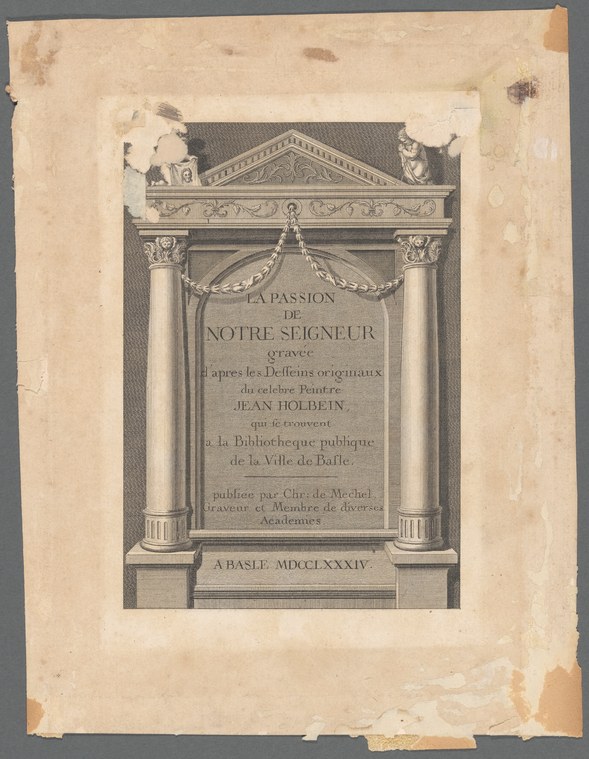
[Title page for] La passion de notre Seigneur ...
Unknown artist
- Collection:
- Prints depicting dance
- Source:
- New York Public Library
- Rights:
- Public domain — free to use, share and adapt.
- Recorded as:
- Public Domain
For a specialist in the history of the book and of religious printing in early modern Europe, this page is evidence of how printers deployed classical ornament and engraved decoration to market religious texts. For a dance historian or dancer, this page should not appear at all—its presence in a dance collection appears to be a cataloguing error or a misfiled leaf from a larger composite volume.
What you are looking at
This is an engraved title page for a religious work, *La Passion de Notre Seigneur* (The Passion of Our Lord), framed within a classical architectural order. The design features two fluted Corinthian columns supporting an entablature with a pediment, all rendered in elegant hatching typical of 16th- or 17th-century printmaking. The columns frame a central cartouche containing the full bibliographic text, suspended by a draped garland of fruits and leaves. Above the entablature, a triangular pediment contains a scene—too small to resolve clearly in reproduction—that appears to show a religious subject, possibly related to the Passion narrative. The whole composition sits on a solid plinth. The page shows age: foxing, staining, and edge damage are visible, consistent with a rare printed book from the early modern period. At the bottom, the Roman numerals read "A BASLE MDCLXXXIV" (1684).
The dancing
No figures are clearly visible or legible at the scale of this reproduction. The small scene in the pediment may contain human figures, but they are too distant to assess gesture, hold, or movement. This is a title page, not a narrative scene.
The dance depicted
No dance is depicted in this image. The catalogue record's assignment to 'dance' appears to reflect only the generic categorization of the holding collection ('Prints depicting dance') rather than the actual content of this particular page. The subject is religious—the Passion of Christ—and the treatment is architectural and emblematic. If the collection holds this item, it may be because other pages within the same bound volume contain dance imagery, but this page itself documents typography and printing practice, not movement.
How it was made
This is an engraving, recognizable from the characteristic fine parallel hatching (crosshatching) used to model form and shadow throughout the composition. The technique requires careful burring of copper plate, and the regularity of the line-work and precision of the architectural rendering suggest skilled professional execution. The date 1684 places it in the mature period of early modern printing in Basel, a major center of humanist and religious publishing. Such title pages circulated widely and were often collected separately from their bindings, which explains its current status as a discrete print.
About this work
This is an engraved title page for a religious text published in Basel in 1684. It documents the printing conventions of the period: the use of classical architectural framing to confer authority and elegance on the printed word, the integration of allegorical or narrative imagery into the decorative scheme, and the high craft standards of the Basel printing industry. The work belongs in a gallery about dance only if the collection's categorization reflects the contents of the full bound volume rather than this page alone. As an isolated print, it is a document of printing history and religious publishing rather than dance history.
How to look at it
Attend to the precision and regularity of the engraver's line-work, visible in the hatching of the columns and the delicate ornament of the capitals. Note how the cartouche is suspended and framed—a common device to draw the reader's eye to the text. The small scene in the pediment, though barely legible at this scale, was intended as an emblem or summary of the book's contents. This page was meant to be examined closely by a reader handling the physical book.
The artist
The artist is not recorded. The engraving was published in Basel, a city with a long tradition of fine printing and book arts. The style is consistent with professional Basel workshop production of the 1680s. Without a signature or attribution in the record, no specific engraver can be identified.
The period
In 1684, the court ballet of the 17th century was in decline in France, and religious drama and spectacle remained important in Catholic regions including Switzerland. The production of lavishly illustrated religious books was a major enterprise of the period. Title pages were sites of artistic display and often engraved by leading craftsmen. The classical architectural vocabulary seen here reflects the humanist revival of antiquity that had dominated European printing since the Renaissance.
Where it lives
The page is held in the New York Public Library's collection of prints depicting dance. Its presence there suggests it was either extracted from a larger volume or catalogued together with other prints from the same edition or holding. The collection classification may reflect the broader contents of a bound volume rather than the specific subject of this page.
Questions about this work
Why is this title page in a dance collection?
This particular page does not depict dance. Its presence in the NYPL's 'Prints depicting dance' collection likely reflects either a cataloguing error, or the fact that it was extracted from or stored with a bound volume that contained dance-related imagery elsewhere. The collection description should be verified against the full contents of the source item.
What does the scene in the pediment show?
The small engraved vignette in the triangular pediment above the entablature appears to contain a religious subject—possibly a scene from the Passion narrative referenced in the title—but it is too small and distant to resolve clearly in this reproduction. A high-resolution image or the original print would allow closer inspection.
Why is the page dated 1684 if it's a religious work?
The date refers to the publication of this edition in Basel. Religious texts continued to be printed and reprinted throughout the early modern period. The 1680s were a time of vigorous religious printing in Protestant and Catholic Europe alike.
More dance artwork





