49 works in this view — arrow keys or swipe to move between them.
Dance in Art
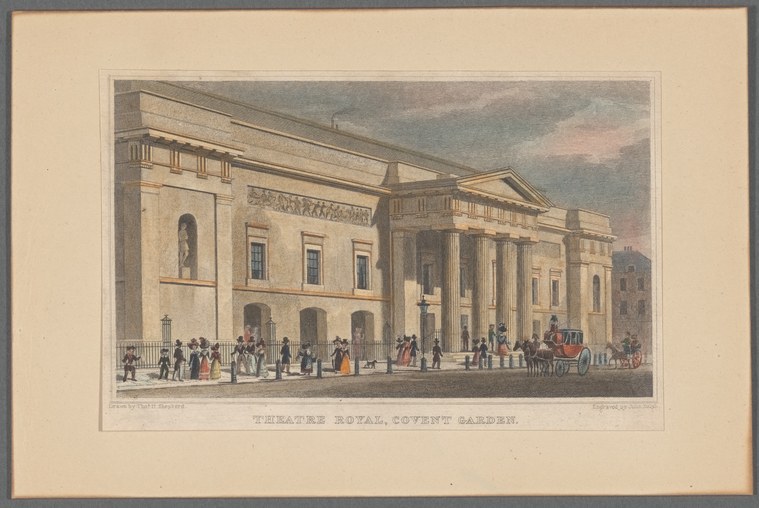
Theatre Royal, Covent Garden
Unknown artist
- Collection:
- Prints depicting dance
- Source:
- New York Public Library
- Rights:
- Public domain — free to use, share and adapt.
- Recorded as:
- Public Domain
Theatre Royal, Covent Garden, was the home stage for Romantic ballet in London—where audiences saw Maria Taglioni, where the transatlantic ballet world converged. This engraving records the physical place where that history happened, making it essential context for understanding how 19th-century ballet was experienced as a social and architectural event, not only as movement.
What you are looking at
This hand-coloured engraving depicts the facade of Theatre Royal, Covent Garden, as it would have appeared in the early 19th century. The neoclassical building dominates the composition, its cream-coloured stone front punctuated by tall arched windows on the ground floor and smaller rectangular openings above. A prominent portico with Doric columns marks the main entrance, topped by a triangular pediment. The street before the theatre throngs with figures in Regency-era dress: gentlemen in dark coats and top hats, women in high-waisted gowns with long skirts, some with parasols or bonnets. A horse-drawn carriage waits at the kerb. The scene captures the social life of the theatre district rather than a dance moment itself—pedestrians pause in conversation, couples and groups cluster on the pavement, and the warm afternoon light casts long shadows across the facade. The sky above is grey and overcast, with touches of pink at the horizon.
The dancing
The figures are rendered in miniature against the vast theatre front, emphasizing the building's grandeur rather than individual bodies. The dress and bearing suggest the leisured classes: men stand upright in formal jackets, women in the high-waisted Empire silhouette characteristic of the Regency period. No figures are shown dancing or in theatrical costume. The composition is a street scene of social promenade, not a depiction of movement or technique.
The dance depicted
This engraving does not depict dance itself, but rather the architectural setting where dance and theatre took place. Theatre Royal, Covent Garden, was the premier venue for ballet in London during the early 19th century, hosting major works of Romantic ballet and the celebrated dancer Maria Taglioni. The image records the building as a social institution—a destination for fashionable society—rather than documenting performance, choreography, or dancers at work.
How it was made
This is a hand-coloured engraving, a reproductive print technique that allowed wide circulation and made architectural views and social scenes accessible to print collectors and institutions. The hand-colouring—applied after printing—gives it the quality of a tinted drawing. Engravings of this kind were common in the early 19th century as a way to document and celebrate public buildings and fashionable gathering places. The technique's precision suits architectural recording, while the figure-work remains schematic.
About this work
Theatre Royal, Covent Garden, was one of the principal stages for ballet in 19th-century London, but this engraving captures it as an architectural monument and social venue rather than as a space where dance happened. The image belongs to a gallery about dance not because it shows dancers or choreography, but because it documents the physical theatre that shaped the experience of ballet in Regency England and beyond. The building itself is the subject; the crowd suggests its cultural importance.
For historians of dance, such architectural records matter because they situate performance in a concrete place. Covent Garden's neoclassical design, its prominent entrance, and its place at the heart of London's social life (visible in the fashionable crowd) all shaped what kind of theatre and what kind of audience ballet enjoyed during the Romantic era. The engraving is a period document of the infrastructure of dance.
How to look at it
Attend to the architectural detail: the proportions of the facade, the order of the columns, the arrangement of windows and entrances. These formal elements defined the sightlines and spatial experience of theatregoers. Then look at the crowd: their stillness, their formal dress, their clustering in small groups. This is not a scene of movement or performance, but of social arrival and departure. The engraving asks you to see the theatre as a civic monument and a fashionable destination, not as a stage. The scale of the building relative to the figures underscores this: the theatre itself is the protagonist.
The period
This engraving dates to the early 19th century, when Covent Garden was at the height of its architectural and cultural prestige. The Regency period (1811–1820) and the decades following saw the theatre established as a symbol of London's cultural authority. Ballet had arrived in England from the Continent, and the 1830s would see the height of Romantic ballet with works like *La Sylphide* (1832) and the English careers of star dancers like Taglioni. This print captures the moment when ballet was becoming a fashionable entertainment for the London elite, whose presence on the street before the theatre speaks to the social centrality of theatrical life.
Where it lives
This engraving is held in the NYPL's collection of prints depicting dance. It is a historical architectural print from the early 19th century, likely issued as a separate print or as part of a series documenting London's public buildings.
Questions about this work
Does this print show dancers or a performance?
No. It is an architectural view of the theatre building and its street frontage, with fashionable society arriving or departing. The focus is on the building itself as a social and civic monument.
Why is this in a dance collection?
Theatre Royal, Covent Garden, was a major venue for ballet in the 19th century, particularly during the Romantic era. The building is an essential document of where and how ballet was experienced as a social event in London.
Who is the artist?
The catalogue record does not identify the artist. The engraving is credited as a hand-coloured print from the period, likely produced as a commercial architectural view for collectors and institutions.
When was this made?
The date is not recorded, but the style and dress of the figures, the condition of the building, and the engraving technique suggest the early 19th century, probably between 1810 and 1835.
More dance artwork





